

A multi-cooker is a pressure cooker that learned a few other tricks. Under the lid it is a heating plate, a removable pot, and a sealed lid that lets steam build up past boiling, so a pot roast that wants three hours in the oven is done in about one. Everything else on the box (slow cook, sauté, yogurt, sous vide, rice, air fry) is the same heating plate running a different program. So the useful questions are short: how much fits, how hard it heats, what the pot is made of, and whether it does the one or two extra jobs you actually need.
This comparison lines up 16 popular multi-cookers on exactly those specs: eight Instant Pots (from the basic Duo to the Wi-Fi Pro Plus and the air-frying Pro Crisp), two Ninjas, and the best-reviewed rivals from Cosori, Breville, CHEF iQ, Our Place, Presto and Midea. Fifteen of them pressure cook. One, the Ninja PossibleCooker PRO, doesn't, and it's here because it's the slow cooker plenty of people buy when they shop this aisle.
Slopsheets says: For most kitchens, buy a 6-quart pressure multi-cooker with a stainless pot and a clear quick-release switch, then stop. The "N-in-1" number on the box is the spec people overweight most. A cooker that pressure cooks and sears well beats one that lists twelve programs and does three of them badly.
Capacity: 6 quarts is the default, and you can't fill it
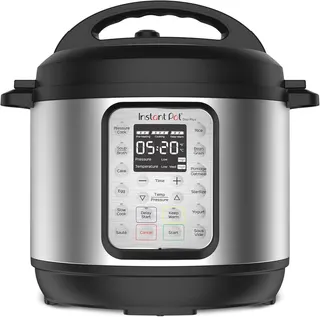
Nearly the whole field sits at 6 quarts: the Instant Pot Duo, Duo Plus, Rio, Pro and Pro Plus, plus the Cosori, Breville Fast Slow Pro, CHEF iQ, Our Place Dream Cooker, Presto and Midea. The Ninja HyperHeat PC201 is a hair bigger at 6.5. Then there's a clear jump to 8 quarts (the Duo 8-quart, the Pro Crisp and the Duo Crisp + Air Fryer), with the Ninja PossibleCooker PRO on top at 8.5.
The quart number on a pressure cooker overstates what you can cook more than it does on most appliances. Every maker's manual sets a max-fill line, because the pot needs headspace for steam to build. That line is two-thirds full for most food and half full for beans, grains and anything that foams.
That's why America's Test Kitchen, after testing the 6- and 8-quart Duo side by side, leans toward 8 quarts for most cooks. Big batches and whole chickens fit without fighting the fill line. The cost is counter space and a heavier pot to lift. A 6-quart cooker still feeds a family of four with leftovers, and it's the size almost every recipe online is written for.
Pay up only if: you batch-cook, make stock, or regularly feed six or more. Then the 8-quart Duo, which shares the 6-quart's controls, is the cheapest way to get the extra headroom.
Power: watts buy you searing, not miracles
Wattage runs from 1,000 to 1,500 here. The basic 6-quart pots (Duo, Duo Plus, Rio, CHEF iQ, Midea) draw 1,000 W, and the Presto 1,005. The Cosori and Breville run 1,100. The Instant Pot Pro, Pro Plus, Duo 8-quart, Our Place, Ninja PC201 and PossibleCooker PRO sit at 1,200. The two air-frying Instant Pots, the Pro Crisp and the Duo Crisp + Air Fryer, top out at 1,500, and nearly all of that extra goes to the air-fry lid's heating element.
More power mostly shows up in two places: how fast the pot comes up to pressure, and how well it sears before you seal the lid. Reviewed found the 1,000 W Duo 60 the slowest of its group to reach pressure. Tom's Guide and ATK both flagged the Rio's sauté as underpowered. Ninja pitches its PC201 HyperHeat base as reaching pressure up to twice as fast, but that's the maker's claim. We found no independent timed test, and early owners still report a wait of around 20 minutes.
The catch: Time to pressure counts toward dinner, but most cook times printed on recipes leave it out. Add 10 to 20 minutes to any "15-minute" pressure recipe, whatever the wattage.
Cooking functions: the most inflated number on the box
Function counts range from Our Place's 4 modes to the Midea's 12-in-1. Instant Pot's counts climb with price: 7 for the Duo and Rio, 9 for the Duo Plus, 10 for the Pro and Pro Plus, 11 for the air-frying models. The CHEF iQ listing says 10-in-1, though CHEF iQ's own site now lists seven cooking functions. Breville and Presto don't make an N-in-1 claim at all, so we counted the modes they list: six for the Breville, five for the Presto.
12-in-1, so it replaces a dozen appliances and does more than a 7-in-1 ever could.
Most of those are presets for one heating plate. Pressure cook, sauté and slow cook do the real work, and how well they're done matters more than how many are listed.
ATK's testing shows the problem. Most multi-cookers it tested made a poor slow cooker: the Duo left beef stew underdone after eight hours, and the Our Place Dream Cooker left it tough. The 9-in-1 Cosori was the exception, doing well at both pressure and slow cooking, which helped make it ATK's best buy. A function that's listed is not a function that works, so when two cookers differ only in their count, ignore the count.
The extras that do earn their place are specific. Sous vide (Duo Plus, Pro, Pro Plus, Pro Crisp, CHEF iQ, PC201, PossibleCooker PRO) is useful if you already cook that way. Yogurt matters to the people who make yogurt. The CHEF iQ's built-in scale, which weighs ingredients right in the pot, is the one feature here no rival has. Reviewed named it best value, though ATK found the first setup (app, account, Wi-Fi and firmware) took about half an hour.
Pressure cooking: what most of these are actually for
All 15 pressure models hit the same basic target, so the differences are in how they release pressure and how much they let you adjust. Instant Pot's newer models (Duo Plus, Rio, Pro, Pro Crisp) use a switch to vent steam instead of the old flick-the-valve routine, and TechRadar singles out that switch as the Duo Plus's best safety upgrade. The Pro Plus releases automatically only. Tom's Guide measured its pulsed release at 82 dB, louder than the Rio and the Duo Plus, and with no manual override.
The Breville Fast Slow Pro gives you the most control: Breville lists eight pressure settings instead of the usual high and low, plus sensors top and bottom, and TechRadar found it did well in every test. ATK's complaint was ergonomic. The hinged lid stands upright and gets in your hands while you sear, and taking it off to clean needs a screwdriver. The Our Place model needs the quick-release button held down for over a minute, per ATK.
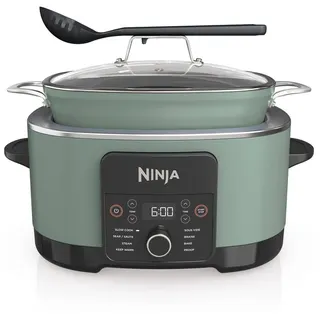
The odd one out is the Ninja PossibleCooker PRO, which doesn't pressure cook. In return it's an 8.5-quart slow cooker that also sears, steams, bakes and does sous vide, and TechGearLab ranked it first of eight slow cookers. Buy it if slow cooking is the point. If you want pressure, skip it.
What the box won't tell you: "Multi-cooker" doesn't guarantee pressure. Check the pressure column before you buy, because the biggest pot in this table can't do the thing most people buy a multi-cooker for.
Air frying: two lids, one storage problem
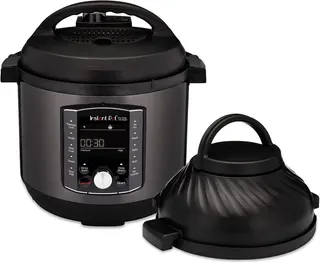
Only two models here air fry out of the box, the Instant Pot Pro Crisp and the Duo Crisp + Air Fryer, both 8 quarts and 11-in-1. Each does it with a second lid, so you swap the pressure lid for a crisping lid and then find a cabinet for whichever one you're not using. Tom's Guide and Homes & Gardens both counted the two lids as the main drawback. Homes & Gardens got crisp-skinned roast chicken from the Pro Crisp by pressure cooking first and air frying after. TechRadar's fries in the Duo Crisp didn't crisp well, and Tom's Guide found its air-fry basket small.
Ninja's one-lid Foodi SmartLid models fixed the lid problem, but they were out of stock or listed as no longer available at Amazon and Best Buy when we checked, so we left them off. Ninja's current pressure cooker, the PC201, doesn't air fry.
Don't overpay for: air frying in a pressure cooker you'll use for stews. A dedicated basket air fryer crisps better and costs less, and our air fryer comparison lists 20 of them.
Inner pot: stainless sears, nonstick releases
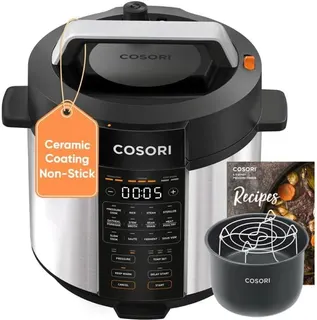
The pot splits the field roughly in half. Every Instant Pot here, plus the Midea, uses an uncoated stainless steel pot. The Cosori, Breville, Our Place, Presto and Ninja PC201 use ceramic nonstick, and the CHEF iQ and PossibleCooker PRO use conventional nonstick.
Stainless browns better and lasts forever. ATK got deep, even searing out of the Duo's pot. The downside is sticking, and Tom's Guide found rice stuck to the Pro's pot. Nonstick cleans in seconds, but the coating is the part that wears out. ATK noted it about the Cosori, along with a dark pot that makes browning hard to see. Reviewed reported early wear on the Our Place pot. The Pro, Pro Plus and Pro Crisp pots also have silicone handles, which matters when you're lifting six quarts of hot stew. The Rio's pot has none, a point ATK held against it.
The catch: A nonstick pot is a consumable. If you plan to keep the cooker for years, stainless (or a maker that sells replacement pots) saves you from replacing the whole appliance when the coating goes.
FAQ
Is the Instant Pot Duo Plus worth it over the basic Duo? Usually, yes. It adds sous vide, sterilize and a few presets, swaps the valve for a steam-release switch, and pairs a dial with a text display, at the same 6 quarts and 1,000 W. TechRadar names it the best budget Instant Pot, and Tom's Guide picks it if you can spend a little more than the Rio.
Should I get the 6-quart or the 8-quart Duo? The 8-quart if you cook in batches, make stock or feed more than four, and have the counter space. The controls are the same, and the 8-quart bumps power from 1,000 to 1,200 W.
Do I need Wi-Fi or an app on a pressure cooker? Rarely. The Pro Plus and CHEF iQ apps let you start and watch a cook remotely, and the CHEF iQ's guided recipes help beginners. But pressure cooking is mostly hands-off anyway, and an app adds setup time and something else that can break.
Which multi-cooker is best for slow cooking? For slow cooking alone, the Ninja PossibleCooker PRO, which tops TechGearLab's slow cooker test but can't pressure cook. Among pressure models, ATK found the Cosori the rare one that slow cooks well too.
Sources / further reading
- The Best Instant Pots and Multicookers, America's Test Kitchen
- The Best Pressure Cookers of 2026, Reviewed
- These are the best Instant Pots you can buy in 2026, Tom's Guide
- The best Instant Pot: versatile multi-cookers tested and rated, TechRadar
- Instant Pot Rio review, Tom's Guide
- Instant Pot Pro cooker review, Tom's Guide
- Instant Pot Pro Plus review, Tom's Guide
- Instant Pot Pro Crisp review, Homes & Gardens
- Instant Pot Duo Crisp and Air Fryer review, Tom's Guide
- Instant Pot Duo Crisp and Air Fryer review, TechRadar
- Breville the Fast Slow Pro multi-cooker review, TechRadar
- Our Place Dream Cooker Review: Form over function?, Reviewed
- Ninja Foodi PossibleCooker Pro 8.5-Quart Review, TechGearLab
- Chef IQ pressure cooker review, Tom's Guide