

A turkey doesn't care how good your thermometer's app looks. It cares whether the thing in its thickest part reads 165°F when the meat is actually at 165°F, and whether you can read it before the oven door has been open long enough to stall the roast. That narrows the 19 meat thermometers in this comparison faster than any feature list does. The shortlist and check-price buttons sit above this article, and the full sortable sheet holds every model side by side. Down here we work through what each column means for your dinner, and which numbers on the box don't mean much.
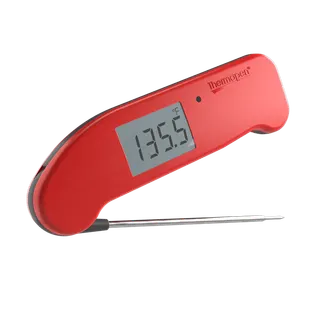
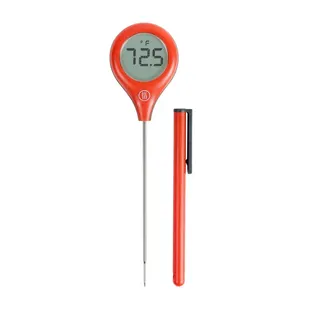
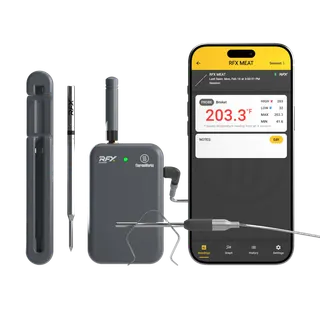
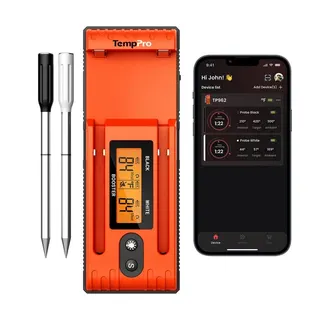
The lineup: six instant-reads (the ThermoWorks Thermapen ONE and ThermoPop 2, TempPro (formerly ThermoPro) TP19H, Lavatools Javelin PRO Duo, Typhur InstaProbe Core and the OXO Good Grips Chef's Precision Thermocouple), three wired leave-in probes (ThermoWorks ChefAlarm, ThermoWorks Signals, TempPro TP829), and ten wireless probes: the MEATER Plus, MEATER Pro and MEATER Pro Duo, TempPro TempSpike and Twin TempSpike, CHEF iQ Sense, ThermoWorks RFX, Combustion Predictive Thermometer, Typhur Sync Gold Dual and Inkbird INT-11P-B.
Which type do you need: instant-read, wired probe, or wireless?
This is the first column on the sheet, and the one that changes how you cook.
- Instant-read thermometers are spot checkers. You open the oven, stab the roast, read the number in a second or two, and close the door. They measure almost anything hot, from steak to candy to frying oil, but they can't stay in the food.
- Wired probes stay in the meat with a heat-proof cable running out of the oven door to a base unit on the counter. The ChefAlarm and Signals are the classic leave-in tools, built for long roasts and smoker sessions where you want an alarm, not a guess.
- Wireless probes put the whole sensor inside a metal stick with no cable at all. The probe talks to a charger or booster, and usually to your phone. Most also carry an ambient sensor in the handle so they can report the oven or grill temperature next to the meat.
America's Test Kitchen's testers are blunt about the order: an instant-read is the one thermometer every kitchen needs, and a leave-in probe earns its place once you're regularly roasting or smoking big cuts. For a Thanksgiving bird, the leave-in probe watches the climb so you don't have to keep opening the oven, and the instant-read double-checks the thigh before carving.
Slopsheets says: If you own zero thermometers, buy an instant-read first. Add a leave-in or wireless probe when you catch yourself opening the oven every ten minutes to check.
Accuracy: the spec every box leads with
Sort the sheet by accuracy and the whole field sits between ±0.4°F and ±1.8°F. That's the manufacturer's stated tolerance, usually across the range where food actually cooks (the sheet's notes say where a tighter figure only holds for part of the scale).
The tight end belongs to the Combustion (±0.4°F on its core sensors), the Thermapen ONE, MEATER Pro, MEATER Pro Duo, Typhur Sync Gold Dual and InstaProbe Core (all ±0.5°F). The ThermoWorks RFX, TP19H, Javelin, OXO and MEATER Plus sit at about ±0.9°F, and the CHEF iQ Sense and ThermoPop 2 at ±1°F. The ±1.8°F group includes the ChefAlarm, even though ATK found it among the most accurate leave-in models it tested.
±0.5°F beats ±1.8°F, so the tighter number cooks the better steak.
Meat keeps climbing several degrees while it rests. A one-degree tolerance gap is smaller than the error you make by probing a little off-center.
Where accuracy does show up is in the lab results, which don't always match the box. Tom's Guide measured the Thermapen ONE far tighter than its own spec, while its OXO test unit ran about half a degree off. ATK found the Combustion fairly accurate but behind its top picks, despite having the best stated tolerance in this lineup.
What the box won't tell you: placement beats precision. Aim for the center of the thickest part, away from bone, and any thermometer here will get you within a safe margin of the USDA's minimums.
Highest internal reading: why wireless probes stop at 221°F
This is the column that catches people out. Every instant-read and wired probe here reads up to 572°F, except the Javelin PRO Duo, which tops out at 482°F. Every wireless probe stops between 212°F and 221°F inside the food.
For meat, this doesn't matter: nothing you roast or smoke should go past about 205°F (that's pulled-pork territory). It matters when you want one thermometer for everything. Sugar work, deep frying and checking oil temperature all need an instant-read or a wired probe. The ambient ceilings also differ a lot: MEATER's own spec sheet warns the Plus (527°F ambient) shouldn't go over open flame, and it points searing cooks to the Pro models instead.
Pay up only if: you reverse-sear over a live fire. Then a high ambient rating (MEATER Pro, RFX, Combustion, Typhur) is the spec that keeps the probe alive.
Probes in the box: one roast or the whole spread
Instant-reads have one probe by definition. Among leave-in models, the count runs from one (ChefAlarm, MEATER Plus, MEATER Pro, TempSpike, CHEF iQ Sense, RFX starter kit, Combustion, Inkbird) to two (MEATER Pro Duo, Twin TempSpike, Typhur Sync Gold Dual), three food probes on the Signals (plus a fourth pit probe), and four on the TP829.
More probes only help if you really cook more than one thing at once: a turkey and a ham, two briskets, or a roast where you watch both ends. ATK's only complaint about the ChefAlarm was that it wanted a second probe. Outdoor Life called the Twin TempSpike functionally identical to a dual-probe MEATER, and it uses the same two-probe idea.
Don't overpay for: four probes to cook one bird. The TP829's probe count is real, but a single good probe and an instant-read cover a normal holiday table.
Water rating: dishwasher, rinse, or wipe
Most of this field carries a printed IP rating, and the sheet ranks them. IP69K (ThermoWorks RFX, Combustion) is built for high-pressure washdown, and Combustion also calls its probe sous-vide safe. The Typhur Sync Gold Dual's probes are IPX8. IP67 (Thermapen ONE, ThermoPop 2, InstaProbe Core, both TempSpikes, Inkbird) survives a dunk in the sink. IP65 and IP66 (ChefAlarm, Signals, TP19H, Javelin, OXO) handle a rinse, not a soak, and the TP829 is only IPX4.
MEATER calls the Pro and Pro Duo fully waterproof and dishwasher safe, and CHEF iQ says the same of the Sense, but neither prints an IP number. The MEATER Plus is only "water-resistant." The sheet puts those unrated claims below the closest printed rating rather than guessing.
The phone app: helpful, or one more thing to break
Wireless probes live or die by their app, and reviewers split sharply here. Outdoor Life gave the MEATER its "Best App" nod and lost no connection over a six-hour smoke. Tom's Guide liked the CHEF iQ Sense's voice alerts and guided cooks, but had to keep the hub close to the probe. ATK found the Combustion's app great when it worked, but pairing the probe, booster and display took effort, and the cook-time predictions only firmed up near the end.
That's why the no-app options have a case. The Twin TempSpike's booster shows temperatures on its own screen, which Outdoor Life liked. The Typhur and ThermoWorks Signals bases also run standalone. The RFX gets the strongest lab endorsement of the group: ATK called it the most accurate and reliable wireless thermometer it has tested, and Engadget found the app plain but dependable.
The catch: A Bluetooth-only probe (Inkbird INT-11P-B, the MEATER Plus without Wi-Fi) ties you to your phone's range. If you want alerts from the couch on the far side of the house, look for a Wi-Fi bridge or a long-range base.
Questions people ask before buying
Should I pick a wireless probe or a wired leave-in? Wired probes never need charging and read higher temperatures. Wireless probes close the oven door fully and move with a rotisserie or a smoker lid. For indoor roasting, both work; for grilling over flame, check the ambient rating first.
Is an instant-read enough for Thanksgiving? Yes, if you're willing to open the oven to check. A leave-in probe just saves you the trips and warns you before the breast overshoots.
Do wireless probes work in a deep fryer? No. Their food sensors top out around 212 to 221°F, well under frying temperature. Use an instant-read or a wired probe.
What temperatures should I aim for? The USDA lists 165°F for poultry, 160°F for ground meat, and 145°F plus a three-minute rest for whole cuts of beef, pork and lamb.
Sources / further reading
- The Best Instant-Read Thermometers, America's Test Kitchen
- The Best Leave-in Thermometers, America's Test Kitchen
- The Best Remote and Wireless Thermometers, America's Test Kitchen
- The best meat thermometers, expert tested and rated, Tom's Guide
- CHEF iQ Sense review, Tom's Guide
- Best Meat Thermometers of 2026, CNET
- Best meat thermometers, CNN Underscored
- The Best Wireless Meat Thermometers, Tested and Reviewed, Outdoor Life
- ThermoWorks RFX review, Engadget
- Meater Pro Duo review, T3
- ThermoWorks Signals review, Smoked BBQ Source
- Inkbird INT-11P-B review, Angry BBQ
- Safe Minimum Internal Temperatures, FoodSafety.gov