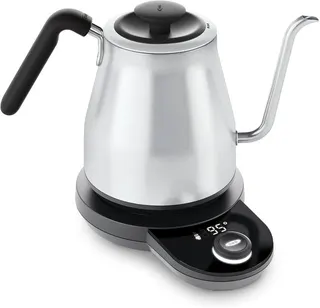
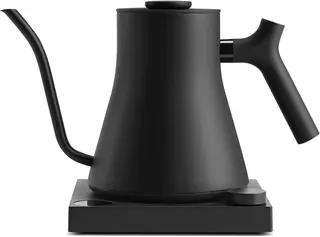
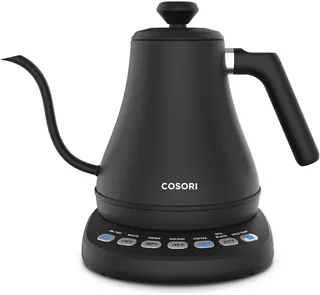
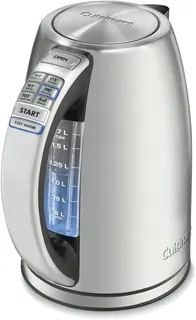


Every gooseneck kettle box makes the same two promises: a pour as thin and steady as a barista's, and water at exactly the temperature you asked for. The first one is mostly true. The second is where the 15 kettles in this comparison split into very different machines, and where the price gap between them starts to make sense. The shortlist and check-price buttons sit above this article, and the full sortable sheet holds every kettle side by side. Down here we explain which of those columns change your coffee and which ones just change the box.
The lineup: eleven goosenecks, from the to-the-degree Fellow Stagg EKG Pro, OXO Brew Adjustable Temperature Pour-Over, Brewista Artisan, Bonavita 1.0L Digital and Greater Goods kettles, through the preset-driven Cosori Original Gooseneck and 5-degree-step Cuisinart GK-1, down to four boil-only pourers (Bodum Bistro 34 oz, Bodum Melior 27 oz, Hario V60 Buono and Chefman Precise Pour). Then, for anyone who drinks more tea than pour-over, four standard-spout temperature kettles: the Cuisinart PerfecTemp, Cosori Digital Glass, Breville IQ and OXO Brew Adjustable Temperature Kettle.
Do you actually need a gooseneck spout?
A gooseneck exists for one job: pouring slowly and precisely over coffee grounds so the water lands where you aim it, at the rate a recipe calls for. Pour-over methods (V60, Chemex, Kalita) depend on that control. For tea, French press, oatmeal and instant noodles, a gooseneck is just a slower way to fill a cup.
That is why the sheet has a spout column and why four standard kettles share this comparison. If your mornings are a tea bag and a mug, a standard kettle holds nearly twice the water, fills a teapot in seconds, and still gives you the green-tea and oolong temperatures that matter. America's Test Kitchen tested the goosenecks partly by how well each spout let testers control the stream, and that is the right lens: the curve of the spout matters more than how pretty the neck looks. Its testers marked the Hario Buono down because a shallow spout curve made it spill, a surprising result for the kettle that defined the shape.
Slopsheets says: Buy a gooseneck if you brew pour-over at least a few times a week. Otherwise the standard-spout kettles at the bottom of the table do everything else better and hold more water.
Temperature control: boil-only, presets, 5-degree steps, or to-the-degree
This is the column that sorts the field. It runs in four tiers, and the sheet ranks it that way:
- Boil only. The Bodum Bistro, Bodum Melior, Hario Buono and Chefman Precise Pour heat to a boil and click off. For coffee that is often fine: let the kettle rest a minute off the boil and you land in the usual brewing range. For green tea it is not.
- Presets. The Cosori Original Gooseneck offers five fixed temperatures (170, 180, 195, 205 and 212°F). The Cuisinart PerfecTemp, Cosori Digital Glass and Breville IQ use the same idea with tea-labeled buttons.
- 5-degree steps. The Cuisinart GK-1 lets you pick any temperature from 140°F up, but only in 5-degree jumps, per TechGearLab's lab notes.
- To-the-degree. The Fellow Stagg EKG Pro, both OXO kettles, Brewista Artisan, Bonavita and Greater Goods let you dial any single degree in their range.
Here is the part the box leaves out: a 1-degree dial does not mean 1-degree water.
Set it to 199°F and you get 199°F water, every time, to the degree.
The best kettles land within about a degree. Plenty of good ones drift three to five degrees, and the display rarely admits it.
The evidence is consistent across labs. America's Test Kitchen found the OXO Brew Pour-Over hit its custom temperatures within 1 degree, while the original Fellow Stagg EKG (the Pro's predecessor) was often 3 to 4 degrees off. Coffee Review's thermocouple caught that same Fellow display reading 1 to 3 degrees above the real water, and marked the OXO down for a different quirk: once it reaches temperature, its screen shows the target, not the water. TechGearLab measured the Cuisinart GK-1 at 2.8°F off on a 200°F coffee target and 4.9°F off on a 175°F green-tea target, while the standard-spout Breville IQ came within 0.6°F on green tea but missed coffee by 4.6°F.
The catch: Precision is a pairing of dial and sensor. A to-the-degree dial on a sloppy sensor is a 5-degree kettle with nicer typography, so lean on the lab measurements above more than on the control type.
Lowest temperature: why 104°F matters to some people
Sort the sheet by lowest temperature and the field spreads out wide. The Fellow Stagg EKG Pro, OXO Brew Pour-Over, Brewista Artisan and Greater Goods all go down to 104°F. The Bonavita and the Cuisinart GK-1 bottom out at 140°F, the Cuisinart PerfecTemp at 160°F, the standard Cosori at 165°F, the Cosori gooseneck and standard OXO at 170°F, and the Breville IQ at 175°F.
For coffee, none of this matters: pour-over lives near the top of the range. The low end is for delicate green teas, gyokuro, and warm water for baby formula or proofing yeast. If you never do those things, a kettle that starts at 170°F gives up nothing you use.
Don't overpay for: a 104°F floor if your kettle will only ever make coffee. It is a tea feature, and a coffee drinker never touches it.
Keep warm: the feature you'll use more than you think
A hold function keeps water at your chosen temperature after it heats, which matters the moment you get distracted between grinding and brewing. The spread here is real:
- 60 minutes: Fellow Stagg EKG Pro (selectable at 15, 30, 45 or 60), Cosori Original Gooseneck, Bonavita, Brewista Artisan, Greater Goods (10 or 60), and the standard Cosori Digital Glass.
- 30 minutes: OXO Brew Pour-Over, Cuisinart GK-1, Cuisinart PerfecTemp, and the standard OXO.
- 20 minutes: Breville IQ.
- None: all four boil-only goosenecks.
America's Test Kitchen checked holds by measuring the water across the full window, and the OXO stayed accurate for its whole 30 minutes. A longer hold is not automatically better, but if your morning routine involves a second cup or a toddler, the jump from zero to thirty minutes is the most useful upgrade in this table.
Capacity: goosenecks are small on purpose
Every gooseneck here holds between 0.8 and 1.0 liters. Makers do this on purpose. A full kettle is heavy, and weight at the end of a long thin spout makes a slow controlled pour harder. One liter covers a large pour-over plus a cup of tea.
The standard kettles hold 1.7 to 1.8 liters: 1.7 for the Cuisinart PerfecTemp and Cosori Digital Glass, 1.75 for the OXO, 1.8 for the Breville IQ. If you're filling a teapot, a French press and a thermos at once, that column is your answer, and it's the clearest reason to skip the gooseneck.
Wattage and boil speed
Wattage is the one spec that predicts speed, and America's Test Kitchen's 3-cup boil test shows it plainly.
The gooseneck field mostly sits at 1000 to 1200 watts. The OXO Brew Pour-Over is the exception at 1500 watts, which explains its lead in that test. All four standard kettles also run at 1500 watts.
What the box won't tell you: a 1500-watt kettle on a kitchen circuit already running a toaster or microwave can trip the breaker. Fast boiling draws real current.
Which gooseneck kettle should you buy?
- For most pour-over drinkers: the OXO Brew Adjustable Temperature Pour-Over Kettle. It has the lab-verified accuracy, the fastest boil, to-the-degree control from 104°F and a 30-minute hold. America's Test Kitchen named it the best adjustable gooseneck.
- For the person who brews every day and wants the best tool: the Fellow Stagg EKG Pro. Its counterweighted handle and fine spout are what Coffee Review praised in the original, and the Pro adds a 104°F floor and a selectable hour-long hold. Home Grounds' 2026 roundup still names the Stagg EKG its best gooseneck overall.
- For value: the Cosori Original Gooseneck. Five presets cover coffee and tea, the hold lasts an hour, and Cosori says the water touches only stainless steel. Home Grounds picked it as its best-value gooseneck.
- For pure boil-and-pour: the Bodum Bistro 34 oz, America's Test Kitchen's best boil-only gooseneck, with the quickest boil of that group.
- If you don't need a gooseneck: the Cuisinart PerfecTemp, which Reviewed named its best electric kettle overall and which TechGearLab measured within 2.3°F on coffee and 1.4°F on green tea.
FAQ
Is a gooseneck kettle worth it for tea? Only if you also brew pour-over coffee. For tea, the temperature control matters and the spout doesn't, so a standard kettle with presets (the Cuisinart PerfecTemp, Cosori Digital Glass or Breville IQ here) does the job with more capacity.
Can I make pour-over with a boil-only gooseneck? Yes. Boil, then let the kettle sit off the base for a short while so the water drops out of a rolling boil. You lose repeatability, not the ability to brew. The Bodum Bistro and Chefman Precise Pour work this way.
Why are gooseneck kettles so small? Weight and control. A slow, steady pour from a long thin spout gets harder as the kettle gets heavier, so makers cap capacity around one liter.
Do I need an app-connected kettle? None of the kettles in this comparison need an app to set a temperature. The Fellow Stagg EKG Pro adds scheduling and an altitude setting on the kettle itself, which is about as much connectivity as a kettle needs.
Sources / further reading
- The Best Electric Gooseneck Kettles, America's Test Kitchen
- The Best Electric Kettles, America's Test Kitchen
- Equipment Report: Digital Electric Gooseneck Pourover Kettles, Coffee Review
- Equipment Review: Fellow Stagg EKG Electric Kettle, Coffee Review
- Equipment Review: OXO Brew Adjustable Temperature Pour Over Kettle, Coffee Review
- The Best Electric Kettles, Lab Tested and Ranked, TechGearLab
- The Best Electric Kettles, Reviewed
- Best Gooseneck Kettles, Home Grounds