

A humidifier has one job: put enough water into the air to get a dry room back into a comfortable range, then stop. Most of the specs on the box are about the first half of that job. The part buyers forget is the stopping.
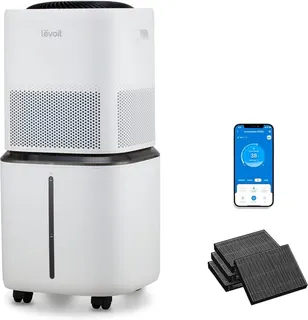
This comparison lines up 24 brand-name humidifiers from Levoit, Dreo, Vicks, Honeywell, Vornado, AIRCARE, Crane, Carepod, Canopy, GoveeLife, Frida, Homedics and Pure Enrichment, every one with a long, well-rated sales record. The full humidifier sheet sorts them on the six things that actually differ: how the water gets into the air, tank size, rated runtime, rated coverage, whether there's a built-in humidistat, and whether there's an app. The field breaks down into 14 ultrasonic cool-mist units, three ultrasonic models that also do warm mist, six evaporative units and one old-school steam vaporizer.
The number that matters is 50 percent
The EPA's guide to home humidifiers gives one hard limit: don't push indoor relative humidity above 50%, because damp air feeds mold and dust mites. Below about 30% is where you get the cracked lips, static shocks and scratchy throat that send people shopping in the first place. So the target is a band roughly 20 points wide, and a good humidifier has to land in it and stay there.
That's harder than it sounds, because a strong humidifier left on high will blow straight through the top of the band.
That result is a compliment to the HM713S's output, not a knock on it. It's also the whole case for the humidistat column. A unit that can measure the room and throttle itself back will hold you near a target. One that can't just keeps going until the tank runs dry, and you're the humidistat. If you'd rather not be, buy a cheap standalone hygrometer and check it.
Slopsheets says: Shop for control before power. Almost every humidifier here can make a bedroom damp. The ones worth buying know when to stop.
Ultrasonic, evaporative or steam: what ends up in your air
Ultrasonic humidifiers (17 of the 24, counting the three warm-and-cool hybrids) shake water into a fine visible mist with a vibrating plate. They're quiet, cheap to run and usually filter-free. The catch is that they put everything in the water into the air, minerals included. With hard tap water, that shows up as a fine white dust on furniture and screens. Mayo Clinic's humidifier guidance recommends distilled or demineralized water for exactly this reason.
Filter-free, so there's nothing to buy after the humidifier itself.
With hard tap water, a filter-free ultrasonic throws the minerals into your room. Distilled water or a demineralization cartridge is the running cost the box leaves off.
Evaporative units (six here) blow air through a wet wick. The water leaves as invisible vapor, and the minerals stay behind in the wick, so there's no white dust and plain tap water is fine. They also regulate themselves to a degree, since evaporation slows as the air gets damper. The trade is the wick itself, which stiffens with scale and has to be replaced, and a fan you can hear. Canopy says to change the Bedside 2.0's filter every five to seven weeks. Levoit rates the Superior 6000S wicks at three to six months.
Steam is the Vicks V745A alone: it boils the water, so the vapor is mineral-free and comes out warm. Boiling takes real power, the water and the outlet get hot, and the scale left in the heating chamber needs regular descaling. It's also the only unit here with a medicine cup for Vicks' inhalants, which is why it's lasted so long.
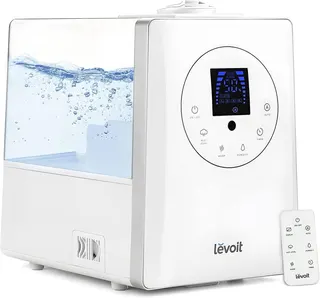
Warm mist on the three ultrasonic hybrids (Levoit LV600HH and OasisMist 450S, Dreo HM713S) heats the water before misting it. The mist feels nicer in a cold bedroom, but it costs power: Live Science lists the HM713S at 26 watts in cool mode and 280 watts in warm.
Pay up only if: you have hard water and hate dusting. Then an evaporative unit is worth the wick budget. With soft water or a jug of distilled on hand, an ultrasonic does the same job for less.
Tank size and runtime: the hours on the box are at the lowest setting
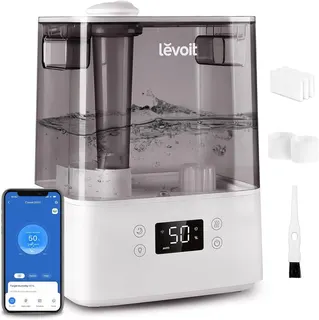
Tanks run from 1.7 liters on the Pure Enrichment MistAire to 22.7 liters (six gallons) on the Levoit Superior 6000S. Most bedroom units sit between 2.5 and 6 liters. Bigger means fewer refills, but also a heavier tank to carry to the sink, which matters more than you'd expect when the tank fills from the bottom. Owners of the LV600HH complain about exactly that. Top-fill designs like the Levoit Classic 300S, Dreo HM311S and Honeywell HEV620B let you pour water in from a jug without flipping anything.
The runtime column is the maker's rated maximum, and every maker rates it on the lowest mist setting. On high, expect a fraction of that.
Read the runtime column as a comparison between units, not a promise. Two oddities are worth knowing. Vornado gives the Evap40 no maximum at all, only that it moves four gallons in 24 hours on high, so its 24 is a floor; Bob Vila's testers found it took closer to 36 hours to empty. And Vicks lists the V745A at up to 12 hours on its spec line but up to 24 in its own product copy. We went with the lower figure.
Coverage: square footage is the maker's own claim
Rated coverage runs from 150 square feet for the Honeywell MistMate HUL520B to 3,600 for the AIRCARE MA1201 console. There's no common test behind these numbers. Each brand picks its own, and a few (Honeywell and Vicks among them) only say "small," "medium" or "large" on their own sites, so the figures in our table for those models come from retailer listings.
Treat coverage as a way to sort humidifiers into size classes, not as a guarantee. A bedroom unit rated at 200 to 300 square feet, a living-room unit at 400 to 750, and a whole-floor unit in the thousands are genuinely different machines. Within a class, ignore small differences. And remember that output, not tank size, is what actually raises humidity. In BabyGearLab's lab test, which ran each unit on high for three hours in a roughly 150-square-foot room, the 1.2-gallon Vicks filter-free model scored 3 out of 10 for effectiveness while Levoit's LV600HH scored 8.
Don't overpay for: a big coverage number on a bedroom. A 3,000-square-foot evaporative tower in a 12-by-12 room is loud, heavy and pointless. Match the class to the room.
The humidistat: half the field has one
Twelve of the 24 have a built-in humidity sensor and an auto mode that holds a target. The other twelve have a dial or a few mist levels, and you adjust them by feel. All four of the big evaporative units have one (the Superior 6000S, Honeywell HEV620B, Vornado Evap40 and AIRCARE MA1201), as do most of the Levoit and Dreo ultrasonic models and the Homedics TotalComfort Deluxe.
Built-in sensors aren't lab instruments. They sit a few inches from the mist, so they tend to read the damp air around the unit rather than the room. Live Science found the LV600HH's sensor reading 70% when two reference meters in the room read 66%, and Levoit's manual asks for plenty of clearance from walls for this reason. Dreo's HM713S went the other way, reading 2 to 4 points low. Either error is fine for holding a room at 45%, as long as you don't treat the number on the display as gospel.
The catch: The GoveeLife H7140 has an auto mode, but no sensor of its own. It needs a separately sold Govee thermo-hygrometer to know the room's humidity, which is why the table marks it as having no built-in humidistat.
App control: nice, rarely necessary
Seven humidifiers here have Wi-Fi apps: four Levoits (Classic 300S, Dual 200S, OasisMist 450S, Superior 6000S), two Dreos (HM311S, HM713S) and the GoveeLife H7140. The useful part is scheduling and the humidity history, which shows you whether the room is actually staying in range overnight. The rest is a phone version of the buttons on the front. If a model has a humidistat and a timer, it can live without the app. If it has an app but no humidistat, as with the Govee, the app can't do the most important job on its own.
The spec we didn't make a column: cleaning
Every source on humidifier safety lands on the same point. Mayo Clinic says a dirty humidifier can grow bacteria and mold and blow them into the room, and both Mayo and the EPA recommend emptying the tank daily and cleaning it every third day. So how easy a humidifier is to clean matters as much as anything in the table.
The designs that make this easy are the ones with few parts and wide openings. Carepod's One has a stainless steel tank and three washable parts that you can boil. Canopy's Bedside 2.0 tank, cap and tray go in the dishwasher, and the Honeywell HCM350B's tank does too. The awkward ones are worth knowing about before you buy: Bob Vila's testers found the Honeywell's tight tank area hard to scrub and the Vornado Evap40's tanks hard to wash, and BabyGearLab rated the Pure Enrichment MistAire hard to clean.
What we'd actually buy
For most bedrooms and living rooms, the Levoit Classic 300S is the pick. It was Reviewed's best humidifier overall, with the second-highest humidity rise in its chamber test, and it fills from the top, holds a target humidity and needs no replacement filter. If you want warm mist, the Levoit LV600HH raised humidity 38.5% in that same test, the most of anything Reviewed has measured, and BabyGearLab ranked it first overall. Its bottom-fill tank and jumpy sensor are the price of that power.
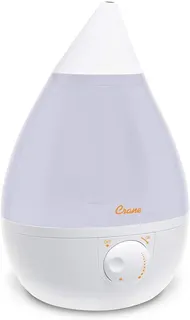
For a whole floor or an open-plan space, the Levoit Superior 6000S is the evaporative unit to buy: Bob Vila's best overall, a six-gallon tank, a real humidistat and no white dust. If you just want a simple, quiet cool-mist unit with nothing to set up, the Crane Drop was effective and quiet in BabyGearLab's test and one of the biggest owner bases in the category. Pair it with a hygrometer, since it has no sensor.
Sources / further reading
- Reviewed, The Best Humidifiers of 2026, three-hour chamber tests with measured humidity rise and runtime.
- Bob Vila, The Best Evaporative Humidifiers for Combating Dry Air, three months of in-home testing of the Levoit Superior 6000S, Honeywell Cool Moisture and Vornado Evap40.
- Bob Vila, The Best Whole-House Humidifiers of 2026, large-space picks including the AIRCARE MA1201.
- BabyGearLab, The Best Baby Humidifiers, lab-measured humidity rise and noise for nursery-sized rooms.
- Live Science, Dreo 713S Smart Humidifier review, room humidity test and sensor accuracy check.
- Live Science, Levoit LV600HH humidifier review, sensor readings against reference meters.
- Mattress Clarity, The Best Humidifiers We Took Home and Tested, at-home testing that favored the Crane Drop.
- U.S. EPA, Use and Care of Home Humidifiers, the 50% ceiling and cleaning schedule.
- Mayo Clinic, Humidifiers: Ease skin, breathing symptoms, water choice and the health case for keeping one clean.