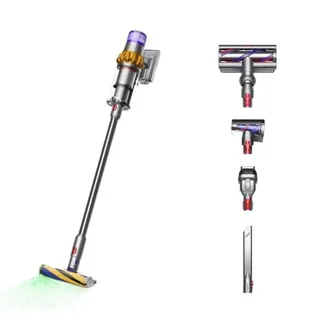
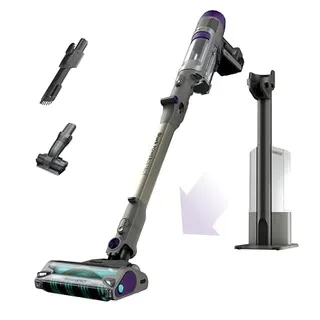
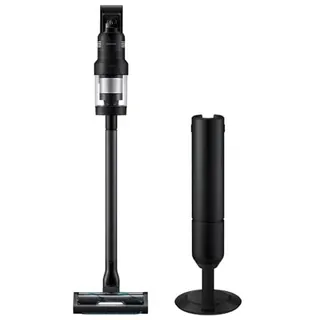
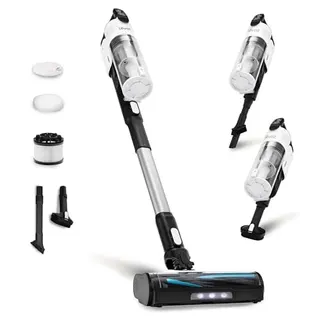


A cordless stick vacuum is a motor, a battery, and a bin, carried at arm's length. Every buying decision comes down to how long the battery lasts, how heavy the thing is after ten minutes, and how often you have to walk to the trash. All three of those specs are printed on the box, and all three are measured in ways designed to flatter the machine.
This comparison keeps the six specs that hold up across brands: rated runtime, published weight, dustbin volume, and whether the machine brings a self-emptying dock, a swappable battery, and a real HEPA filter. Suction is deliberately not a column. Dyson and Samsung publish air watts, Tineco and Levoit publish pascals, and Shark mostly publishes neither, so any single suction column would be three different units pretending to be one number. The labs that actually test pickup are cited below instead.
Slopsheets says: Read the runtime number as a ceiling nobody reaches. Every "up to 70 minutes" in this category is an eco-mode figure, and on the setting you will actually use for carpet, most of these run for under fifteen.
Rated runtime: an eco-mode number in a boost-mode world
The runtime spec is honest in the narrowest possible sense. Shark states it plainly on its own product pages, listing the PowerDetect at 70 minutes "measured in ECO mode," and the UK Detect Pro sheet goes further with "tested in ECO mode, with non-motorised tool," meaning the 60 minutes was recorded with the powered floor head removed. Levoit is equally upfront: 50 minutes in Eco with an attachment, 30 minutes once you clip on the brush head that does the vacuuming.
Run the same machines at the power setting carpet actually needs and the numbers collapse. TechGearLab's timed runs put the Dyson Gen5detect at 67 minutes on low and 7 on high, the V15 Detect at 64 and 9, the Shark PowerDetect at 47 and 12, and the Samsung Bespoke Jet at 54 and 10. The Levoit LVAC-200 is the interesting exception, at 35 minutes low and 17 high, because its boost mode is far less aggressive than a Dyson's, which is a different way of saying it pulls less hard.
The spread between machines still means something, though. The Samsung Bespoke AI Jet Ultra's 100 rated minutes is the longest single-battery figure here by a wide margin, and it earns it with a physically larger pack. At the other end, the Dyson V8's 40 minutes and the Eureka RapidClean Pro's 40 are short enough that a whole-house clean becomes a two-session job.
Two numbers in this field need an asterisk, and both are in the table with a note. Dyson advertises the Gen5outsize at "up to 140 minutes," which is two 70-minute batteries swapped by hand partway through. LG quotes the CordZero A9 Kompressor at up to 120 minutes, again across the two included packs. Neither machine runs for two hours; each runs for one, twice.
What the box won't tell you: A rated runtime is a battery specification, not a cleaning specification. The useful question is how many minutes of boost the machine holds, and the only people publishing that are the independent labs.
Weight: the published figure is not the weight you hold
Every maker publishes a weight, and almost none of them mean the same thing by it. Dyson quotes the full assembled machine: 7.72 lb for the Gen5detect, 8.6 lb for the Gen5outsize, 5.22 lb for the V12 Detect Slim. Shark does the same, which is why the Stratos reads 8.9 lb and the Vertex Ultra 9.04 lb. Tineco and Levoit publish the handheld body instead, 3.53 lb and 3.2 lb respectively, which is why their cells in the table are blank rather than fake. Bissell publishes "less than 8 lb" and leaves it there.
Even the honest assembled figures mislead, because a stick vacuum is a lever. Most of the mass sits in your hand while the floor head rides on the carpet. Vacuum Wars weighs the handle unit separately for exactly this reason, and their bench numbers tell a different story: the 7.72 lb Gen5detect is 2,258 g in the hand, about 5.0 lb, and the 6.8 lb V15 Detect is 2,069 g, about 4.6 lb. The Shark PowerDetect Clean and Empty, which reads as one of the heaviest machines on paper at 8 lb, is 1,804 g in the hand, roughly 4.0 lb, and is genuinely one of the easier flagships to hold up to a ceiling corner.
The column still sorts usefully, as long as you read it as "how much machine is there" rather than "how tired will my shoulder be." On that reading the Samsung Jet 75 Complete at 5.07 lb and the Dyson V12 Detect Slim at 5.22 lb are the genuinely small machines, and the Vertex Ultra at 9.04 lb is the one that will make you put it down.
Dustbin capacity: the spec that decides how often you stop
Bin volume gets the least attention on the box and does the most damage to the experience. The range in this group is nearly six to one. At the bottom, the Shark Vertex Ultra holds 0.32 L and the Detect Pro 0.35 L, which in a house with a shedding dog means emptying mid-clean, every clean. At the top, the Dyson Gen5outsize takes 1.9 L and the V16 Piston Animal claims 1.3 L compacted, which Dyson achieves by pressing the dust down with a piston rather than by making the bin physically enormous.
The middle is where most of the field sits and where the compromises show. The Samsung Jet 75 Complete's 0.8 L on a 5.07 lb body is the best capacity-to-weight ratio here by a distance. The Levoit LVAC-200's 0.75 L is remarkable for a budget machine and beats every Shark in the comparison. Meanwhile the LG CordZero A9 Kompressor's 0.44 L is small enough that LG built a compaction mechanism to compensate, which works, and still leaves you with a 0.44 L bin.
XL dust cup, engineered for whole-home cleaning without interruption.
Shark's "XL" cup on the PowerDetect is 0.7 L. The Detect Pro's is 0.35 L, half that, and both wear similar language. The dock exists because the smaller bin genuinely runs out.
Self-emptying docks: worth it, and for a specific reason
Six machines here dock and empty themselves: both PowerDetect and Detect Pro auto-empty Sharks, the Samsung Bespoke AI Jet Ultra, the Samsung Jet 75 Complete, and, in the sense that matters to buyers, nothing from Dyson. Dyson's Floor Dok charges and stores the machine but does not empty it, which is the one convenience feature Dyson has consistently declined to build into its cordless line.
The dock is worth paying for when the vacuum's bin is small, which is why Shark sells the pairing it does. The Detect Pro's 0.35 L bin into a 2 L base is a genuine transformation of the machine; the same vacuum without the dock is the one you get tired of. RTINGS reaches a similar conclusion about the PowerDetect line, ranking the docked version above the bare one despite identical cleaning hardware.
There is a cost beyond money. A dock takes floor space roughly the size of a kitchen bin, and the emptying cycle is loud. Consumer Reports' testing of stick vacuums notes the tradeoff plainly: hands-off emptying is convenience, not cleaning performance, and it does nothing for how much dirt comes off the carpet.
Pay up only if: your bin is under half a litre or you have pets. On a Samsung Jet 75 with 0.8 L, or a Levoit with 0.75 L, the dock is a nice-to-have. On a 0.35 L Detect Pro it is the difference between a vacuum you use and a vacuum you resent.
Swappable batteries: the spec that decides how long the machine lives
Eighteen of the twenty machines here take a click-in battery you can pull out and replace. Two do not, and both are instructive. The Dyson V8's pack is user-replaceable but held in with a screw, so you can service it in five years and you cannot swap it mid-clean. The Eureka RapidClean Pro's 25.2 V pack is integrated, which means when the cells degrade, and lithium cells always degrade, the vacuum is finished.
That is the whole argument for the column. A stick vacuum's battery is the part that dies first, usually somewhere between years three and five, and a swappable pack turns a dead vacuum into a fifty-dollar part. It is also what makes the two-battery machines work: the Gen5outsize and the LG CordZero ship with a spare precisely because swapping is the only way past the runtime wall.
The catch is that batteries are priced like the accessories they are. Samsung's replacement packs for the Bespoke line and Dyson's click-in cells both cost a meaningful fraction of a budget vacuum, and Miele's exchangeable 25.2 V pack for the Triflex HX2 is no cheaper. Cheap machine, cheap battery is not how this market works.
HEPA filtration: near-universal, and two exceptions worth knowing
Almost everything in this comparison filters to a HEPA standard, and the claim is mostly meaningful, because a stick vacuum blows its exhaust out at knee height in the room you are standing in. Dyson seals the whole machine and rates the Gen5detect and V16 to HEPA. Shark's Anti-Allergen Complete Seal covers the whole current lineup. Samsung rates the Bespoke AI Jet Ultra's multi-layer system at 99.999 percent, and Miele's lifetime HEPA filter on the Triflex HX2 is the best-sealed exhaust in the group.
The exceptions are all at the budget end, and they are worth being precise about rather than sneering at. The Levoit LVAC-200 has a five-stage filter Levoit rates at 99.9 percent down to 0.3 micron, which is close to HEPA's 99.97 percent and is not the same claim; Levoit reserves the actual HEPA filter for the LVAC-300 Pro. The Eureka RapidClean Pro is also five-stage without a HEPA rating, and the Bissell CleanView XR relies on a SmartSeal allergen system rather than a rated filter. For hard floors and a household without allergies, none of that matters much. For a bedroom with a dust allergy, it is the column to sort on.
So which cordless stick vacuum should you buy?
Start with the bin, because it decides how often you stop. Then check the boost runtime, not the rated one. Then decide whether the dock is solving a problem you have. Our four picks:
- Best overall, Dyson V15 Detect. The reference machine: 0.77 L bin, 60 rated minutes, and the laser head that genuinely changes how you clean hard floors. RTINGS still ranks it at the top of its cordless list, and by now it has years of cheap third-party batteries and parts behind it, which the V16 will not have for a while.
- Best hands-off, Shark PowerDetect Clean and Empty. The best non-Dyson carpet cleaner in the group, with the auto-empty base that makes the 0.7 L bin a non-issue and, per Vacuum Wars' handle measurement, one of the lightest flagships to actually hold.
- Longest real runtime, Samsung Bespoke AI Jet Ultra. 100 rated minutes on one battery, the tightest exhaust sealing here, and an All-in-One station that empties into a bag rather than a bin. It is the most expensive machine in this comparison and it is the one that most reduces how much dust ends up back in the room.
- Best budget, Levoit LVAC-200. A 0.75 L bin, a swappable battery, and a body light enough to carry upstairs, for a fraction of flagship money. It is a hard-floor machine with a non-HEPA filter, and if that describes your home it beats spending four times as much.
Frequently asked questions
Why is the real runtime so much shorter than the box number? Because the rated figure is measured in eco mode, and often with the powered floor head removed. Shark and Levoit both state this in their own specifications. On the boost setting that carpet needs, independent timed runs put most flagships between 7 and 12 minutes.
Is a self-emptying dock worth the extra money? It is worth it when the vacuum's bin is small, roughly under half a litre, or when you have shedding pets. It does nothing for cleaning performance. On a machine with a 0.75 to 0.8 L bin, it is a convenience rather than a fix.
How much does weight actually matter? More than the spec sheet suggests, and differently. Published weights cover the whole assembled machine, but most of the load in use sits in your hand. A vacuum listed at 8 lb can be lighter in the hand than one listed at 7 lb, which is why the handle weights that Vacuum Wars publishes are worth checking before you buy.
Do I need HEPA in a vacuum? More than in most appliances, because a stick vacuum exhausts at knee height in the room you are cleaning. If anyone in the house has a dust or pet allergy, buy a rated HEPA machine with a sealed body. Otherwise a good five-stage filter is fine for hard floors.
Should I buy the newest model? Usually not. The gap between a V15 Detect and a Gen5detect is about 40 air watts and a built-in crevice tool, while the gap in price and in the availability of cheap replacement batteries is much larger. The previous flagship, bought after the new one launches, is the reliable value play in this category.
Sources / further reading
- RTINGS: The 5 Best Cordless Vacuums, independent lab testing with measured pickup, airflow, and battery performance.
- Vacuum Wars: Best Cordless Vacuums, bench-measured handle weights, sealed suction, and dustbin volumes.
- TechGearLab: The Best Cordless Stick Vacuums, timed low-power and high-power runtime across 21 tested machines.
- Consumer Reports: Best Stick Vacuums, lab-tested cleaning scores across the major brands.
- Modern Castle: Vacuum cleaner reviews, objective side-by-side testing used here to cross-check manufacturer specs.