

Every portable air conditioner has two cooling numbers printed on it, and the big one is decoration. That is not a conspiracy theory, it is federal policy: since the Department of Energy's test procedure took hold, every unit sold in the US carries a Seasonally Adjusted Cooling Capacity figure that measures what the thing does in a room with a hot hose running through it, next to the older ASHRAE number that measures what it does in a lab where none of that is happening.
Manufacturers print both. Then they put the ASHRAE number in the product title, in 40-point type, on the box, and in the model name. The SACC number goes in the spec table, usually in parentheses, sometimes only on the retailer's page.
We built the full sheet out of both, for 22 units from Midea, Whynter, LG, De'Longhi, Frigidaire, BLACK+DECKER, Honeywell and Dreo. Sort it by "Real cooling (SACC)" and the shopping gets a lot simpler.
The two BTU numbers, and why only one of them cools you
ASHRAE-128 tests a portable AC with the indoor and outdoor sides held at fixed conditions, which flatters a machine that in real life sits entirely inside the room it is cooling. SACC, the DOE standard, adds back the two things that actually happen in your apartment: heat radiating off the exhaust hose, and outside air getting sucked in through window gaps to replace the air the unit just blew outdoors. Sylvane's explainer walks through the arithmetic, and TCL publishes its own version for anyone who wants to hear it from a manufacturer.
Across our 22 units, the average unit loses 28% of its headline number on the way to its real one.
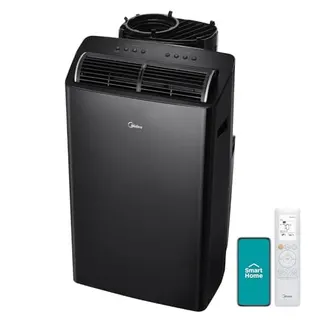
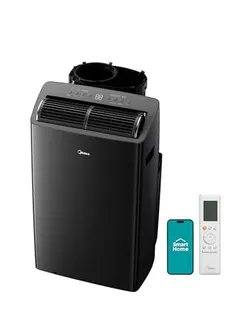
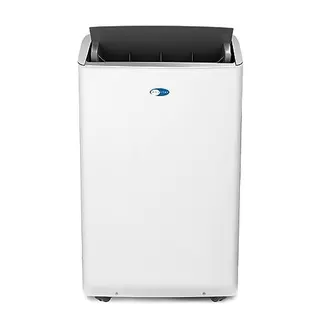
The gap is not uniform, and that is the useful part. The Midea Duo units drop only 14%, from 14,000 to 12,000, because a dual-hose design gives the DOE test less to penalise. The Whynter Elite ARC-122DS drops 42%, from a proud 12,000 on the box to 7,000 in the room, which is less cooling than a unit two sizes down from a better brand.
Slopsheets says: Never compare two portable ACs on the number in the product title. If a listing shows you only the ASHRAE figure, the SACC figure is on the manufacturer's spec page, and it is the one that decides whether you sleep.
What "cools up to 700 square feet" actually buys you
Room-size claims are worse than the BTU numbers, because nobody regulates them. Each brand picks its own number, and the spread is absurd. Normalise every unit here to claimed square feet per 1,000 SACC BTU and Dreo promises 30, while De'Longhi promises 81. Same physics, same country, nearly three times the confidence.
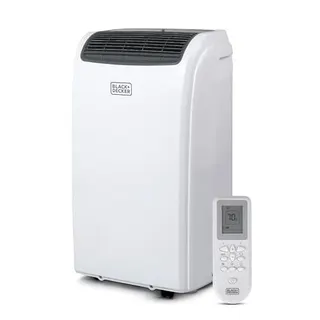
BLACK+DECKER puts the sharpest version of this in one sentence: the BPACT14WT is sold for rooms "up to 700 sq. ft." on 10,200 SACC BTU. Dreo's AC516S has essentially the same 10,000 SACC BTU and rates itself for 400.
Cools rooms up to 700 square feet, so it will handle an open-plan living room and the kitchen behind it.
The same cooling power is sold by Dreo as a 400 sq ft unit. Somebody is wrong by 300 square feet, and it is not the brand quoting the smaller number.
A rough sanity check that costs nothing: figure on 20 BTU of SACC capacity per square foot for a normal room with normal insulation, more if it faces the afternoon sun or sits under a roof. That puts 10,000 SACC BTU at roughly 500 square feet in easy conditions and closer to 350 in a hot top-floor flat. Every 700 sq ft claim in this table fails that test. Dreo's numbers pass it comfortably, which is either engineering honesty or a legal department that reads reviews.
The catch: The units with the most generous room claims are usually the ones with no inverter and no app, competing on the only number a shopper will read. Generosity in the marketing copy is not generosity in the compressor.
One hose or two: the single biggest design choice
A single-hose unit blows your indoor air out of the window. That air has to be replaced, and it gets replaced by hot outdoor air pulled in through every gap in the room. You are, in a small way, using the air conditioner to ventilate your apartment with July.
A dual-hose unit draws its condenser air from outdoors and sends it back outdoors, so the room stays roughly at the pressure it started at. This is why the seven dual-hose units here punch above their ASHRAE class and why they cluster at the top when you sort by SACC. RTINGS' lab testing of the Whynter NEX ARC-1230WN and the Midea Duo shows the same pattern in measured room temperatures rather than ratings.
The trade is size and price. Dual-hose units are bulkier, the window kit is fiddlier, and the cheapest one here still costs more than a competent single-hose unit. The Midea Duo goes further with a hose-in-hose arrangement that runs the intake inside the exhaust, which keeps the window bracket to a single opening.
Pay up only if: your room has a door you keep open, a leaky old window, or a west-facing wall. In a small sealed bedroom, a good single-hose inverter unit like the LG LP1419IVSM will keep up fine and cost less.
Noise is the other reason to care, and it is the one spec nobody publishes honestly, which is why it is not a column in our table. Manufacturers quote the quietest setting and call it the noise level. ConsumerAnalysis measured 17 units with a meter and found real ranges of roughly 52 to 63 dB on the Midea Duo and 63 to 66 dB on the cheapest units in their group, against marketing claims in the low forties. The inverter models are genuinely quieter, but none of them are quiet.
Heat mode, and the expensive way to use it
Six units here run in reverse. That is worth real money if you have a room your central heating never reaches, a garage workshop, or a shoulder season where firing up the whole house is silly.
It matters how they do it. The Midea MAP14HS1TBL and the Whynter ARC-1230WNH are heat pumps, so they move heat rather than making it, and they give you more warmth than they draw in electricity. The BLACK+DECKER BPACT14HWT uses a resistive element, which converts electricity to heat at exactly one to one, the same as a $30 space heater.
Don't overpay for: a resistive heat mode. If the spec sheet says "supplemental heat" with no heating BTU figure larger than its power draw, you are paying an air conditioner premium for a hair dryer.
Wi-Fi: pleasant, rarely decisive
Ten of these have an app. It is genuinely useful for exactly two things: starting the unit before you get home, and scheduling it to back off overnight instead of freezing you at 4am. LG's ThinQ is the most polished, Midea's has had the most years of bug fixes, and Dreo's is the most feature-happy of the newer entries.
It is not a reason to choose a worse cooler. The Whynter ARC-14S has no app, no inverter, and a design old enough to drink, and its dual-hose plumbing still beats most connected single-hose units at the thing you bought it for.
What we'd actually buy
If the room is a bedroom and the budget is normal, the Midea Duo MAP12S1TBL is the answer, and everything above it in the table is you paying for square footage you do not have. If it is a living room, or a room that connects to other rooms, go to the 14,000/12,000 tier and take either the Midea MAP14S1TBL or the Whynter NEX ARC-1230WN depending on whether you want the better app or the better build.
If the budget is genuinely tight, buy the BLACK+DECKER BPACT12WT, ignore every word on its box, and put it in a room under 350 square feet. It will work. It will also be loud, and you will hear the compressor cycle all night, because that is what $300 buys.
And if you are shopping in a heatwave, which is when everyone shops for these: sort the table by SACC, not by the model name. The model name is a marketing department's opinion. The SACC number is a test result.
Sources / further reading
- Sylvane, ASHRAE vs. SACC BTU Ratings, the clearest plain-English account of what the DOE procedure adds back in.
- TCL, Portable Air Conditioner ASHRAE and SACC BTU Ratings, a manufacturer explaining its own two numbers.
- RTINGS, Whynter NEX ARC-1230WN review and Midea Duo MAP12S1TBL review, repeatable lab measurements of room temperature and noise.
- ConsumerAnalysis, Best Portable Air Conditioner (17 models tested), metered noise figures that contradict most published specs.
- Reviewed, The Best Portable Air Conditioners, useful side-by-side of ASHRAE and DOE ratings per model.
- Forbes Vetted, Best Portable Air Conditioners, hands-on impressions across most of the units here.
- PickHVAC, SACC BTU DOE vs ASHRAE, on why negative pressure is specifically a single-hose problem.