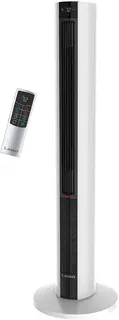
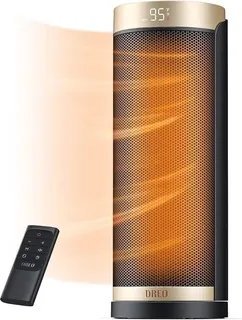
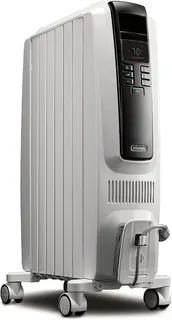
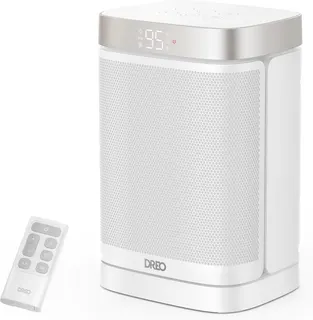


Every plug-in space heater in this comparison makes the same amount of heat. Not roughly the same. The same. The 2.5-pound personal cube on a desk and the 28.6-pound fake wood stove in a living room both top out at 1,500 watts, and a watt of electricity turned into heat is a watt of heat no matter whose logo is on the grille.
That sounds like a reason to buy the cheapest one. It isn't, quite. What separates these 20 heaters is how the heat leaves the box, how precisely the thing knows when to stop, whether it switches itself off when the dog knocks it over, and how long the company will stand behind it. Those are the columns in the full space heater sheet, and they decide whether a heater is a good buy or just another 1,500-watt box.
The field: Lasko, Dreo, De'Longhi, Honeywell, Vornado, Dr. Infrared Heater, Duraflame, Pelonis, Comfort Zone and BLACK+DECKER. Thirteen ceramic heaters, three oil-filled radiators, two infrared cabinets and two fan-forced coil heaters, every one of them a brand-name model with a long, well-rated sales record.
Why every heater here tops out at 1,500 watts
A standard US bedroom outlet sits on a 15-amp, 120-volt circuit, which is 1,800 watts on paper. Electrical code treats anything that runs for hours as a continuous load and caps it at 80% of the circuit, which lands at 1,440 watts. Heater makers round that to 1,500, and EngineerFix's explainer walks through the arithmetic. Multiply 1,500 watts by 3.412 and you get the hourly heat output of every heater on this page.
Resistance heaters also convert essentially all of that electricity into heat, which is why "energy efficient" on a space heater box is close to meaningless. A University of Missouri Extension analysis makes the point bluntly: price doesn't change the conversion rate, and a typical home needs many times more heat than one plug-in unit can supply. The only way a space heater saves money is by letting you turn the central thermostat down while you warm the one room you're actually in.
Infrared heats up to 1,000 square feet and cuts your heating bill in half.
It draws the same 1,500 watts as a ceramic cube and makes the same heat. The Missouri Extension math puts one unit at roughly a thirteenth of what a well-insulated 1,500 sq ft home needs.
Slopsheets says: Ignore wattage, ignore "efficiency," and ignore the square-footage claim. Every heater here makes the same heat. Shop on how it delivers that heat, how well it controls it, and how safe it is around the people and pets in the room.
Ceramic, oil-filled, infrared or coil: same heat, different delivery
Ceramic heaters (13 of the 20) push air across a hot ceramic element with a fan. They warm you within a minute or two, the case stays cool enough to touch, and they're light. The trade is fan noise and dry, moving air. Tom's Guide's testing picked the Lasko FH500 as its best overall because it heated a 15-by-10-foot room more evenly than anything else they tried, and it's a ceramic tower that doubles as a summer fan.
Oil-filled radiators (the three De'Longhi models) have no fan at all. They heat a sealed reservoir of oil, which warms the fins, which warm the room by convection and radiation. They're silent and keep giving off heat after the element cycles off, which makes them the bedroom heater of choice. They're also slow. Consumer Reports' lab found the Dragon4 TRD40615T warms a room at a moderate pace but takes a long time to warm a person sitting nearby, and its exhaust area can get hot enough to hurt.
Infrared units (the Dr. Infrared DR-968 and the Duraflame 3D stove) use quartz elements, often with a fan behind them. Up close, infrared warms you and the furniture directly instead of heating the air first, and on a cold evening that feels noticeably cozier. Bob Vila's infrared testing liked the humidifier version of the DR-968 cabinet and named the Duraflame its best floor-standing pick, mostly for the flame effect.
Fan-forced coil heaters (the Vornado MVH and Honeywell HHF360V) blow air over a bare wire element. They're cheap and simple, and their performance depends on the fan around them. Vornado's vortex airflow is the reason the MVH heats a room evenly; Honeywell's round 360 design throws heat in every direction at once.
Pay up only if: the heater lives in a bedroom. Then a silent oil-filled radiator, or a very quiet ceramic tower like Dreo's Solaris Slim H3, is worth the extra. Anywhere you're awake, a fan heater's speed beats a radiator's silence.
Weight: 2.5 pounds to 28.6 pounds
Weight is a better proxy for what kind of heater you're buying than the product title is. The three lightest units here, the Comfort Zone CZ442E (2.5 lb), the BLACK+DECKER BHDC201 (2.8 lb) and the Lasko 754200 (3.2 lb), are personal heaters: you point them at your feet, not at the room. Ceramic towers sit in the 4.4 to 7.3 lb band and move easily between rooms. Lasko's FH500 is the outlier at 11.5 lb because it's also a 42-inch tower fan.
Everything from 19 lb up is a radiator, an infrared cabinet or a stove, and those aren't meant to be carried from room to room every evening. The De'Longhi radiators weigh 23 to 26 lb because the oil is the point. The Duraflame stove, at 28.6 lb, is heavy because it's furniture.
Thermostats: a dial is a guess
Thirteen of the 20 heaters let you set an actual temperature. The other seven use an unmarked or loosely marked dial that you turn until it clicks off at "about right." Family Handyman's hands-on test of the Vornado MVH found it quiet and even, but the dial carries no temperature markings at all, so you learn its positions by feel.
This matters more than it sounds. With a dial, you find "comfortable" by trial and error, and you find it again every time the weather outside changes. The Lasko 755320 is a good example of the alternative: the up and down buttons set a number on the display, and the heater cuts out a couple of degrees above it. De'Longhi's Dragon Digital TRD40615E does the same in 1-degree steps on an oil-filled radiator, which is the quietest way on this list to hold a bedroom at an exact temperature overnight.
The catch: Lasko's 751320 counts as "digital" here because you can pick a set point from the remote, but it shows that set point with indicator lights, not a number. Lasko's own manual also says its auto-temperature mode works on High only.
Oscillation, and the heaters that don't need it
Nine heaters oscillate, all of them ceramic. Oscillation turns a heater's hot spot into a sweep, which matters for a fan heater blowing a narrow jet of air across the room. It matters much less for the heaters that don't do it. Radiators warm a room by convection and don't need to aim. The Honeywell HHF360V throws heat out in all directions by design. The Vornado MVH relies on its vortex airflow to mix the whole room, which isn't oscillation and is marked accordingly in the table.
The Dreo WH719S is the odd one: a wall-mounted heater whose louver sweeps heat downward rather than a base that rotates. It's also the only heater here with an app, which Yahoo Tech's reviewer called the best way to run it because the on-unit buttons are cryptic. In that test it took a medium bedroom from 59°F to 67°F in 15 minutes.
Warranty: the spec that tells you what the maker expects
Twelve of the 20 heaters carry a 3-year warranty. Seven carry one year: all three Dreo models, the Duraflame stove, the Pelonis tower, and the Comfort Zone and BLACK+DECKER personal heaters. One, the Vornado MVH, carries five.
That doesn't make Dreo's heaters bad. The Atom One and the Solaris Slim H3 are among the best-reviewed heaters on this list, and Bob Vila's testers named the Solaris their best overall electric heater. But a heater runs for hours a day, every day, for four or five months a year, and warranty length is the one number where a manufacturer puts money on its own reliability. De'Longhi's warranty paperwork is inconsistent across documents (US pages say three years, some older manuals say one), so register the radiator and keep the receipt.
Don't overpay for: a flame effect. The Duraflame stove is a lovely piece of living-room theater, and Bob Vila's testers liked how quickly it warmed the objects in the room, but its heat is the same 5,118 BTU as a basic ceramic tower and its warranty is a year.
The safety switch we didn't make a column
Not every heater here has a tip-over switch, and that's the safety feature reviewers keep returning to. Tom's Guide and Bob Vila both marked down the Lasko 754200 because it keeps running if knocked over (Lasko's revised 754201 adds the switch), and Lasko's product pages for the 751320 and 755320 towers don't list one either. Honeywell's HCE323V goes the other way and adds a motion-sensor safety feature on top of its tip-over switch.
The Consumer Product Safety Commission estimates portable heaters are involved in about 1,600 fires a year, with roughly 70 deaths. Its rules are simple and apply to every heater on this page: plug it straight into a wall outlet (never a power strip or extension cord), keep three feet of clearance from bedding, curtains and furniture, and turn it off when you leave the room or go to sleep.
What we'd actually buy
For one heater that warms a real room, the Lasko FH500 is the pick: Tom's Guide's test-room best overall with a digital thermostat, a tip-over switch and a three-year warranty, and you get a tower fan for summer thrown in. For a bedroom, the Dreo Solaris Slim H3 is quiet, precise and slim enough to tuck beside a nightstand. If silence matters more than speed, the De'Longhi Dragon Digital TRD40615E is the radiator to buy, because it adds the exact thermostat and timer that the mechanical Dragon and the ComforTemp skip.
On a tight budget, the Dreo Atom One gives you a 1-degree digital thermostat and oscillation in a 3.8 lb box, just with a one-year warranty. The Lasko 754200 is cheaper and has a huge fan base, but it lacks the tip-over switch that its own successor added. Spend the extra few dollars.
Sources / further reading
- Tom's Guide, The best space heaters, room-heating tests that put the Lasko FH500 on top.
- Tom's Guide, Lasko 754200 review and Honeywell 360 Degree Surround Heater review, metered noise and spot-heating results.
- Bob Vila, The Best Electric Heaters, hands-on testing that named the Dreo Solaris Slim H3 best overall.
- Bob Vila, The Best Infrared Heaters, tests of the Dr. Infrared cabinet and the Duraflame 3D stove.
- Bob Vila, The Best Space Heaters, where tip-over protection decided the picks.
- Consumer Reports, Space Heater Ratings, lab scores for heating speed, safety and noise (full ratings for members).
- Family Handyman, Vornado space heater test, a three-hour bedroom trial of the MVH.
- Yahoo Tech, Dreo smart wall heater review, a cold-weather room test of the WH719S.
- University of Missouri Extension via Farm and Dairy, Infrared heaters: claims and realities, the math behind room-size and savings claims.
- EngineerFix, Why 1,500 watts is the limit for portable heaters, the circuit arithmetic.
- U.S. Consumer Product Safety Commission, winter heating safety release (2026), fire statistics and placement rules.