

December asks a lot of one machine: twelve dozen cookies, a few batches of cinnamon-roll dough, a bowl of egg whites for meringue. That's the job this comparison is built around. The shortlist and check-price buttons sit above this article, and the full sortable sheet lines up all 17 mixers side by side. Down here we go column by column: what each spec means once there's butter in the bowl, and which numbers on the box you can ignore.
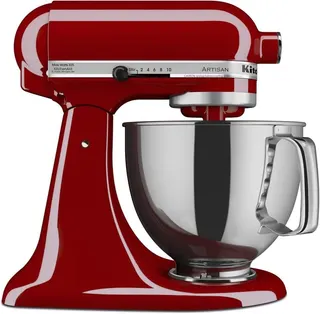
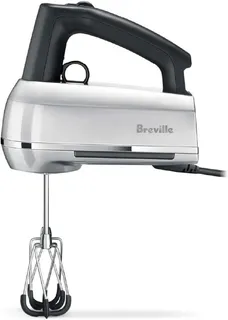
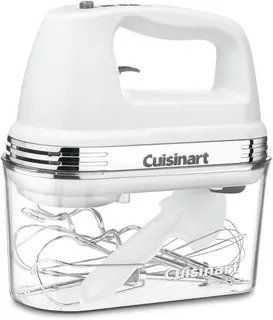
The lineup: eight stand mixers (the KitchenAid Artisan 5-Quart, KitchenAid Classic 4.5-Quart, KitchenAid Artisan Mini 3.5-Quart, Bosch Universal Plus, Cuisinart Precision Master SM-50, GE 5.3-Quart Tilt-Head, Hamilton Beach Professional 5-Quart and Hamilton Beach 4-Quart) and nine hand mixers (the Breville Handy Mix Scraper, Cuisinart HM-90S and HM-50, KitchenAid 5-, 7- and 9-Speed, Braun MultiMix 5, Hamilton Beach 6-Speed and BLACK+DECKER Helix Performance Premium).
Stand mixer or hand mixer: which design do you need?
The Design column on the sheet splits the field four ways.
- Tilt-head stand mixers hinge at the back. You flip the motor head up to get at the bowl, then lock it down to mix. Seven of our eight stand mixers work this way, including every KitchenAid in the table.
- Bowl-lift machines keep the head fixed and raise the bowl into the beater with a lever. That's KitchenAid's big-batch design. None made this table: the 6-quart Pro 600 that Wirecutter named its runner-up is discontinued, and KitchenAid's current bowl-lifts didn't clear our review bar.
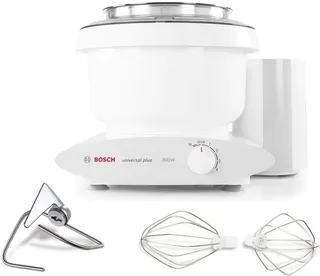
- Base-drive is the Bosch Universal Plus. The motor sits under the bowl and drives the beaters up through a center column, so there's no head in the way at all.
- Handheld mixers are the other nine. They live in a drawer, cost a fraction of a stand mixer, and handle cookies, cake batter and whipped cream fine. They will not knead bread.
The split is simple: a hand mixer covers small jobs and cramped kitchens, while bread dough and big batches belong to a stand mixer. If your baking is two batches of cookies a year and the occasional whipped cream, buy a good hand mixer and keep the counter space.
Slopsheets says: Bake bread or double batches more than once a month? Get a stand mixer. Everyone else should start with a hand mixer and wait to see if they outgrow it.
Bowl capacity: 3.5 to 6.5 quarts, and bigger isn't automatically better
Sort the stand mixers by bowl and they run from the 3.5-quart Artisan Mini to the 6.5-quart Bosch, with most of the field clustered between 4.5 and 5.5 quarts. Hand mixers show a blank here: you bring your own bowl.
Capacity matters at both ends. A big bowl holds a double batch of cookie dough without flinging flour over the rim. But a big bowl can also be too big for small jobs. Wirecutter's testers found the 6-quart Pro 600's whip couldn't reach a single egg white at all, and GearLab marked the KitchenAid 7-quart bowl-lift down because its wider bowl mixed less evenly than the tapered tilt-head bowls.
The small end has limits too. ATK named the Artisan Mini its best small mixer and said it aced most tests, but it ran out of torque on sticky, high-hydration pizza dough and couldn't take a double batch.
The catch: a 5-quart bowl handles a standard batch of cookies or one or two loaves of bread. Only go bigger if you routinely double recipes.
Rated power: the column that tells you the least
This is the spec printed biggest on most boxes, and it's the weakest predictor of how a mixer handles dough. Stand mixers here range from 250 watts (Artisan Mini) to 500 (Bosch, Cuisinart SM-50). Hand mixers range from 60 watts (KitchenAid 5-Speed) to 350 (Braun MultiMix 5, BLACK+DECKER Helix).
The problem is that wattage measures what the motor draws from the wall, not what reaches the beater. Gearing, motor design and how the beater sweeps the bowl decide the rest. GearLab's stand mixer lab shows it plainly.
ATK's results point the same way: it found the Cuisinart struggled to bring cookie and ciabatta dough together. The Cuisinart is still a decent cake-and-cookie machine at its price, and it carries a three-year warranty to KitchenAid's one. Just don't buy it for its wattage.
Two notes on the hand-mixer numbers. KitchenAid doesn't publish wattage for its hand mixers, so the 60 and 100 watt figures on the sheet come from retail listings (the sheet's notes say so). And Breville rates the Handy Mix Scraper at 150 watts on its own US page, though most retailers list 240. We use the maker's number. It's also the hand mixer that every lab we read said powers through dense cookie dough best, which tells you how little the watts mean.
Don't overpay for: wattage. Compare lab results on stiff dough instead, since that's the test that separates mixers.
Speed settings: you'll use about three of them
Stand mixers here offer 4 to 12 speeds, hand mixers 5 to 9.
Twelve speeds give you finer control than ten, so the 12-speed Cuisinart is the more capable mixer.
You knead on low, cream on medium and whip on high. KitchenAid even limits dough-hook work to speed 2, and the 4-speed Bosch is the bread machine of this group.
ATK flagged that speed-2 limit on the KitchenAid 7-quart, and it applies across KitchenAid's tilt-heads too. What does matter is the bottom of the range. A gentle first speed (often sold as "soft start") keeps flour and powdered sugar in the bowl. On hand mixers this shows up clearly in the labs: GearLab praised the slow start on the Cuisinart HM-90S and KitchenAid 9-Speed, while ATK marked the Hamilton Beach 6-Speed down because its lowest setting was already too fast.
Controls matter more than the count. ATK rated the KitchenAid 9-Speed "recommended with reservations" because its switch-plus-buttons layout led testers to shut it off mid-mix, and called the Cuisinart HM-90S's controls the most intuitive in its test.
What the box won't tell you: look for a true slow first speed, not a high speed count. That's the difference between a clean counter and a powdered-sugar cloud.
Weight: heavy is good on the counter, bad in your hand
Weight cuts opposite ways for the two types, which is why the sheet doesn't rank it in either direction.
A stand mixer kneading stiff dough shakes, and mass is what keeps it from walking toward the edge of the counter. The KitchenAids (16 to 22.8 pounds) and the GE (21 pounds) sit at the heavy end. The lightest stand mixer here, the 8.9-pound Hamilton Beach 4-Quart, walked across ATK's counter once its suction feet got dusty. The Bosch is the exception at 12 pounds: its base-drive design puts the motor low under the bowl instead of up in the head, and ATK found it sturdy while kneading.
For hand mixers, lighter wins, because you're holding it for the whole creaming step. The field runs from about 2 pounds (KitchenAid 5-Speed) to 3.2 pounds (Cuisinart HM-50, BLACK+DECKER Helix). Where a maker's listed weight clearly included the storage case, the sheet uses the lab-measured weight of the mixer itself and says so in the notes.
Pay up only if: you'll knead stiff dough often. Then a heavy KitchenAid or the low-slung Bosch earns its counter space. For cookies and cakes, a light stand mixer or a 2-pound hand mixer is plenty.
Attachment hub: the reason KitchenAid owners keep their mixers for decades
The last column is a yes or no: does the mixer have a power port that drives accessories? All three KitchenAid stand mixers do, through the front hub that runs pasta rollers, meat grinders, spiralizers and the rest. KitchenAid's Artisan spec sheet says the hub powers more than 12 optional attachments. The Cuisinart SM-50, GE and Hamilton Beach Professional have their own front ports, and the Bosch drives its blender and other accessories from the base.
The Hamilton Beach 4-Quart has no hub, and no hand mixer does. If you'll never roll pasta or grind meat, skip this column. If you might, KitchenAid has by far the widest range of attachments, and KitchenAid sells them to fit its whole stand mixer line.
Which mixer should you buy?
- Best overall: KitchenAid Artisan 5-Quart. It was Wirecutter's long-time top pick and GearLab's best overall (92 out of 100, perfect whipping and kneading scores), and it's heavy enough to stay put. It isn't cheap, and the warranty is one year.
- Best hand mixer: Breville Handy Mix Scraper. ATK's winner, GearLab's Editors' Choice and Serious Eats' best overall. The rubber-edged beaters scrape the bowl as they go and run quietly. It's expensive for a hand mixer, and it's the heaviest of the lab favorites.
- Best for bread: Bosch Universal Plus. The biggest bowl here and a base-drive design ATK found sturdy and quick at kneading. It's loud at high speed, and the plastic body feels less premium than a KitchenAid.
- Best value: Cuisinart HM-90S. ATK's best buy among hand mixers and a GearLab Editors' Choice. It's strong on cookie dough with a soft start, but it's one of the loudest.
- Smaller kitchens: the KitchenAid Classic 4.5-Quart beat bigger, pricier machines in ATK's testing. The Artisan Mini suits single batches if you never knead stiff dough.
Frequently asked questions
Can a hand mixer knead bread dough?
Not well. A few models ship with dough hooks, but ATK noted hot-plastic smells from hand mixers in its bread test, even on its winner. Use a hand mixer for batters, cookie dough and whipping, and knead bread by hand or in a stand mixer.
Tilt-head or bowl-lift?
Tilt-heads are easier to load and scrape and fit under more upper cabinets. Bowl-lifts hold bigger bowls more rigidly, which helps with heavy dough. For most home bakers a tilt-head is the better fit, and every stand mixer that cleared our bar is a tilt-head except the base-drive Bosch.
Is a stand mixer worth it if I only bake during the holidays?
Only if holiday baking means many batches. For a few dozen cookies, a good hand mixer costs far less and goes back in a drawer afterwards. If you bake bread, double batches or meringues every week, the stand mixer frees your hands and pays for its counter space.
Why do stand mixers walk across the counter?
Stiff dough makes the beater pull unevenly, and a light machine shifts with each turn. Heavier mixers and low-mounted motors resist this. Kneading at the speed the manual recommends (low, usually speed 2) helps too.
Sources / further reading
- The Best Stand Mixers of 2026, America's Test Kitchen
- The Best Hand Mixers of 2025, America's Test Kitchen
- The Best Stand Mixers (Lab Tested & Ranked), GearLab
- The Best Hand Mixers, GearLab
- The 6 Best Hand Mixers of 2026, Tested & Reviewed, Serious Eats
- The best stand mixer, Wirecutter (syndicated on Engadget)
- The Best Alternatives to the KitchenAid Stand Mixer, Reviewed
- The Best Stand Mixer Models, According to Our Test Kitchen Team, Taste of Home
- KitchenAid Artisan Series KSM150PS spec sheet, KitchenAid
- Bosch Universal Plus MUM6N10UC, Bosch
- Breville Handy Mix Scraper, Breville