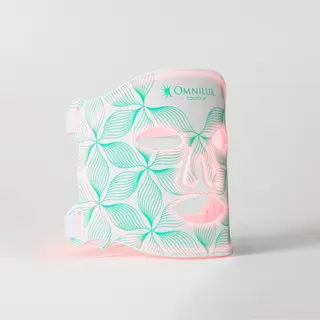
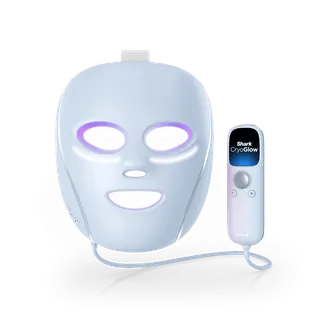
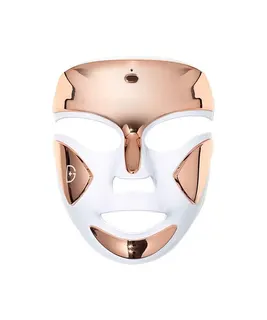
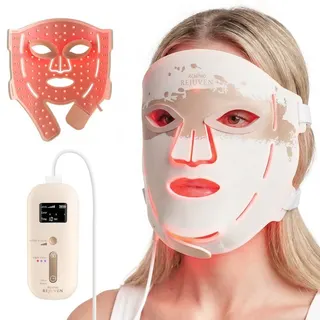


Every mask in this comparison lights up red and promises firmer, smoother skin. Ten of the fifteen are FDA-cleared, and every one carries a recognizable brand name. Where they really split is the plumbing: how many wavelengths they run, whether there's a cable hanging off your chin, how long you sit there, and how much of the "FDA-cleared" sticker survives a search of the FDA's own database.
So this guide skips the before-and-after selfies and sticks to the six specs you can check: wavelengths, near-infrared, LED count, FDA clearance, session length, and whether the mask is wire-free while you wear it. Every mask sits side by side in the full red light therapy mask sheet, sortable on all six.
The field: Omnilux (three masks), CurrentBody (two), Therabody (two), Shark, Dr. Dennis Gross, Solawave, Qure, HigherDOSE, iRestore, RENPHO and Novaalab. Prices run from roughly $200 to $650. One thing up front: these are cosmetic devices cleared for wrinkles or mild acne, not medical treatment for a skin condition. If you have one, or you take anything that makes you light-sensitive, ask a dermatologist before you start.
How we picked and checked
We started from the masks that turn up again and again in hands-on roundups from Reviewed, Fortune and TODAY, then kept only brand-name masks with a real sales and review record. Specs come from maker pages and, wherever one exists, the device's FDA 510(k) summary, which lists the exact wavelengths and treatment times the agency reviewed. Where a maker and its own filing disagree, we went with the filing and noted the gap on the sheet.
We dropped a few masks that show up in "best of" lists: a €1,850 salon mask with four reviews, a newer brand whose wavelengths we couldn't pin down, a sauna maker's mask whose own help center says its FDA application is still "in progress," and a $950 luxury mask with almost no public reviews.
FDA clearance: read the indication, not the sticker
An FDA 510(k) clearance means the agency agreed a device is "substantially equivalent" to one already on the market, for a specific use. For these masks that use is narrow: reducing facial wrinkles, treating mild to moderate inflammatory acne, or both. It doesn't mean the FDA tested how well your particular mask works.
FDA-cleared, so it's been proven to turn back the clock.
Cleared as equivalent to an older device, for wrinkles or for acne, sometimes only one of the two. Results claims come from the maker's own studies.
Here's how the field shakes out when you look each mask up in the FDA database:
- Cleared, filing found (10): Omnilux Contour Face and Omnilux Clear, both CurrentBody masks, Shark CryoGlow, Therabody TheraFace Mask, Dr. Dennis Gross DRx SpectraLite FaceWare Pro, Qure Q-Rejuvalight Pro, Solawave Wrinkle Retreat Pro and HigherDOSE. Several were filed by the contract manufacturer under a model number rather than the retail name. HigherDOSE's clearance, for example, is listed as the "HIGHERDOSE Red and Infrared Light Mask (MK66-L)" from a Shenzhen maker.
- Maker says cleared, no filing we could match (4): Omnilux Men, Therabody TheraFace Mask Glo, iRestore Illumina and RENPHO Artemis. The original TheraFace Mask is cleared, but its filing describes a 648-LED mask, and the Glo has 504. iRestore's FDA filings we found are all for its hair-growth helmets. We left these cells blank instead of guessing either way.
- Not cleared (1): Novaalab's page says its masks are made in an "FDA-registered facility," which is a different thing. Registration covers the factory, not the device.
The indication matters as much as the clearance. Omnilux Clear's filing covers acne only. The Contour Face's covers wrinkles only. Shark, Dr. Dennis Gross, Qure and the TheraFace Mask are cleared for both. Solawave's newer Pro mask is cleared for wrinkles, even though the older Solawave mask was sold for acne too.
Slopsheets says: Treat "FDA-cleared" as the minimum bar, then check what it was cleared for. A wrinkle mask won't do much for breakouts, and the reverse is true too.
Wavelengths: more colors, more modes, not more results
Wavelength decides what a mask is for. Red light around 630 to 660 nm and near-infrared around 830 nm are the anti-aging pair. Blue at about 415 nm is the acne light. Everything else (amber at 590 to 605 nm, green at 532 nm) is a supporting act that makers add for tone and redness claims.
The field splits three ways:
- Red and near-infrared only: Omnilux Contour Face (633 + 830 nm) and HigherDOSE (630 + 830 nm), plus CurrentBody Series 2 and Omnilux Men, which add a 1072 nm deep near-infrared. Simple anti-aging masks with one job.
- Red, near-infrared and blue: Shark CryoGlow, both Therabody masks, iRestore Illumina and RENPHO Artemis. These cover wrinkles and breakouts with separate modes.
- Four or more colors: CurrentBody Series 3 (six wavelengths, 415 to 1072 nm), Qure (five), Dr. Dennis Gross, Solawave and Novaalab (four each).
A long wavelength list is mostly a menu of modes. CurrentBody's own FDA summary for its six-wavelength mask notes that the 532 nm green light is there for "comfort/relaxation" rather than a skin claim. Pick the mask whose colors match the problem you actually have, and ignore the count.
Pay up only if: you want one mask for both fine lines and breakouts. Then blue plus red plus near-infrared is worth having, and Shark, Dr. Dennis Gross and the TheraFace Mask are cleared for both uses.
Near-infrared: the one most masks get right
Fourteen of the fifteen masks include near-infrared, usually at 830 nm, and that's the light most of the at-home anti-aging research uses. The odd one out is Omnilux Clear, an acne mask that runs only blue and red by design.
Three masks go further with 1072 nm "deep near-infrared": Omnilux Men and both CurrentBody masks. It's a big selling point in their marketing, but Light Therapy Insiders' review of the Omnilux Men points out that the research behind 1072 nm for skin is thin, and its spectrometer test only measured the red and standard near-infrared output. Treat it as a bonus, not a reason to buy.
LED count: the most quoted number that tells you the least
LED counts in this group run from 108 (Novaalab) to 750 (CurrentBody Series 3), and it's the figure makers love to print biggest. It's also the weakest guide to what you're getting.
Counting isn't even consistent. Omnilux's 132 is 66 bulbs with two chips each. HigherDOSE describes the same layout as "66 dual-core LEDs (132 diodes)." Dr. Dennis Gross's page says "up to 100 lights" in one line and 100 red plus 60 blue in another. Qure doesn't publish a count at all.
The spec that would settle it is irradiance, the light power hitting each square centimeter of skin. Only a couple of makers print it. HigherDOSE lists 26 mW/cm² for red and 24 mW/cm² for near-infrared. Solawave lists a dose of 11.7 J/cm² for its 3-minute session, which works out to roughly 65 mW/cm². The other makers give you an LED count and leave the rest to the photos.
What the box won't tell you: how much light actually lands on your face. If a maker publishes irradiance or dose, that's worth more than any LED count on the front of the box.
Session length: 3 minutes vs 12
Session time is the spec that decides whether you'll keep using the thing. These masks fall into three groups:
- 3 minutes: Dr. Dennis Gross FaceWare Pro, Qure Q-Rejuvalight Pro and Solawave Wrinkle Retreat Pro. All three are FDA-cleared.
- 6 to 9 minutes: Shark CryoGlow's default anti-aging routine (about 6, with 8 for acne) and the TheraFace Mask (9 minutes across three 3-minute modes).
- 10 to 12 minutes: Everything else, from the Omnilux masks to RENPHO, with the TheraFace Mask Glo longest at 12.
Short isn't automatically weaker. Dose is power times time, so a 3-minute mask needs to push more light per second to match a 10-minute one. Solawave's published numbers suggest it does. For the others, the FDA filings show each maker's recommended routine, usually 3 to 5 sessions a week for several weeks. CurrentBody's Series 2 filing, for example, spells out 10 minutes, five times a week, for six weeks.
The catch: most of the results claims are built on weeks of consistent use. A 3-minute mask you wear five times a week beats a 12-minute one that lives in a drawer.
Wire-free: only four of fifteen
Almost every mask here is battery powered, but most still run a cable from the mask to a handheld controller with the battery inside. That cable is what you notice. It tugs when you turn your head, and TODAY's tester found the Omnilux Contour's controller wire showing wear after long use.
Wire-free comes with trade-offs. The batteries live in the mask, so the masks are hard shells rather than floppy silicone, and the original TheraFace Mask runs about two hours per charge, according to Garage Gym Reviews. Some of the corded masks make up for it in other ways. Shark's controller also runs cooling pads under the eyes, which NBC Select's tester liked but found noisy.
Comfort and fit: what reviewers keep mentioning
Specs don't cover how a mask sits on your face, but the hands-on reviews agree on a few patterns:
- Flexible silicone vs hard shell. Omnilux, CurrentBody, HigherDOSE, Solawave and Novaalab are soft and bend to your face. Shark, Therabody, iRestore and Dr. Dennis Gross are rigid. Rigid masks keep LEDs at a fixed distance but are bulkier to store.
- Eye protection varies. Reviewed found HigherDOSE's included goggles didn't fully block the light, and that the TheraFace Mask's eye shield works but can leave marks.
- Fit gaps. Light Therapy Insiders flagged gaps around the nose and jaw on the Omnilux Men, and a strap that presses on the bridge of the nose.
Which red light therapy mask should you buy?
- Best overall: Omnilux Contour Face. The longest track record in this group, a flexible silicone shell that fits most faces, and a wrinkle clearance you can look up. It does one thing (red plus near-infrared, 10 minutes), and it does it without gimmicks.
- Best for wrinkles and acne: Shark CryoGlow. 480 LEDs, an FDA clearance that covers both uses, and under-eye cooling, at a lower price than most masks with a comparable spec sheet. The rigid shell and corded controller are the trade.
- Best wire-free: Dr. Dennis Gross DRx SpectraLite FaceWare Pro. A 3-minute session with no cable, red and blue modes, and clearance for both wrinkles and acne. Fewer LEDs than the big hard-shell masks, but the short session makes it easy to stick with.
- Best value: RENPHO Artemis. Red, blue and near-infrared, 324 LEDs and a 10-minute timer for well under half the price of most masks here, with thousands of solid retailer reviews. We couldn't match its FDA claim to a filing, so treat it as a budget pick, not a cleared device.
Questions people ask before buying
Do red light therapy masks actually work? The best evidence supports modest improvements in fine lines and mild acne with regular use over several weeks. That's what the FDA clearances cover, too. Don't expect the same results as an in-office laser or a prescription retinoid.
Are LED masks safe for your eyes? The light is bright, especially blue. Most masks include eye cutouts with shields or separate goggles. Use them, keep your eyes closed, and check with a doctor first if you take light-sensitizing medication.
How long before you see results? The FDA filings and maker routines we read run 4 to 8 weeks of use, 3 to 5 times a week. If a mask promises visible change after a session or two, that's the maker's marketing, not the clearance.
Is a cheaper mask worth it? It can be, if it has red plus near-infrared and you'll use it consistently. The main things you give up are a confirmed FDA clearance and, often, a published wavelength spec you can trust.
Sources / further reading
- Reviewed, The Best LED Masks of 2026, hands-on testing of Qure, HigherDOSE and the TheraFace Mask, including the eye-protection notes.
- Fortune, The Best Red Light Therapy Masks of 2026, a tested roundup with wavelength and irradiance guidance.
- TODAY, Shark CryoGlow vs Omnilux Contour Face, a long-term side-by-side test of the two best-known masks.
- NBC Select, Shark CryoGlow review, on the cooling pads, shell and controller.
- Garage Gym Reviews, Therabody TheraFace Mask, for battery life and fit.
- The Gadgeteer, RENPHO Artemis review, a hands-on review of the budget pick.
- Light Therapy Insiders, Omnilux Men review, with spectrometer measurements of the mask's output.
- FDA 510(k) K242796, Shark CryoGlow, the source for Shark's wavelengths, LED count and dual indication.
- FDA 510(k) K191629, the clearance behind the Omnilux Contour Face.
- FDA 510(k) K210948, Omnilux Clear, cleared for acne only.
- FDA 510(k) K250966, CurrentBody Series 2, with the 10-minute, five-times-a-week protocol.
- Solawave Wrinkle Retreat Pro, the maker's wavelengths, LED count and published dose.
- HigherDOSE Red Light Face Mask, one of the few maker pages that publishes irradiance.