

Powered bookshelf speakers have the amplifier built in, so a pair plus a source is a whole stereo. No receiver, no speaker-wire spaghetti from a box under the TV. What separates them is the back panel. Whether there's a phono input decides if your turntable plugs straight in. HDMI decides whether the TV remote runs the volume. Wi-Fi decides whether you stream from an app or put up with Bluetooth. Those columns sit behind the 19 pairs in this comparison, from KEF, Klipsch, Edifier, Kanto, ELAC, Ruark, Victrola, Audioengine, Cambridge Audio and Fluance. The shortlist is above this article, and the full sortable sheet puts every pair side by side. Down here we go column by column and point out where the spec sheet oversells.
The lineup: three KEFs (the Coda W, LS50 Wireless II and LSX II LT); three Klipsch Heritage-style systems (The Fives II, The Sevens II and The Nines II); three Edifiers (the M90, R1700BTs and R1280DB); three Kantos, all new second-generation models (the Yu4, Yu6 and Tuk); two Audioengines (the A2+ Gen 3 and A5+ Wireless); the ELAC Debut ConneX DCB41; the Ruark MR1 Mk3; the Victrola Tempo VPS-400; the Cambridge Audio L/R S; and the Fluance Ai41.
Quick answers, if you only read this far:
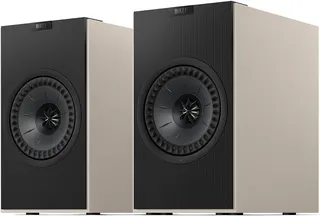
- Best overall: the KEF Coda W, What Hi-Fi's top active speaker. It has a phono input, HDMI ARC and USB-C, but no Wi-Fi.
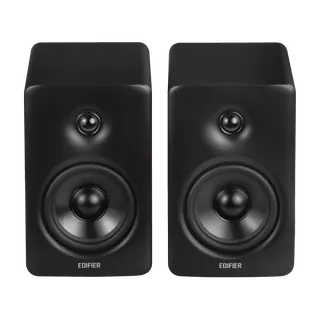
- Best value: the Edifier M90, Wirecutter's upgrade pick, with HDMI eARC and near-flat measurements in Wirecutter's tests.
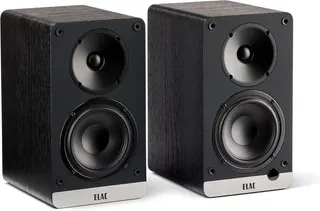
- Best for a turntable on a budget: the ELAC Debut ConneX DCB41. It has a phono stage, HDMI ARC, USB and optical in one pair.
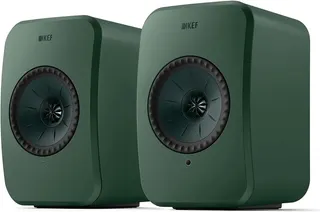
- Best for streaming: the KEF LSX II LT, a 2026 What Hi-Fi Award winner with AirPlay 2 and Chromecast built in.
- Best on a desk next to a record player: the Ruark MR1 Mk3, which What Hi-Fi rates as one of the better built-in phono stages it has heard in powered speakers.
Powered vs active vs passive: what this sheet covers
Every pair here has its amplifier inside the cabinet, so you never buy a separate amp. That's the line we drew. Passive bookshelf speakers, the kind that need a receiver, aren't on this sheet.
Inside that group there's a split the stores rarely mention. In a "powered" pair, one speaker holds the amp and inputs and feeds the other over a cable. The ELAC, Ruark, Audioengines, Edifier M90 and Fluance work that way. What Hi-Fi uses "active" for speakers with a separate amplifier for each driver, and the Cambridge L/R S and KEF Coda W are built like that. TechRadar points out that the L/R S is active rather than merely powered. It's a real engineering difference. Wirecutter's view is that at these prices, powered speakers can't claim a clear sound advantage over passive ones, so don't pay extra for the word alone.
Built-in phono preamp: the column for turntable owners
A turntable's cartridge puts out a signal too weak to drive anything. A phono preamp boosts it and applies the equalization records need. If your turntable has one built in, any line input will do. If it doesn't, the speakers need a phono input, or you buy another box.
The eight are the KEF Coda W, Ruark MR1 Mk3, ELAC DCB41, all three Klipsch systems, and the Kanto Yu4 and Yu6. Not every phono stage is equal. In its MR1 Mk3 review, What Hi-Fi plugged a Rega Planar 3 RS Edition into both the Ruark and the ELAC. It called the Ruark's phono stage very good, and the ELAC's less clear and dynamically stunted. What Hi-Fi also lists the Coda W's phono stage as something that could be better, and it says the same about the ELAC in its own review.
Watch the Kanto Tuk. The first-generation Tuk had a phono preamp. The second generation, out since September, swaps it for a second line-level RCA input. Kanto's comparison chart shows the change. If you're buying the new Tuk for a turntable without a preamp, budget for one.
Slopsheets says: If your turntable already has a preamp (many Audio-Technica and Sony decks do), this column doesn't matter. If it doesn't, filter on it first. Our turntables sheet shows which decks have one.
HDMI: the column that lets the TV remote work
HDMI ARC means the TV sends its sound to the speakers over one cable. With CEC, the TV remote then controls the volume. eARC is the newer version, which has more bandwidth. Eight pairs have one or the other. Five have eARC: the KEF LS50 Wireless II, Edifier M90, and all three Klipsch systems. Three have ARC: the KEF Coda W, KEF LSX II LT and ELAC DCB41.
Everything else connects to a TV through optical, if it has an optical input, or an analog cable. Optical works, but you usually end up with two remotes. The Victrola Tempo gets partway there. Wirecutter likes its signal-sensing input, which switches the speakers on and off with the TV.
HDMI eARC and Dolby Atmos support, so a pair of these replaces a soundbar.
WIRED found The Fives II couldn't compete with a soundbar's upfiring surround. Wirecutter says home theater is easier to build with passive speakers and an AV receiver.
HDMI on a stereo pair is about convenience and dialogue, not surround. If you want height effects, our soundbars sheet is the better place to start.
Wi-Fi streaming: apps vs Bluetooth
Every pair on the sheet has Bluetooth. Only five also stream over Wi-Fi: the KEF LS50 Wireless II and LSX II LT, and the three Klipsch systems. Wi-Fi gets you AirPlay 2, Chromecast or Google Cast, and Spotify and Tidal Connect, so the music plays from the cloud rather than your phone. WIRED started a Tidal playlist on The Fives II, turned off its phone, and the music kept playing. Klipsch's first-generation Fives, Sevens and Nines only had Bluetooth, according to Gear Patrol.
The trade-off is that streaming hardware costs money. What Hi-Fi's advice is to choose streaming only if you'll use it, because you can add a streamer later. That's part of why the Coda W, with Bluetooth only, still tops What Hi-Fi's list.
USB audio: the computer column
Fourteen pairs take USB audio, which lets a laptop send a digital signal straight to the speakers' own DAC instead of the laptop's headphone output. The five without it are the KEF LS50 Wireless II (its USB port is for service only), Audioengine A5+ Wireless, Fluance Ai41, Edifier R1700BTs and Edifier R1280DB. TechRadar listed the missing USB port as the Ai41's main drawback, and recommended against it for anyone gaming on a PC without an optical port.
Subwoofer out: almost a given
Eighteen of 19 have a subwoofer output. The exception is the Edifier R1280DB. Edifier sells a separate R1280DBs if you want one. Small woofers make this useful. Wirecutter says the Victrola Tempo's 4-inch woofers can't produce powerful bass, but adding a subwoofer is easy. The Fluance Ai41 and the second-generation Kanto Yu4 and Yu6 roll the bass off the main speakers automatically when a sub is plugged in, and the Kanto Tuk has a selectable filter.
Woofer size, and the power number to ignore
Woofers on the sheet run from 2.75 inches on the Audioengine A2+ Gen 3 to 8 inches on the Klipsch Nines II. A bigger woofer generally moves more air, which helps in a bigger room. TechRadar calls the Nines II a tough pair to beat for a large room, and also notes they're heavy. The Ruark's 3.3-inch driver is clearly made for a desk. What Hi-Fi still says it handles party volumes well.
We left wattage off the sheet on purpose, because brands quote it in different ways.
The catch: A bigger woofer doesn't fix a bad room or a speaker shoved against the wall. Rear-ported pairs like the Edifier M90 and Fluance Ai41 sound different depending on how close they sit to a wall, so leave some space behind them.
How the AI score was decided
The AI score is our opinion, formed from published reviews and lab measurements and weighed against this sheet only. It isn't hands-on testing. Value counts for a lot. A cheaper pair that reviewers rate highly beats a pricier one that's merely fine.
The KEF Coda W scores highest, at 9.1. What Hi-Fi ranks it the best active speaker overall, and it fits a phono stage, HDMI ARC and USB-C into a compact pair. The LS50 Wireless II, at 8.8, is the class reference, but it costs a lot and skips USB audio and phono. The Edifier M90, at 8.7, is the bargain: Wirecutter measured it at ±2.1 dB through most of the audio range and says it sounds a little clearer than pricier rivals.
The Klipsch trio sits around 8. They have every input on the sheet, and WIRED and TechRadar both liked them, but prices went up a lot over the first generation. TechRadar calls the Nines II's price jump over the originals steep, and it hit bugs with Dirac Live room correction. The new Kanto Yu4, Yu6 and Tuk land in the 7s. The Yu4 and Yu6 only went on sale in mid-November, and we haven't found lab reviews of any of the three second-generation models yet. The Edifier R1280DB comes last at 5.6. It's cheap and very popular, but it has no USB, no phono and no sub out.
Pay up only if: You'll use HDMI or Wi-Fi every day. A mid-priced pair with a phono input and Bluetooth covers most homes.
Picking by setup
- Turntable plus speakers, nothing else: the Ruark MR1 Mk3 on a desk, the ELAC DCB41 or Kanto Yu6 on a shelf. Or pair any speaker with a preamp-equipped deck from our turntables sheet.
- TV and music in one pair: the Edifier M90 on a budget, the KEF Coda W or Klipsch Fives II if you'll spend more.
- Streaming first: the KEF LSX II LT. Turntable owners should note it has no analog input at all, which TechRadar flags in its review.
- Computer desk: the Cambridge Audio L/R S or Audioengine A2+ Gen 3, both with USB-C. TechRadar calls the L/R S one of the best desktop systems for the money, though it notes the bass is a bit heavy.
Frequently asked questions
Do powered bookshelf speakers need a receiver? No. The amplifier is inside one or both speakers. You plug them into the wall and connect a source.
Can I plug a turntable straight into powered speakers? Only if the speakers or the turntable have a phono preamp. Eight pairs on this sheet do.
Are powered speakers better than a soundbar for TV? For music and stereo width, often yes. For surround and height effects, no. A stereo pair with HDMI ARC or eARC is the closest you'll get to a soundbar's convenience.
Sources / further reading
- What Hi-Fi?: Best active speakers 2026
- What Hi-Fi?: Ruark MR1 Mk3 review
- Wirecutter: The Best Bookshelf Speakers
- Wirecutter: 2026 Best New Picks awards
- WIRED: Klipsch The Fives II review
- TechRadar: Klipsch The Nines II review
- TechRadar: Cambridge L/R S review
- TechRadar: Fluance Ai41 review
- Gear Patrol: Klipsch's second-generation powered speakers
- Gear Patrol: Kanto Yu4, Yu6 and Tuk upgrades
- Kanto: Yu4 and Yu6, first vs second generation
- Kanto: Tuk G1 vs G2
- Klipsch: The Fives II inputs
- Klipsch: The Sevens II inputs
- ELAC Debut ConneX DCB41
- Edifier M90
- Audioengine A2+ Gen 3 specifications
- Ruark MR1 Mk3
- Cambridge Audio L/R S
- Fluance Ai41