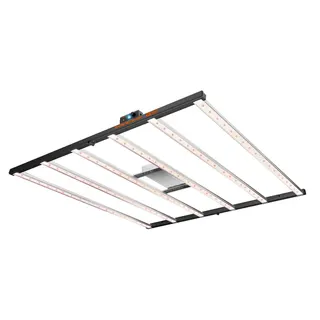
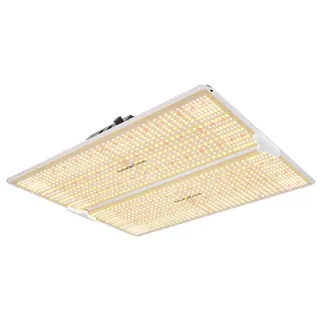
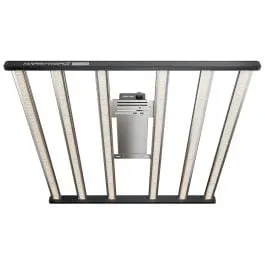
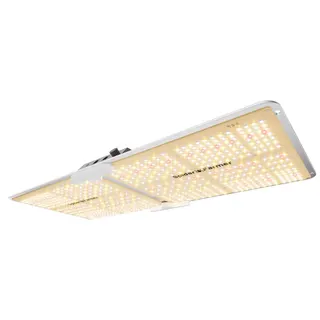


If you grow in a 4x4 tent, the Spider Farmer SF4000 is still the sensible default LED grow light. If you want that canopy pushed close to its ceiling, buy the SE7000. Nearly every other choice on this sheet comes down to two questions: what size tent you have, and whether you want a phone app involved.
First, a disclosure. This trending list leans hard toward one brand. Twelve of the 17 fixtures are Spider Farmer, three are Mars Hydro and two are VIPARSPECTRA. The comparison is still useful, but it tells you more about Spider Farmer's lineup than about the whole market.
The full sortable table is on the category sheet. This post goes through each attribute, what it means for your tent and your power bill, and where the published figures run out.
Light output (PPF): total photons, not brightness
PPF (photosynthetic photon flux) is the number of usable photons a fixture puts out every second, in µmol/s. It's the closest thing this category has to horsepower. The researched spread runs from 166 µmol/s on the SF600 strip light to 2,940 µmol/s on the SE1000W commercial bar fixture.
Raw PPF misleads on its own, because these lights are built for tents of very different sizes. Dividing output by the manufacturer's flowering coverage gives a fairer number: µmol/s per square foot of canopy. These are our own calculations from the published specs, and they're upper bounds, since some light always lands on the tent walls:
- 4x4 (16 sq ft): SE7000 about 134, SE5000 about 89, FC-E4800 about 84, SF4000 about 73
- 5x5 (25 sq ft): SE1000W about 118, SF7000 about 71
- 3x3 (9 sq ft): SE3000 about 95, SF2000Pro about 67
- 2x4 (8 sq ft): SE4500 about 114, TSL2000 about 90, SF2000 about 76, XS2000 unknown
- 2x2 (4 sq ft): SE1500 about 107, TS1000 about 86, SF1000 about 62, XS1000 unknown
The two VIPARSPECTRA boards are blank because we found no published total PPF for either one. Coco For Cannabis did run a PAR map of the XS-2000 and found even coverage across a 2x4. That's a good sign, but you can't sort a table on it.
Slopsheets says: Compare output per square foot, not raw PPF. Within each tent size, the SE bar lights consistently sit at the top. The catch is that you're paying for intensity a beginner's plants may not be able to use.
Efficiency (PPE): the spec that decides your power bill
PPE (photosynthetic photon efficacy) is how many µmol of light a fixture produces for each joule of electricity, so the unit works out to µmol per watt-second. The best in this group is 2.9 µmol/J, shared by the SE7000, SE5000 and SE1000W. The worst is 2.28 µmol/J on the SF600, with the TS1000 close behind at 2.3.
A gap of 0.6 µmol/J sounds small. In practice, the TS1000 produces 343 µmol/s from 150 W, and a fixture rated at 2.85 µmol/J, like the SE1500, would need only about 120 W to match it. Or flip it around: the SE1500 draws the same 150 W and produces 428 µmol/s, about 25% more light for the same electricity.
One caveat came up when we checked the arithmetic. For a few boards, published PPF divided by published wattage doesn't match the published PPE. The SF2000's 608.5 µmol/s over 200 W works out to about 3.0, while its listed PPE is 2.7. The spec sheets don't say which figure is wrong, so we treat the second decimal place of any PPE claim as noise.
Slopsheets says: Over a year of grows, efficiency affects your cost more than almost any other spec. The older boards in this sheet (TS1000, TSL2000, SF1000) give back their low purchase price slowly, through higher electricity use.
Actual power draw: every watt ends up as heat in the tent
Power draw ranges from 74 W (SF600) to 1,000 W (SE1000W). Lower draw is only better if the light still covers your canopy. Usually a lower number just means a smaller light.
Daily energy use makes this more concrete. On a typical 12-hour flowering schedule, our math gives:
- SE1000W: 12 kWh per day
- SE7000: about 8.8 kWh per day
- SF4000: 5.4 kWh per day
- SF1000 on an 18-hour veg schedule: 1.8 kWh per day
Almost all of that energy turns into heat inside your tent. That's why we flag the SE1000W: most home tents can't make use of its full output without added CO2 and serious cooling.
It helps when a rated wattage holds up under testing. In Coco For Cannabis' PAR test of the FC-E4800, the light measured close to its 480 W rating. The same site also tested the Mars Hydro TSL 2000 and noted that its test units had already been used, which is worth keeping in mind when you read older lab numbers.
Slopsheets says: Choose the power draw your ventilation can handle, then pick the most efficient light at that wattage. Power draw doesn't tell you how good a light is.
Flowering coverage: a manufacturer claim, not a guarantee
Rated flowering coverage ranges from 4 sq ft (2x2 lights) to 25 sq ft (the SE1000W and SF7000). The SF600 has no flowering rating, which is honest, because it's a seedling and shelf light.
Coverage tells you which tent a fixture is meant for. It says nothing about how hard the light drives that tent. The SF4000 at 450 W and the SE7000 at 730 W are both rated for 16 sq ft, yet the SE7000 puts about 83% more light into the same space. A matching rating doesn't make two lights equivalent.
The SF2000Pro is rated for 9 sq ft and the SF2000 for 8, and that one square foot matters. The Pro has a square footprint for 3x3 tents, while the standard SF2000 is shaped for a 2x4.
Slopsheets says: Use coverage to choose the size of light, then use output per square foot to choose the model within that size.
Form factor: quantum boards, bars, and one strip light
The sheet includes four layouts:
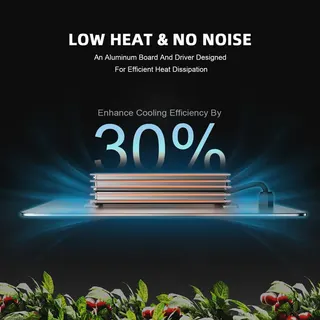
- Quantum boards (SF1000, SF2000, SF2000Pro, SF4000, TS1000, TSL2000, XS1000, XS2000) are flat panels. They're simple, and the Spider Farmer boards run without fans.
- Bar-style fixtures (the SE series and FC-E4800) spread the diodes across several bars, which lights a 4x4 more evenly than a single board.
- Foldable bars (SF7000) are the older take on the same idea.
- Linear strip (SF600) is a T5 replacement for shelves and seed trays.
Bar lights differ among themselves, too. The SE1500's bars are fixed, while the FC-E4800's detach. In its FC-E4800 review, Coco For Cannabis liked the adjustable bar positions because they let you avoid the hot spot that evenly spaced bars tend to create in the center.
Slopsheets says: For a 2x2 or 2x4, a board is good enough and costs less. In a 4x4 or larger, even coverage starts to show up in your yield, and bars earn their extra cost.
Dimmable: nearly universal, with one exception
Sixteen of the 17 fixtures can be dimmed. The SF600 can't. Pepper Geek's hands-on review counted the missing dimmer as a con, along with a somewhat flimsy build. The same review found the SF600 silent and very even over a long, narrow shelf, which is the job it was designed for.
Dimming lets one light carry a whole grow: low for seedlings, turned up for flowering. The SE models add app scheduling, and the SE5000 adds sunrise and sunset ramps. That control is the main reason to pay more for an SE3000 or SE1500 over a board of the same size.
Slopsheets says: Nearly every light here dims. What you're actually choosing is a knob or an app, and only the app gives you scheduling.
Daisy-chain control: confirmed on 12, unknown on 4
Daisy-chaining links several fixtures so one controller dims them all. Our research confirmed it on 12 lights: the SE7000, SE5000, SE4500, SE1000W, SF4000, SF2000, SF1000, FC-E4800, TSL2000, TS1000, XS2000 and XS1000. It's unconfirmed for the SF7000, SF2000Pro, SE3000 and SE1500, and the SF600 doesn't support it.
This only matters if you'll run more than one light. Plenty of people do, usually after starting in a 2x4 and moving to a bigger tent with two fixtures.
Slopsheets says: If you might add a second light later, choose one with confirmed daisy-chain support. A blank cell in the table means we couldn't confirm it, not that the light can't do it.
Best LED grow light for each tent size
- 2x2: Start with the SF1000. Pepper Geek found its Mean Well driver and Samsung diodes solidly built. Choose the SE1500 if you want app scheduling and more flowering intensity.
- 2x4: The SF2000 is the default. The SE4500 gives you about 50% more output for about 60% more power.
- 3x3: The SF2000Pro or the SE3000. The SE3000 has higher output per square foot and app control.
- 4x4: The SF4000 if you want simple. The SE5000 gives about 21% more output for 30 extra watts. Choose the FC-E4800 for a cheaper bar light, or the SE7000 for maximum light. Spider Farmer's SE7000 product page and SF4000 page list the published specs.
- 5x5: The SE1000W, but only if you can deal with the heat. The SF7000 still works, though the newer SE bar lights beat it on efficiency.
- Seed trays and shelves: The SF600, as long as you don't expect it to flower plants.
LED grow light FAQ
Is the SE1000W overkill for a home grow tent? For most people, yes. Spread over its rated 25 sq ft, it produces about 118 µmol/s per square foot, roughly what the SE7000 does in a 4x4. Plants can only use that much light with added CO2 and strong cooling, and most home tents have neither. You can run it dimmed, but then you've paid for output you aren't using.
Is the SF2000Pro's Samsung LM301H EVO diode upgrade worth it over the SF2000? On paper, no. The Pro lists 599.9 µmol/s and the standard SF2000 lists 608.5, both from 200 W and both at 2.7 µmol/J. Buy the Pro for its square footprint in a 3x3 tent, not for extra performance.
Can the SF600 flower plants? It isn't built for that. At 166 µmol/s, with no flowering coverage rating and no dimming, it's a light for seedlings, clones and herb shelves. Even the smallest boards here produce more light for flowering and let you control it.
Why do the VIPARSPECTRA lights score lower here? Testing didn't turn up a problem. Independent PAR testing found the XS2000 lit a 2x4 evenly. They score lower because our research found no published total PPF for either light, so their output per square foot can't be compared with the others. Spider Farmer's more detailed spec sheets are easier to check.
Sources / further reading
- Coco For Cannabis: Mars Hydro FC-E4800 PAR Test & Review
- Coco For Cannabis: ViparSpectra XS-2000 PAR Test & Review
- Coco For Cannabis: Mars Hydro TSL 2000 PAR Test & Review
- Pepper Geek: Spider Farmer SF600 and SF1000 Grow Light Review
- Spider Farmer: SE7000 product page
- Spider Farmer: SF4000 product page
- Spider Farmer: SF600 product page