

The best cordless leaf blower for most yards in 2026 is a 40V-to-60V brushless handheld rated somewhere between 600 and 800 CFM, sold as a kit with a big battery. Below that, you are buying a patio sweeper. Above it, you are mostly paying for a number on the box. We lined up 22 popular battery blowers from EGO, RYOBI, Greenworks, Husqvarna, Toro, Milwaukee, DeWalt, Makita, WORX, CRAFTSMAN and BLACK+DECKER and compared them on the five things that actually separate them: rated airflow, rated air speed, bare-tool weight, battery platform, and whether a battery comes in the box.
The spec sheets in this category are unusually slippery. Airflow and speed are measured with the turbo button held down and the narrowest nozzle attached. Weights are quoted without the battery, which is the heaviest part. Runtime claims assume the lowest setting, which nobody uses on wet October leaves. So wherever a lab put a force meter or a decibel meter on these machines (mostly Pro Tool Reviews, with Bob Vila and Consumer Reports filling in), we lean on that instead of the box.
Slopsheets says: Pick your battery platform first, then the blower. If you already own DeWalt or Milwaukee packs, their blowers are fine for driveways and light leaf duty. If you are starting from zero and have real trees, an EGO, RYOBI 40V, Greenworks 60V or Husqvarna kit gets you gas-class force without the pull cord.
Airflow (CFM): how much air it moves
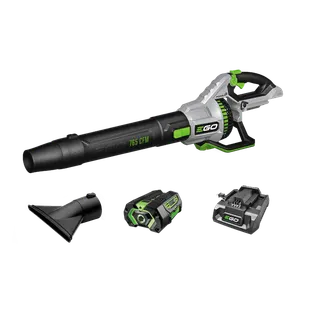
CFM, cubic feet per minute, is the volume of air leaving the tube. It is the number that decides how big a pile you can push, so it is the headline spec on every box. The field here runs from about 100 CFM on the BLACK+DECKER 20V sweeper to 900 CFM on the Toro 60V Flex-Force, with the serious leaf movers clustered between 600 and 880: EGO's LB6151 (615), LB6504 (650), LB7654 (765) and LB8803 (880), the RYOBI 40V Whisper and Greenworks 80V (both 730), the Greenworks 60V (700), and Husqvarna's Leaf Blaster 350iB (800).
The rated figure is a ceiling. Every one of these is quoted in turbo or boost, usually with a specific nozzle. Husqvarna's own spec table shows how much the method matters: the 350iB's 800 CFM is a boost-mode peak at the round nozzle, while the same table lists 555 CFM for airflow measured in the housing. Compare rated numbers only against other rated numbers.
The 18V and 20V tools sit lower for a physical reason. A single 18V or 20V pack can only deliver so much power, which is why the Milwaukee M18 FUEL 2724, Makita XBU03 and DeWalt DCBL722 all land around 450 to 460 CFM, and why Milwaukee's 600 CFM model needs two M18 batteries at once.
Air speed (MPH): what lifts the stuck stuff
Air speed is how fast that air leaves the nozzle. CFM moves a loose pile; MPH is what peels wet, matted leaves off a lawn or blasts grit out of a driveway crack. The big 56V and 40V units are rated between 170 and 200 MPH (EGO's LB7654, LB8803 and the Husqvarna all claim 200), while the WORX Power Share blowers sit at 75 to 95 MPH, and reviewers found them better at tidying than at shifting wet leaves.
Speed depends even more on the nozzle than airflow does. EGO's own manuals show it: the LB6504 is rated 180 MPH with its tapered nozzle and 160 without, and RYOBI sells the 40V Whisper with tips rated 160, 175 or 190 MPH. A narrow nozzle trades volume for velocity, so a blower can't hit its best CFM and its best MPH in the same configuration.
Why measured force beats both numbers
Because CFM and MPH pull against each other, Pro Tool Reviews skips both and measures thrust in newtons with a force meter, which captures the combined push you actually feel on the leaves. On that scale the field spreads out fast. EGO's LB7654 hit 25.3 N in turbo on its kit battery, which PTR called the strongest battery blower it had tested. Husqvarna's 350iB measured 24.4 N. A tight pack of very good blowers sits right around 20 N: the Toro 60V (20.3 N), EGO LB6504 (20.3 N), RYOBI 40V (20.0 N) and Greenworks 60V (20.0 N). The 18V class lands near 11 N, and PTR pegs a decent residential gas handheld at around 12.
The surprise is that the biggest CFM number doesn't win. EGO's 880 CFM LB8803 measured less force on its kit battery than the older 765 CFM model did on its own.
The catch: A blower's top rating assumes the battery can keep up. The 880 CFM EGO ships with two 4.0Ah packs, and on one of those it lands mid-pack in PTR's nine-blower head-to-head. Its headline number only shows up on a battery the kit doesn't include.
Weight: the bare-tool number vs. what your arm holds
Our weight column is the bare tool without a battery, because that is the only number most makers publish consistently. It flatters everyone. EGO's blowers are around 4.6 to 4.9 lb bare, yet Bob Vila weighed the LB6504 at 10.2 lb ready to blow and said the LB7654's roughly 10 lb loaded had the tester switching hands every few minutes. The battery is the heavy part, and the high-force blowers need big ones.
Loaded, most full-size kits here weigh about 9 to 12 lb. Pro Tool Reviews found the Husqvarna 350iB one of the lightest handhelds it had tested at 9.9 lb with its battery, while the Toro came in at 11.9 lb with its 4.0Ah pack and placed heaviest in PTR's head-to-head. Balance matters as much as mass: PTR praised the balance of the RYOBI 40V, Greenworks 60V and Toro, and the Greenworks for hanging nose-down on its own, which keeps your wrist from doing the aiming.
A few rows need footnotes, and the table carries them: Makita publishes only a with-battery weight for its two-battery XBU02, Toro publishes no weight at all (the figure is PTR's measurement), and DeWalt lists an "assembled product weight" that runs well above what PTR reported for the bare tools.
Battery platform and what's in the box
For most buyers, this decides everything else. Batteries are the expensive part, and they only fit their own brand's tools. If your garage already holds DeWalt 20V, Milwaukee M18 or Makita LXT packs, a tool-only blower like the DCBL722B, 2724-20 or XBU03Z costs a fraction of a kit and shares batteries you already charge. Just know what you are getting: PTR measured the Milwaukee 2724 and Makita XBU03 at about 11 N, and the Makita ran only 10 minutes 25 seconds on high from a 5.0Ah pack. They are hard-surface cleanup tools.
If you are starting from scratch, the kit is the value. The RYOBI RY404100 ships with two 4Ah batteries and a rapid charger, the WORX WG584 with two 20V packs, the EGO LB8803 with two 4.0Ah packs, and the Husqvarna with a large BLi30. Note that the Greenworks 80V row here is the tool-only version, because its battery kit has dropped off Greenworks' US store, and Milwaukee's 2824 dual-battery blower needs two M18 packs you supply.
Up to 84 minutes of runtime, as DeWalt claims for its 60V blower on the lowest setting with a 9.0Ah pack.
In turbo, the strong blowers Pro Tool Reviews timed lasted roughly 9.5 to 14 minutes per battery. Plan on a second pack for any real leaf day.
Runtime isn't in our table for that reason: every maker quotes it at a different setting with a different battery, so the numbers can't be compared honestly. The measured ones tell the story. In turbo, PTR got 9:32 from the Toro on its 4.0Ah pack, 10:32 from the RYOBI per 4Ah battery, about 13 minutes from the EGO LB7654 and the Greenworks 60V, and 13:55 from the Husqvarna. On high, the Husqvarna's big kit battery stretched to 38 minutes, the longest PTR recorded among these.
Noise: why the RYOBI Whisper has a name
Noise isn't a table column because makers measure it in incompatible ways (at the ear, at 50 feet, under ANSI or not). But two lab numbers are worth knowing before you fire one up at 8 a.m. next to a neighbor's bedroom window.
Tools in Action called the RYOBI the quietest blower it had used, and ToolGuyd found the Whisper line genuinely quiet in its earlier testing. At the other end, PTR measured the Toro at 92 to 93 dB(A) in turbo, and Bob Vila's tester wanted hearing protection for it. Consumer Reports, per Quartz's summary, found the Greenworks 60V quiet enough not to need ear protection, and it topped CR's handheld scores.
Pay up only if: you have big deciduous trees and wet leaves. For a driveway, a deck and a few shrubs, a 450 CFM tool on batteries you already own does the job, and a sweeper like BLACK+DECKER's 20V handles grass clippings on the walk without pretending to be a leaf blower.
Which cordless leaf blower should you buy?
Start with batteries you own, then size to your trees. Our three picks:
- Best overall: EGO Power+ LB7654. The strongest force Pro Tool Reviews measured from a kit battery, rated 765 CFM and 200 MPH, and Bob Vila found it matched a gas backpack on wet, matted leaves. The trade is roughly 10 lb in your hand.
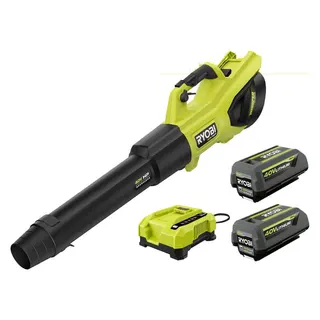
- Best value: RYOBI 40V HP Whisper RY404100. About 20 N of measured force, the quietest numbers in the lab data, good balance, and two 4Ah batteries in the box so you can swap mid-job.
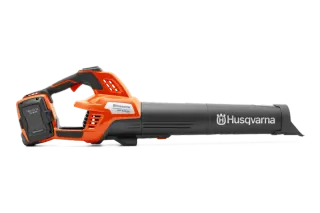
- Best for big yards: Husqvarna Leaf Blaster 350iB. Second only to the EGO 765 in force measured on a kit battery, one of the lightest full-power handhelds loaded, and a kit battery that ran 38 minutes on high in PTR's test.
Close behind: the Greenworks Pro 60V BL60L512, Consumer Reports' top-scoring handheld per Quartz, and EGO's LB6504, Bob Vila's 2026 runner-up. If your lawn has more grass than trees, our robot lawn mower sheet covers the other half of yard work.
Frequently asked questions
Is a cordless leaf blower as strong as a gas one? The top tier is. Pro Tool Reviews puts a good residential gas handheld at about 12 N of force, and most of the 40V-to-60V flagships here measured about 20 N or more on their kit batteries, with EGO's LB7654 on top at 25.3 N. The 18V and 20V single-battery blowers sit at or just below gas handheld territory.
How long does a battery leaf blower actually run? In turbo, expect roughly 9.5 to 14 minutes per battery from the high-power models, based on Pro Tool Reviews' timed tests. On high (not turbo) the better kits run 15 to 38 minutes. Manufacturer "up to an hour" claims assume the lowest setting.
Do I need a backpack blower instead? Only for acreage or commercial-scale leaf volume. The strongest handhelds here now out-push most gas handhelds, and Bob Vila found the EGO 765 kept pace with a gas backpack on wet leaves. Backpack units mainly buy you longer runtime and a lighter load on your arm.
Is a tool-only blower a bad deal? Not if you already own that brand's batteries, since the pack is the expensive part. If you don't, a kit almost always costs less than buying the bare tool, a battery and a charger separately, and two-battery kits like RYOBI's and WORX's let you swap packs mid-job.
Sources / further reading
- Pro Tool Reviews: Best Cordless Leaf Blower Head-to-Head Review, force, runtime and noise measured across nine blowers.
- Pro Tool Reviews: EGO 765 CFM Blower Review LB7654, the highest force reading in our data.
- Pro Tool Reviews: EGO Power+ 56V 880 CFM Handheld Blower Review, force measured across three battery sizes.
- Pro Tool Reviews: Husqvarna 40V Battery-Powered Leaf Blaster review, boost force and long-runtime testing.
- Pro Tool Reviews: Ryobi 40V HP Brushless 730 CFM Leaf Blower Review, the quietest at-ear readings here.
- Pro Tool Reviews: Toro 60V 900 CFM Leaf Blower Review, the highest rated airflow, tested.
- Pro Tool Reviews: Greenworks Pro 60V 700 CFM Blower Review, balance, force and runtime.
- Bob Vila: The Best Leaf Blowers of 2026, Tested by Lawn-Care Experts, hands-on yard testing.
- Bob Vila: Tested, Is the Ego 765 Leaf Blower Really the World's Most Powerful?, the gas-backpack comparison.
- Quartz: The 9 best battery leaf blowers of 2026, according to Consumer Reports, a summary of CR's handheld scores.
- Tools in Action: RYOBI 40V Blower, real-world noise and balance impressions.
- Gardener's Path: Worx WG584 review, a year of ownership.