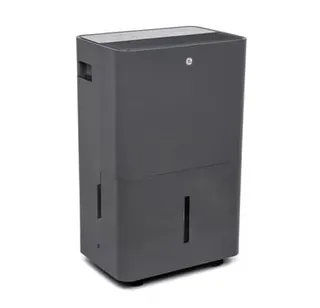
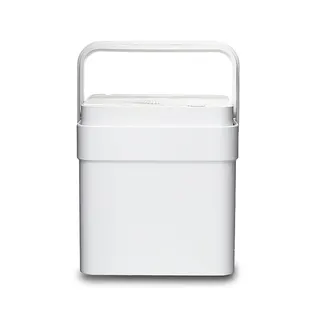
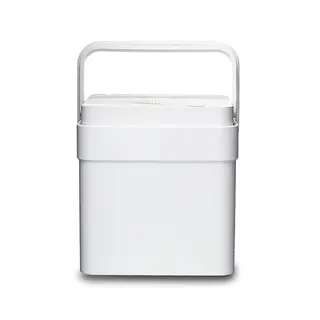
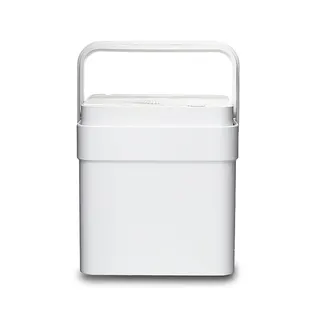


Nine of the 14 dehumidifiers in this comparison carry the same 50 pints/day rating. If you shop by the big number on the box, you'll end up choosing by color.
The short answer: when most models share a 50-pint rating, three specs decide how a dehumidifier fits your week. The first is water tank capacity, meaning how much it holds before it stops. The second is whether it has a built-in pump to send that water somewhere useful. The third is weight, which you feel every time you carry it down the basement stairs. We compared all six key specs for GE, Midea, Frigidaire, Honeywell and hOmeLabs, and leaned on lab results from RTINGS and Consumer Reports where they exist.
Dehumidifier specs at a glance
| Model | AHAM rating (pints/day) | Tank (pints) | Built-in pump | Wi-Fi |
|---|---|---|---|---|
| GE APYR50LC | 50 | 14 | Yes | No |
| GE APER50LZ | 50 | 15 | Yes | Yes (SmartHQ) |
| GE ADHL35LA | 35 | 8.5 | No | No |
| Midea Cube 50 | 50 | 33.8 | No | Yes |
| Midea Cube 50 with pump | 50 | 33.6 | Yes | Yes |
| Midea Cube 35 | 35 | 34 | No | Yes |
| Midea Cube 35 with pump (discontinued) | 35 | 34 | Yes | Yes |
| Midea Cube 20 | 20 | 25.4 | No | Yes |
| Midea MAD50PS1WS | 50 | 12.8 | Yes | Yes |
| Frigidaire FFAP5034W1 | 50 | 17.6 | Yes | No |
| Frigidaire Gallery FGAC5044W1 | 50 | 16.9 | No | Yes |
| Frigidaire FFAD5033W1 (discontinued) | 50 | 16.8 | No | No |
| Honeywell TP70WKN | 50 | Not published | No | No |
| hOmeLabs HME021002N | 35 | 6.4 | No | No |
All 14 models are Energy Star certified.
Does the pint rating matter? Most of the field is tied at 50 pints
The AHAM rating is the number of pints of water a unit pulls from the air in a day under a standardized test condition. This group splits into three tiers:
- 50 pints/day: GE APYR50LC, GE APER50LZ, Midea Cube 50 (with and without pump), Midea MAD50PS1WS, Frigidaire FFAP5034W1, Frigidaire Gallery FGAC5044W1, Frigidaire FFAD5033W1, Honeywell TP70WKN
- 35 pints/day: Midea Cube 35 (with and without pump), GE ADHL35LA, hOmeLabs HME021002N
- 20 pints/day: Midea Cube 20
Model names don't always match the rating. The Honeywell is the TP70WKN, but it's rated at 50 pints/day. The U.S. test procedure changed in 2019 and moved to cooler test conditions, so the same hardware posts a lower number under the new test, and a few older names stuck around. When you compare models, use the current AHAM figure and ignore the number in the model name.
The rating is also a ceiling under one set of conditions. It doesn't promise anything about your basement. RTINGS ranks the GE APYR50LC above the Frigidaire FFAP5034W1 and the Midea 50-pint units even though they all share the same rating, and its lab tests credit the GE's strong airflow in open spaces. Two machines with identical ratings can perform quite differently in a real room.
Slopsheets says: Get a 50-pint unit for any basement or large open area. A 35-pint unit makes sense for a bedroom or a single damp room. Save the 20-pint size for spaces that are small and only mildly humid. Once you're in the 50-pint tier, stop comparing ratings and start comparing tanks and pumps.
Which dehumidifier has the biggest water tank?
The Midea Cube line has the biggest tanks, and this is where the field splits apart. The largest tank is more than five times the size of the smallest:
- Midea Cube family: 34 pints (Cube 35 and Cube 35 with pump), 33.8 (Cube 50), 33.6 (Cube 50 with pump), 25.4 (Cube 20)
- Frigidaire: 17.6 (FFAP5034W1), 16.9 (Gallery FGAC5044W1), 16.8 (FFAD5033W1)
- GE: 15 (APER50LZ), 14 (APYR50LC), 8.5 (ADHL35LA)
- Midea MAD50PS1WS: 12.8
- hOmeLabs HME021002N: 6.4
- Honeywell TP70WKN: not published in our research data
On the Cube, the reservoir is the base of the machine rather than a drawer tucked inside it. That's how even the 20-pint Cube holds more water than any GE or Frigidaire in this group. It also explains why the Midea MAD50PS1WS looks bad by comparison: it's a conventional tower, and despite the Midea name it has one of the smaller tanks among the 50-pint units.
The bottom of the list is where the trouble is. RTINGS' measurements flag the hOmeLabs tank as very small. At 6.4 pints, a 35-pint-rated machine running hard in a damp room could fill it several times a day. The GE ADHL35LA's 8.5-pint bucket has the same problem to a lesser degree, which is a shame, because Consumer Reports otherwise rates it well.
Big tanks have one catch. Water weighs a little over a pound per pint (our calculation), so a full 34-pint Cube reservoir is roughly 35 pounds of water. You'll make far fewer trips than with a 14-pint bucket, but each trip is a real lift.
Slopsheets says: If you'll be emptying a bucket by hand, the Cube's reservoir is the most useful spec in this whole comparison. If you'll be draining by hose or pump, tank size barely matters, and the GE APYR50LC's small bucket stops being a weakness.
Do you need a dehumidifier with a built-in pump?
You need a pump if the unit sits below grade with no floor drain nearby. Every unit here can presumably drain by gravity through a hose. A built-in pump pushes water up and out to a utility sink, a window, or a drain that sits higher than the unit. In a basement without a floor drain, that decides whether the machine runs all season or shuts off every time the bucket fills.
Has a pump: GE APYR50LC, GE APER50LZ, Frigidaire FFAP5034W1, Midea Cube 50 with pump, Midea Cube 35 with pump, Midea MAD50PS1WS.
No pump: Midea Cube 50, Cube 35 and Cube 20, Frigidaire Gallery FGAC5044W1, Frigidaire FFAD5033W1, Honeywell TP70WKN, GE ADHL35LA, hOmeLabs HME021002N.
The paired models tell you a lot. The Midea Cube 50 with and without a pump weigh the same 41.5 pounds and have nearly identical reservoirs (33.6 vs. 33.8 pints), so the pump adds essentially no bulk. Frigidaire's FFAP5034W1 puts a pump on the platform the discontinued FFAD5033W1 used, and it tests better too. The Frigidaire Gallery adds Wi-Fi but no pump, which we think gets the priorities backwards for a basement.
Slopsheets says: If the unit is going below grade and there's no floor drain right next to it, treat the pump as required. Among the pump-equipped options, the GE APYR50LC has the strongest lab record, the Midea Cube 50 with pump has the largest tank, and the Frigidaire FFAP5034W1 is the simplest.
Does Energy Star certification help you choose? Every unit here has it
All 14 models are Energy Star certified. That's good for the category, but it means the certification won't help you choose. Energy Star's dehumidifier program sets a minimum efficiency bar, and every model in this group clears it. If efficiency is your tiebreaker, go to lab measurements instead. RTINGS notes, for example, that the Midea Cube 35 puts out little heat, which matters in a bedroom.
Slopsheets says: Check the box and move on. In this lineup, Energy Star gets a unit in the door. It doesn't make one better than another.
Is Wi-Fi worth it on a dehumidifier?
Wi-Fi and app control are handy, but rarely the deciding spec.
Connected: the whole Midea lineup (all five Cubes plus the MAD50PS1WS), GE APER50LZ (SmartHQ), Frigidaire Gallery FGAC5044W1.
Not connected: GE APYR50LC, GE ADHL35LA, Frigidaire FFAP5034W1 and FFAD5033W1, Honeywell TP70WKN, hOmeLabs HME021002N.
An app is most useful for a tank-full notification, or for checking humidity in a basement you don't visit often. Most of that goes away when a pump drains the water continuously. The two top-rated basement machines in RTINGS' testing, the GE APYR50LC and the Frigidaire FFAP5034W1, have no app at all.
The GE APER50LZ shows how little connectivity adds on its own. It takes GE's 50-pint, pump-equipped hardware and adds SmartHQ. That's a reasonable package, but nothing in the lab results we found puts it above its app-free sibling, the APYR50LC.
Slopsheets says: An app earns its place on bucket-only units in rooms you don't check often. On a pump-equipped unit draining to a sink, Wi-Fi is a convenience and nothing more.
How much do dehumidifiers weigh? Close on paper, not with a full tank
Published weights run from 33.1 lb (Midea Cube 20) to 46.6 lb (Midea MAD50PS1WS). The 50-pint units sit between 41 and 46.6 lb. Honeywell and hOmeLabs weights weren't in our research data.
The Cube 20 is light for this group but heavy for its class. A 20-pint machine usually weighs much less, and the big base reservoir accounts for the difference. The discontinued Cube 35 with pump is the heaviest Cube at 45.2 lb, 5.6 lb more than the pump-free Cube 35. Among the 50-pint units, the Midea MAD50PS1WS is the heaviest and holds the least water, which is another strike against it.
Empty weight matters once, when you move the unit into place. Full-tank weight matters every time you empty it, and that depends far more on tank size than on the empty weight in the spec sheet.
Slopsheets says: The empty-weight spread among the 50-pint units is under six pounds, so it shouldn't decide anything. If you'll be carrying a full bucket up stairs, a pump will do more for your back than a few pounds of lighter chassis.
Discontinued models: still listed, harder to recommend
Two units in this group are on their way out. Midea has discontinued the Cube 35 with pump (MAD35PS1QGR). HouseFresh's testing of the Cube line praised its efficiency and huge base bucket, but stock is shrinking. Frigidaire's FFAD5033W1 was a long-running best seller and still dries rooms dependably, but Frigidaire has discontinued it, and the FFAP5034W1 replaces it with a pump and better test results.
Slopsheets says: If you find either one at a good price, it'll still dry a room. Otherwise, buy the current model.
Which dehumidifier fits your space?
- Large open basement, no floor drain: GE APYR50LC, per RTINGS' testing. Plan on a hose, because the 14-pint bucket fills fast.
- Basement where you'd rather empty a bucket now and then than fiddle with a hose: Midea Cube 50 with pump. It has a 33.6-pint reservoir with the pump as backup.
- You want a machine with no app and nothing to set up: Frigidaire FFAP5034W1.
- Bedroom: Midea Cube 35, RTINGS' bedroom pick, which Consumer Reports also rates highly.
- Small room, mild humidity: Midea Cube 20.
- Tight budget: if you go with the hOmeLabs, plan on continuous drainage from the start.
FAQ
Why is the Honeywell TP70WKN called a 70 when it's rated at 50 pints? The U.S. test procedure for dehumidifiers changed in 2019 and now uses cooler conditions, so the same hardware posts a lower number. The model name reflects the old rating. Use the 50-pint AHAM figure when comparing it with other units.
Do I need a built-in pump if my basement has a floor drain? Usually not. If the drain sits lower than the unit's drain outlet, gravity does the work through a standard garden hose. You only need a pump when the water has to go up or across to reach a sink, a window, or a drain that's higher than the unit.
Does the Midea Cube's nesting design do anything besides save space? Yes. Building the reservoir into the base is why the Cube line holds 25.4 to 34 pints, compared with 6.4 to 17.6 pints for the non-Cube units here. Nesting down for off-season storage is a bonus on top of that.
What size dehumidifier do I need for a basement? A 50-pint unit suits a basement or large open area. A 35-pint unit fits a bedroom or a single damp room, and a 20-pint unit is for small, mildly humid spaces.
Sources / further reading
- RTINGS: The best dehumidifiers
- RTINGS: The best basement dehumidifiers
- RTINGS: The best dehumidifiers for bedrooms
- RTINGS: Frigidaire FFAP5034W1 review
- Consumer Reports: Best dehumidifiers
- Consumer Reports: Dehumidifier buying guide
- HouseFresh: Midea Cube dehumidifier review
- ENERGY STAR: Dehumidifiers
- ENERGY STAR: Dehumidifier specification, Version 6