

A wireless mic only has one job, and you find out it failed after the shoot, when the interview you can't redo has a two-second hole in it. That's the lens for the 20 clip-on wireless microphone kits in this comparison. The headline range on the box matters less than whether the transmitter keeps its own copy, what it weighs on a shirt collar, and whether it lasts a full day of filming. The shortlist and check-price buttons sit above this article, and the full sortable sheet lines every kit up side by side. Down here we go column by column and point out where the spec sheet oversells.
The lineup: five from DJI (the Mic 3, Mic 2, Mic Mini, Mic Mini 2 and Mic Mini 2S), four from RØDE (Wireless PRO, Wireless GO (Gen 3), Wireless Micro and Wireless ME), five from Hollyland (Lark M2S, Lark M2, Lark Max 2, Lark A1 and Lark A2), two from Insta360 (Mic Pro and Mic Air), plus the Sennheiser Profile Wireless, Sony ECM-W3, Shure MoveMic Two Receiver Kit and Saramonic Ultra.
What is a wireless lavalier mic kit?
Every kit here is the same basic idea: one or two small transmitters clip to the people talking, each with a microphone built in, and a receiver plugs into your camera, phone or computer. The receiver either sits in a camera's hot shoe with a 3.5 mm cable or plugs straight into a phone's USB-C port. Some kits, like the Hollyland Lark M2S Combo, ship both kinds of receiver.
They're selling fast right now: DJI and Hollyland kits fill much of Amazon's wireless lavalier best-seller list this month. The six columns below are the ones reviewers keep coming back to when they rank these kits.
Transmitter weight: from 7 grams to 35
Weight decides whether the mic sits flat on a T-shirt or drags the collar down into the shot. The field splits in two. The pearl and button mics (Hollyland's Lark M2S at about 7 g, Insta360's Mic Air at 7.9 g, the Lark A1 and A2 around 8 g, Shure's MoveMic at 8.2 g) almost disappear. The square-box designs from RØDE and Saramonic weigh 32 to 35 g each.
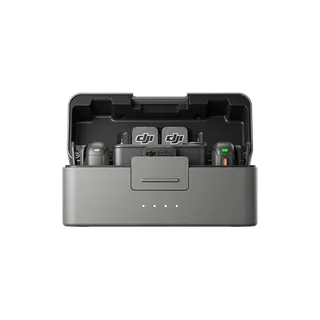
The DJI Mic 3 sits in the middle, and it's the one to watch. Fstoppers points out that at 16 g it still records a 32-bit float backup the whole time it transmits, which used to need a RØDE-sized box.
Slopsheets says: For phone vlogs and talking-head videos, go light. You only need a 30-gram transmitter if you're wiring a hidden lav, and that's a column further down.
Max range: what 400 meters means indoors
DJI prints 400 m for the Mic 3 and all three Mic Minis, Insta360 claims the same for the Mic Pro, and Hollyland, Insta360 and Saramonic sit at 300 m or more for most of their kits. RØDE's Wireless Micro and Wireless ME say 100 m. Shure's MoveMic is the outlier at 100 feet, which SoundGuys rounded to 30 m and listed as a con.
Those headline numbers are open-field, line-of-sight figures. Fstoppers' buying guide warns that a wall, a crowd or a room full of 2.4 GHz devices pulls usable range down to tens of meters. The same guide found that turning on the Mic 3's Lossless Audio mode, the one you'd pick for paid work, cuts range roughly in half and costs about two hours of battery.
400 meters, so you can film from across a football pitch.
DJI's own interference figure for the Mic 3 is 80 m, and Lossless mode halves the open-air number before anyone walks into a crowd.
Bodies count too. Digital Camera World's Lark A1 test had the reviewer walk away with their back to the camera, which blocks the line of sight, and the budget kit kept a clean signal to about 77 steps. Its Lark M2S review, by contrast, noted some dropout at a distance.
The catch: range is a tiebreaker, not a reason to buy. If you shoot weddings or conferences, look for onboard recording instead, so a dropout costs you nothing.
Transmitter battery life: 6 to 11.5 hours
The small DJI Mic Minis lead here at up to 11.5 hours per transmitter, with the Mini 2S, Hollyland Lark Max 2 and Lark M2S close behind at 9 to 11. The older DJI Mic 2, the Sony ECM-W3 and the Saramonic Ultra sit at 6. Many kits ship in a charging case that refills the transmitters between takes, and Tom's Guide counted up to 40 hours of total use from the Mic Mini 2S and its case.
Hollyland's numbers come with a footnote. Hollyland quotes the 9 hours for the Lark M2S and Lark A1 with noise cancelling switched off, so expect less with it on.
Don't overpay for: an extra two hours on paper. Every kit here outlasts a typical shoot day once you top it up in the case at lunch.
Onboard recording: the backup that saves the take
This is the column we'd sort by first. Nine of the 20 kits record a copy of the audio to memory inside each transmitter while also sending it to the receiver: the DJI Mic 3, Mic 2 and Mic Mini 2S, RØDE's Wireless PRO and Wireless GO (Gen 3), Hollyland's Lark Max 2, Sennheiser's Profile Wireless, Insta360's Mic Pro and the Saramonic Ultra. If the radio link glitches, you drop that clean file into your edit and move on.
The Mic Mini 2S changed this column this year. Tom's Guide gave it Editor's Choice for offering flagship features at a fraction of the cost, and the backup recording is the big one. TechRadar's review of the cheaper Mic Mini 2 confirms that model has no internal storage. That backup is the headline difference between the two, and it's the one we'd pay for.
Without onboard recording you're trusting the radio completely. That's fine for a phone vlog where you can re-record. It isn't fine for an interview.
Pay up only if: you film things that happen once. For everything else, the DJI Mic Mini 2S is the cheapest way into a backup file on this sheet.
32-bit float: insurance against clipping
All nine of those kits record the backup as 32-bit float. Shout too loudly into a normal 24-bit recording and the peak is gone for good. A 32-bit float file keeps it, so you can pull the level down in editing. On the kits that offer it, 32-bit float applies to the transmitter's internal file. Insta360 and Saramonic say so outright.
Sennheiser added it to the Profile Wireless in a later firmware update, which is why TechRadar's launch review still lists no 32-bit as a con. Tom's Guide's Rode Wireless Pro review lists 32-bit float alongside a safety track and timecode as the reasons to buy it, and the RØDE Wireless GO (Gen 3) got the same 32-bit backup in Digital Camera World's review.
What the box won't tell you: 32-bit float only helps if you grab the backup file afterward. If you never plan to open the transmitter's storage, skip it.
Lav mic input: when you need to hide the mic
Eight kits have a 3.5 mm jack on the transmitter for a separate lavalier microphone: the DJI Mic 2, RØDE's Wireless PRO, GO (Gen 3) and ME, the Sennheiser Profile Wireless, the Sony ECM-W3, the Insta360 Mic Pro and the Saramonic Ultra. The Hollyland Lark Max 2 gets there with an included USB-C to 3.5 mm adapter. RØDE's Wireless PRO ships two Lavalier II mics with locking connectors in the box.
A plug-in lav is what you need when the mic has to go under a collar, a scarf or a jacket. Fstoppers recommends the transmitter's own capsule when the chest is exposed and a lav when the mic must be hidden, which is why it singles out the Wireless PRO's included lavs.
The DJI Mic 3 dropped the jack that the Mic 2 had. Tom's Guide listed the missing lav port among its few cons, alongside a clip that didn't feel secure.
Worth knowing: if you film narrative work, a wedding or anything with costumes, the Wireless PRO or a Mic 2 still beats the newer DJI here.
Best wireless microphone for each kind of shooter
- Best overall: DJI Mic 3. Tom's Guide calls it the gold standard, and Fstoppers and Digital Camera World both rank it first. It's light, records a 32-bit backup, and takes up to four transmitters on one receiver.
- Best value: DJI Mic Mini 2S. Most of the Mic 3's safety net for far less, in a 12 g body.
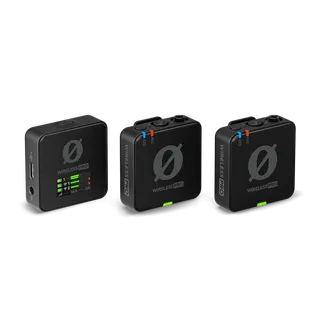
- Best for hidden lavs: RØDE Wireless PRO. Timecode, locking lav inputs and two lavs in the box. It weighs more and Tom's Guide found its controls fiddly.
- Best budget phone kit: Hollyland Lark A1. Digital Camera World's best budget pick, with noise cancelling that handled a loud air conditioner in its test.
Questions people ask before buying
Is the DJI Mic Mini 2S worth it over the Mic Mini 2? If you film anything you can't redo, yes. The 2S adds onboard recording with a 32-bit float backup, which TechRadar's review confirms the Mini 2 lacks. For casual phone vlogs where a retake is easy, the Mini 2 is enough.
DJI Mic 3 or RØDE Wireless PRO? The Mic 3 for most people: it's lighter, its dual-band radio dodges crowded venues, and reviewers rank it first. Pick the Wireless PRO if you need to hide lav mics under clothing or sync with timecode.
Do wireless mics work with an iPhone? Yes. Most kits here sell a USB-C receiver that plugs straight into recent iPhones and Android phones, and several, like the Hollyland Lark M2S Combo, also include a camera receiver. Tom's Guide found the Insta360 Mic Air's plug-in receiver drains the phone's battery.
Which wireless mic has the best noise cancelling? Trusted Reviews found the Insta360 Mic Pro's three-mic array beat the DJI Mic 3's. Avoid the Sennheiser Profile Wireless and RØDE Wireless GO (Gen 3) if this matters, since reviewers flagged both for having no noise cancelling.
Sources / further reading
- DJI Mic 3 review: The gold standard for content creation, Tom's Guide
- Best Wireless Microphones for Creators, Fstoppers
- Best wireless microphones, Digital Camera World
- DJI Mic Mini 2S review, Tom's Guide
- DJI Mic Mini 2 review: mini upgrade, massive price cut, TechRadar
- Rode Wireless Pro review, Tom's Guide
- RØDE Wireless Go Gen 3 review, Digital Camera World
- RØDE Wireless Micro review, Digital Camera World
- Sennheiser Profile Wireless review, TechRadar
- Insta360 Mic Pro review, Trusted Reviews
- Insta360 Mic Air review, Tom's Guide
- Shure MoveMic Two Receiver Kit review, SoundGuys
- Sony ECM-W3 Wireless Mic review, Digital Camera World
- Saramonic Ultra review, TechRadar
- DJI Mic 3 specs, DJI