

The battery figures for the 20 wireless gaming headsets in this table run from 22 hours to 300. That is the widest spread of any spec on the sheet. It is also the one most likely to send you home with the wrong headset, because what decides how often you charge is the conditions behind the number, not the number itself.
Every manufacturer here rates battery life with the lights off, usually at half volume, and often with noise cancelling switched off too. Some of the short numbers aren't really short: the 22-hour headset ships with a second battery and a charger for it, so it never actually runs flat. And one of the long numbers comes from a headset with no Bluetooth at all. None of that is visible if you read the column on its own, so this guide reads it next to the others.
Six specs decide how a wireless gaming headset fits into your setup: rated battery life, weight, driver size, whether it has Bluetooth, whether it has real active noise cancelling, and what kind of mic it uses. The table covers 20 current models from SteelSeries, Razer, Logitech G, Astro, HyperX, Corsair, Sony, Turtle Beach and Audeze. Every one is a recognizable brand that reviews well, with specs taken from manufacturer pages and lab reviews, which are linked at the bottom. Sound quality isn't a column, because no single number captures it. Where reviewers agree on how something sounds, we say so in the prose.
Rated battery: from 22 hours to 300, and why the short ones aren't always short
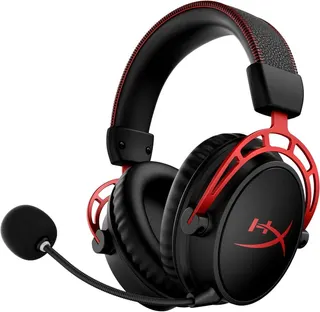
The long end belongs to HyperX. The Cloud Alpha Wireless is rated at 300 hours over its 2.4 GHz dongle, a figure HyperX announced at launch and has never walked back. The Cloud III Wireless is rated at 120, and Dexerto measured about 110 hours at 60% volume in its review, which is unusually close to the claim. Behind those two sits a cluster at 80 hours: the Turtle Beach Stealth 600 Gen 3, the Stealth 700 Gen 3, and the Audeze Maxwell 2.
The short end needs context before it means anything.
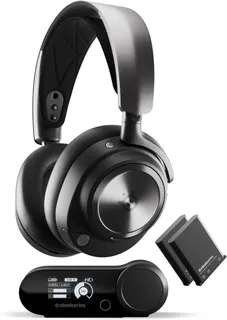
The SteelSeries Arctis Nova Pro Wireless is rated at 22 hours. That's per battery, and the box comes with two. Its base station charges the spare while you use the other one, and swapping takes seconds, so in practice the Nova Pro is the one headset on this list you never have to stop playing to charge. The Astro A50 X is rated at 24 hours, but it sits on a charging dock when you're not wearing it, which is the same idea in a different shape. If you put your headset down at the end of every session, a short rating on a docked headset costs you nothing.
The ratings that do need watching are the ones with conditions attached. Logitech rates the G733 at 29 hours with its lighting off, and about 20 with RGB on. Corsair rates the HS80 Max at 65 hours with RGB off, which drops to about 24 with the lights on. Sony rates the INZONE H9 II at 30 hours with noise cancelling off. The light show on a gaming headset is the biggest single drain on its battery, and the rated number always assumes you've turned it off.
The catch: Battery figures are rated with RGB off, at moderate volume and over the 2.4 GHz dongle. If you leave the lighting on, expect a third to two-thirds less. If you leave the headset on a dock or swap batteries, the column hardly matters.
Weight: 250 grams to 560, and the trade the heaviest one makes
The lightest headset here is the Razer Barracuda X at 250 grams. Close behind are the SteelSeries Arctis Nova 3X, Sony INZONE H5, and Sony INZONE H9 II, all at 260 grams, then the Arctis Nova 5 at 265. The H9 II's figure is measured without its detachable boom mic, which adds a few grams back. Read the weight column with that kind of footnote in mind: some makers weigh with the mic attached and some without. HyperX lists the Cloud Alpha Wireless at 322 grams without its mic and 335 with it.
The heavy end is where the trade-offs show. The Corsair Virtuoso Max Wireless weighs about 417 grams, and published figures range up to 431. PC Gamer scored it 74 and cited the weight among its complaints. Several reviewers named comfort as its weak point, despite the padding. The Turtle Beach Stealth 700 Gen 3 is around 405 grams.
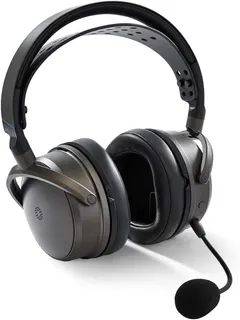
The Audeze Maxwell 2 is in a class of its own at 560 grams, up from about 490 for the original Maxwell. That weight buys 90 mm planar magnetic drivers, the kind of driver usually found in audiophile headphones rather than gaming headsets. The Maxwell 2 is the sound-quality pick in this table, and the weight is what that costs. TechRadar's review called it incredible but not a big step up from the original.
Slopsheets says: Under about 300 grams, most people stop noticing a headset after ten minutes. Above 400, clamp force and padding start to matter as much as the number. If your sessions run four hours, give weight more say than you'd expect.
Driver size: 30 mm to 90 mm, and why it predicts almost nothing
Most of this table uses 40 mm or 50 mm dynamic drivers. HyperX goes to 53 mm on the Cloud III Wireless, and Turtle Beach goes to 60 mm on the Stealth 700 Gen 3. The extremes are worth explaining.
The smallest driver here is in the Sony INZONE H9 II, at 30 mm. SoundGuys notes that it's the same driver Sony uses in its WH-1000XM6, one of the best-reviewed pairs of consumer headphones on the market. A small driver from a company that knows how to tune one beats a big driver tuned to boom.
At the other end, the Audeze Maxwell 2's 90 mm figure isn't comparable with the rest, because it's a planar magnetic driver: a thin film driven across its whole surface rather than a cone pushed from the middle. Planar drivers are a different technology, so measuring them against dynamic drivers in millimeters is apples to oranges.
60 mm drivers, so it must sound bigger and better than a 40 mm or 50 mm headset.
Tuning, the enclosure and the fit of the pads decide the sound. A 30 mm driver from Sony's flagship headphones beats plenty of bigger ones.
Treat the driver column as trivia, or as a way to spot the planar headset. Don't use it to rank sound.
Bluetooth: 16 of 20 have it, but having it is not the whole story
Four headsets in this table are dongle-only: the Logitech G733, the HyperX Cloud III Wireless, the HyperX Cloud Alpha Wireless and the Sony INZONE H5. Leaving out Bluetooth is part of how the two HyperX models reach their battery numbers. It also means none of the four will connect to your phone.
Among the 16 that do have Bluetooth, the question that matters is whether it runs at the same time as the 2.4 GHz dongle. The Razer BlackShark V3 Pro, SteelSeries Arctis Nova 7 Wireless Gen 2, Corsair Virtuoso Max and Turtle Beach Stealth 600 and 700 Gen 3 all mix both, so you can game on the dongle and take a phone call over Bluetooth in the same headset. That costs battery: SteelSeries rates the Nova 7 Gen 2 at 54 hours on the dongle and 38 with both connections running. The Audeze Maxwell 2 has Bluetooth with LE Audio and LDAC support, but it can't play dongle and Bluetooth audio together, per SoundGuys.
There's one platform catch. The PS5 doesn't natively support Bluetooth headsets, so on a PlayStation you'll use the dongle whatever the box says. Tom's Hardware also found the Astro A50 X's Bluetooth range weak, so its Bluetooth is really there for a phone sitting next to you.
Pay up only if: You actually take calls or listen to podcasts while you game. Simultaneous Bluetooth is a great feature for that and a wasted line on the spec sheet if you don't.
Active noise cancelling: four headsets, and a lot of marketing that isn't it
Only four headsets here have real active noise cancelling on the ear cups: the SteelSeries Arctis Nova Pro Wireless, the Razer BlackShark V3 Pro, the Corsair Virtuoso Max and the Sony INZONE H9 II. Sony's comes from the same company that makes the WH-1000X line, and reviewers rate it as effective. Reviewers call Razer's hybrid ANC on the BlackShark V3 Pro effective but not class-leading.
Look closely at the wording on everything else. "AI noise cancellation" on the Arctis Nova 5 and "noise-cancelling mic" on the HyperX Cloud Alpha Wireless both describe software or hardware that cleans up your voice for your teammates. Neither does anything to the noise coming into your ears. That's useful, but it isn't ANC, and the ANC column marks it as false.
The Audeze Maxwell 2 in this table doesn't have ANC. Audeze sells a separate Maxwell 2 ANC model at a higher price, which isn't listed here.
Don't overpay for: ANC if you game in a quiet room. It earns its price in a shared apartment, on a train with a handheld, or next to a loud PC fan. On a desk in a quiet bedroom, a closed-back headset with good pads already blocks most of what you'd want blocked.
Mic: twelve detachable booms, and why mic type tells you nothing about quality
Twelve of the 20 have a detachable boom, three have a retractable boom (all three are SteelSeries: the Nova Pro, Nova 7 Gen 2 and Nova 5), and five have a fixed boom that mutes when you flip it up (the Astro A50 X, Corsair HS80 Max, Sony INZONE H5, and the two Turtle Beach Stealth models). Detachable is best if you also wear the headset outside, retractable is the tidiest, and flip-to-mute is the fastest way to mute mid-game.
None of that tells you how your voice sounds, and in this category mic quality varies more than any spec suggests. The Logitech G522 got singled out for an unusually good mic for its class. Reviewers rated the mic on the Razer BlackShark V2 Pro (2023) among its best features. Then the newer BlackShark V3 Pro got a Tom's Hardware headline saying you'll sound worse on it. KitGuru's review of the Arctis Nova 7 Gen 2 called its mic thin. Reviewers called the mic on the Logitech G Pro X 2 its weak spot, and Dexerto found the HyperX Cloud III Wireless mic picks up background noise.
What the box won't tell you: If you stream or spend a lot of time in party chat, read a mic review before you buy, and ignore the mic type and the bitrate on the box. The mic is the part of the headset that only other people hear, and that's why spec sheets get away with saying so little about it.
What the table is actually telling you
Sort the table by AI score and a pattern shows: the top isn't whoever has the biggest single spec. It's the headsets with the fewest compromises across all six columns.
The SteelSeries Arctis Nova Pro Wireless is our best overall pick. It has real ANC, a hot-swap battery system that means it never dies, Bluetooth, and a retractable mic, and Tom's Hardware rated it good enough for music as well as games. It's expensive, and it relies on SteelSeries' software, but the only thing it compromises on is price.
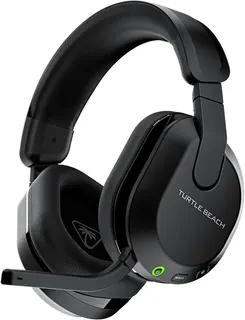
The Audeze Maxwell 2 is the pick for sound, if you can accept 560 grams on your head. The HyperX Cloud Alpha Wireless is the pick for battery: its 300-hour rating is real, and it's usually sold well under flagship prices. The Turtle Beach Stealth 600 Gen 3 is the value pick, with 80 hours of battery, Bluetooth alongside the dongle, and a broad platform list at a budget price. Reviewers knocked its plasticky build and clamp force, not its sound.
One last thing to check before you buy: consoles. Several headsets here come in separate Xbox and PlayStation editions (the Arctis Nova 3X is the Xbox version of the 3P, for example), because Xbox wireless audio needs its own licensed hardware. Check you're buying the edition for your console. It's the most common mistake people return a headset over.
Sources / further reading
- Tom's Hardware, SteelSeries Arctis Nova Pro Wireless review, on the hot-swap batteries and the base station.
- KitGuru, SteelSeries Arctis Nova 7 Wireless Gen 2 review, including the thin-mic verdict.
- Tom's Hardware, SteelSeries Arctis Nova 5 Wireless review.
- Vooks, SteelSeries Arctis Nova 3X Wireless review.
- Tom's Hardware, Razer BlackShark V3 Pro review, on its ANC, its dual wireless and its mic.
- Tom's Hardware, Razer BlackShark V2 Pro (2023) review.
- KitGuru, Razer Barracuda X (2022) review.
- Tom's Hardware, Logitech G Pro X 2 Lightspeed review.
- Tom's Hardware, Astro A50 X review, the source for its weak Bluetooth range.
- Windows Central, Logitech G522 Lightspeed review.
- Dexerto, HyperX Cloud III Wireless review, with its measured battery test.
- HyperX, Cloud Alpha Wireless launch announcement, the source for the 300-hour rating.
- PC Gamer, Corsair Virtuoso Max review.
- PC Gamer, Corsair HS80 Max Wireless review.
- SoundGuys, Sony INZONE H9 II, on the shared WH-1000XM6 driver.
- Tom's Hardware, Turtle Beach Stealth 700 Gen 3 review.
- GamesRadar, Turtle Beach Stealth 600 Gen 3 review.
- SoundGuys, Audeze Maxwell 2 launch coverage, on what changed and what it still can't do.
- TechRadar, Audeze Maxwell 2 review.