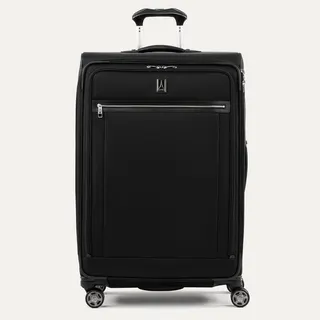
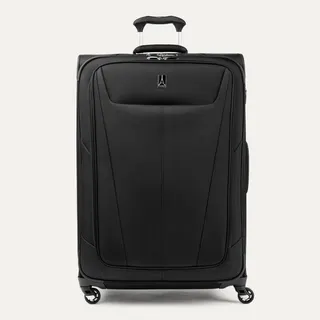
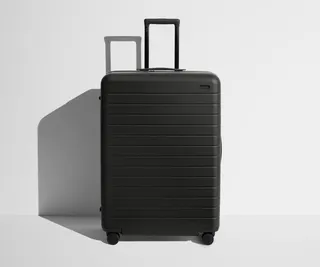
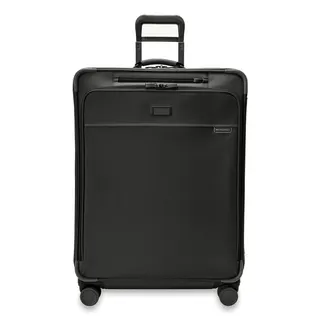


Two weeks or more away, with no plan to do laundry every third day, calls for a really big bag: 100 liters or more. Bags that size get judged by people who never read the spec sheet: the airline's sizer, the check-in scale, and the baggage handler who throws them onto the belt. So we compared 15 bags of 100 liters and up from Travelpro, Samsonite, Briggs & Riley, Away, Béis, July, Delsey, The North Face and Eagle Creek on the five specs those people actually care about: capacity, outside size, empty weight, shell, and warranty. The list includes two wheeled duffels, because at this size they're a real alternative to a suitcase. The picks and price buttons sit above this article, and the full sortable sheet has every bag side by side.
The short answer: the Travelpro Platinum Elite Large Check-In is the best 100-liter-plus bag overall, the Travelpro Maxlite 5 Large is the one to buy if the 50-pound limit keeps catching you, the Away The Large is the best hardshell that stays within the 62-inch size rule, and the Briggs & Riley Baseline Large is the buy-it-once option, with a warranty that covers airline damage.
Outside size: almost every 100-liter bag is over the airline limit
This is the spec almost nobody checks, and at this capacity it's the one that bites. Most US carriers cap a standard checked bag at 62 linear inches (height plus width plus depth, wheels and handles included). Delta's baggage page charges $200 each way for a domestic bag between 63 and 80 inches and refuses anything bigger.
- At or under 62 inches: Briggs & Riley Baseline Large (61), Away The Large (62) and Travelpro Maxlite Air Large (62).
- Just over: July Checked Plus (62.5) and Eagle Creek Cargo Hauler 130L (62.8). A sizer may never notice that, but it's there on paper.
- Clearly over: Béis Large Check-In (63.2), Delsey Chatelet Air 2.0 (63.5), Samsonite Winfield 2 and Delsey Helium Aero (63.8 each), Delsey Sky Max 2.0 31" (64.3), Travelpro Maxlite 5 (65), Samsonite Omni PC 28" (65.5), Samsonite Freeform (65.8) and Travelpro Platinum Elite (66.8).
- In a different league: The North Face Base Camp Rolling Thunder 36" at 71.6 inches. Plan on paying the oversize fee every time.
Plenty of people check oversized bags for years and never get charged. Still, you're the one taking the risk, so know which side of the line your bag sits on.
Slopsheets says: If you fly mostly on US carriers and hate surprises at the counter, sort the sheet by linear size first. Only three of these bags give you 100 liters without arguing with the 62-inch rule.
Capacity: the liter numbers aren't measured the same way
Volume is where luggage marketing gets loose, and it matters here because 100 liters is the cutoff for this list. Travelpro lists the Platinum Elite Large at 143.5 liters, while OutdoorGearLab measured 128.8. The Maxlite Air Large is listed at 114 liters, but its case measures 27.5 by 18.5 by 12 inches, a box of about 100 liters, so that figure almost certainly includes the expansion zip. Samsonite publishes no liter figure for the Freeform, Winfield 2 or Omni PC. Where the maker gives a number we use it, and where it doesn't, the sheet shows OutdoorGearLab's measured figure and says so.
With that caveat, here's how they spread:
- The giants: The North Face Rolling Thunder 36" (160 L), Travelpro Platinum Elite (143.5 L) and Maxlite 5 (142 L), and the Eagle Creek Cargo Hauler (129 L). All four are soft-sided, and the two duffels give up structure entirely for raw volume.
- The 100-to-120-liter middle: Delsey Helium Aero (120 L), Travelpro Maxlite Air (114 L, see above), Samsonite Freeform (112.5 L measured), Béis (111 L, 132 L expanded), July Checked Plus and Delsey Chatelet Air 2.0 (110 L each), Samsonite Omni PC (108 L measured), Delsey Sky Max 2.0 31" (108 L, soft-sided), Samsonite Winfield 2 (105 L measured) and Away The Large (104 L, though OutdoorGearLab measured 99.2).
- Right at the line: Briggs & Riley Baseline (100 L, 122 L with its expansion system).
For two weeks or more, about 110 liters is plenty for most people. Bigger bags mostly let you pack more weight than the airline will take, which brings us to the next spec.
Empty weight: every pound of bag is a pound of clothes you leave home
The scale doesn't care what the weight is made of. At the usual 50-pound checked limit (Delta's overweight fees start at 51 pounds), a heavy empty bag eats your allowance before you've folded a single shirt. And a 100-liter bag filled with ordinary clothes gets close to 50 pounds faster than most people expect.
The Eagle Creek Cargo Hauler 130L weighs just 4.4 pounds because it's a wheeled duffel with no rigid frame. The lightest real suitcases are the Travelpro Maxlite 5 Large (8.0 lb, 142 liters) and the Delsey Sky Max 2.0 31" (8.2 lb). OutdoorGearLab's testing of the smaller Maxlite 5 rated its wheels middling and found it less sturdy than the Platinum Elite, which is the usual price of lightness. The Samsonite Freeform is the lightest hardshell at 9.6 pounds. At the heavy end sit the Briggs & Riley Baseline (13.6 lb), the Delsey Helium Aero (12.5 lb, though Delsey's own pages disagree on that figure) and the Away The Large (12.1 lb).
The catch: A big capacity number and a 50-pound limit work against each other. If you pack dense (shoes, toiletries, gifts on the way home), you'll hit the scale limit long before you fill 140 liters.
Shell: polycarbonate, polypropylene, fabric, or a duffel
Nine of the 15 bags are hardshells, and eight of those use polycarbonate: Away, July, Béis, both large Delsey hardshells, Samsonite Winfield 2 and Omni PC, and the Travelpro Maxlite Air. Polycarbonate flexes under impact instead of cracking, which is why premium hardshells use it. The Samsonite Freeform uses polypropylene, which is lighter but scratched easily in OutdoorGearLab's drop tests.
Four are soft-sided suitcases: both Travelpro softsides, Briggs & Riley and the Delsey Sky Max. Fabric scuffs instead of cracking and usually has outside pockets. OutdoorGearLab rolled its test bags down concrete stairs and hosed them down. The nylon Platinum Elite came out with only minor corner scuffs, and the Briggs & Riley scored 9.8 out of 10 for construction.
The two wheeled duffels, The North Face and Eagle Creek, are the most forgiving shape of all: they squash into car trunks and odd spaces in the hold, and you can stuff them past what a rigid case would take. The trade-off is no structure to protect what's inside, and on the TNF, a bag much longer than any airline wants.
Hardshell isn't automatically tougher. In OutdoorGearLab's testing the Away's shell showed no structural damage after drops, but water got in through its zipper in the hose test, and the Winfield 2 picked up scuffs fast. Owners of the Delsey Helium Aero report cracked shells.
Expandable: useful on the way home, risky at the scale
Ten bags expand: the three Travelpros, Briggs & Riley (100 to 122 liters), Béis (111 to 132 liters), Delsey Helium Aero and Sky Max, and the three Samsonites. Away, July, the Chatelet Air 2.0 and both duffels don't. Away sells expansion as a separate model, The Large Flex.
Expansion is handy on a long trip, when you come home with more than you left with. It also makes the size and weight problems worse: an expanded bag is deeper, so even further past 62 inches, and a 130-liter bag holds well over 50 pounds of stuff without much effort. The Béis helps a little here, with a built-in weight indicator on the handle.
Warranty: "lifetime" means very different things
Lifetime warranty, so if the airline wrecks it, it gets fixed for free.
Most warranties cover manufacturing defects. Only some brands, Briggs & Riley most famously, promise to fix airline damage too.
Nine bags carry some form of lifetime cover: the three Travelpros, Briggs & Riley, Away, Béis, July, The North Face and Eagle Creek. The details differ a lot. Briggs & Riley's "Simple as that" guarantee explicitly covers airline damage. Away's LifetimeCare promises repair support for the life of the bag, with free repairs and up to one replacement in the first five years. Samsonite and Delsey give 10 years on their hardshells, and the Delsey Sky Max gets three.
Pay up only if: you check a bag several times a year. On a suitcase you check twice a year, a $900 warranty is expensive insurance. On one that flies monthly, the Briggs & Riley guarantee pays for itself.
Is a 100-liter suitcase too big for most trips?
For a weekend, yes. For two weeks or more, or for one bag shared between two people, 100 to 115 liters is about right, and that size can still come in under 50 pounds if you pack mostly clothes. Go up to the 140-liter-plus bags only for bulky gear (ski clothes, a dive kit, baby things), and expect both overweight and oversize fees if you fill them.
Suitcase or wheeled duffel for a long trip?
Take a suitcase if you're moving between hotels and want packing cubes and a clamshell that opens flat. Take a wheeled duffel if you're heading somewhere rough (gravel roads, boats, small planes) or you need to squeeze a lot of soft gear into one bag. The Eagle Creek is the light, airline-friendly duffel. The North Face is the expedition-size one, and its 71.6 inches means oversize fees.
Sources / further reading
- OutdoorGearLab: The Best Luggage of 2026
- OutdoorGearLab: Travelpro Platinum Elite Large Check-In review
- OutdoorGearLab: Briggs & Riley Baseline Large Expandable Spinner review
- OutdoorGearLab: Away The Large review
- OutdoorGearLab: Samsonite Freeform Large Spinner review
- OutdoorGearLab: Samsonite Winfield 2 Fashion 28 review
- OutdoorGearLab: July Checked Expandable review
- Delta: excess and overweight baggage fees
- Travelpro: Maxlite Air V2 Large Check-In specifications
- Eagle Creek: Cargo Hauler 130L Rolling Duffel
- Delsey: Sky Max 2.0 31-inch Expandable Check-In