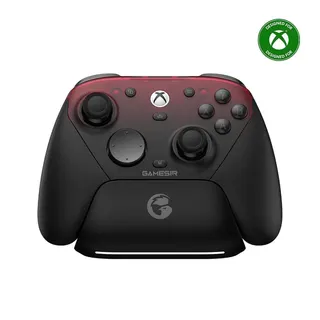
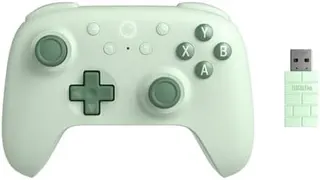
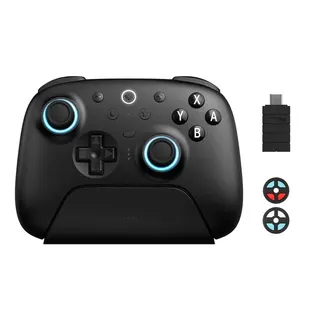
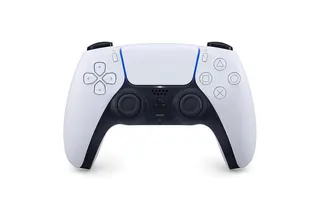


The cheapest drift-resistant controller in this table costs about $25. The most expensive controller still using the old drift-prone sticks costs $200, and Sony makes it.
That is the strange shape of the gamepad market right now. Every controller Sony, Microsoft and Nintendo sell, from the $70 DualSense to the $200 DualSense Edge and the $180 Xbox Elite Series 2, still uses potentiometer thumbsticks: the carbon-track design that wears down and starts sending input when your thumb isn't touching anything. Meanwhile 8BitDo, GameSir and Razer moved to magnetic Hall effect and TMR sensors, which don't rub against anything and so don't wear in the same way. The fix for stick drift is sitting in the bargain bin.
This comparison covers 15 wireless controllers across PC, Xbox, PlayStation and Switch, picked from brands people actually buy and that reviewers have taken apart. Seven specs decide how a pad will treat you a year from now: the stick sensor, how many back buttons you get, whether the triggers have physical stops, the rated battery life, the weight, how it connects, and which platforms it officially supports. Prices, star ratings and review counts aren't here, because they move daily. The labs and reviewers whose testing we lean on are linked at the bottom.
Stick sensor: why a $25 pad outlasts a $200 one
There are three kinds of thumbstick in this table, and the difference is mechanical.
Potentiometer sticks measure position with a wiper sliding across a resistive track. That contact wears, dust gets in, and the reading drifts. A 2021 teardown analysis reported by The FPS Review estimated the DualSense's stick modules were rated for roughly 417 hours of play before wear sets in, which is not a lot of Elden Ring. Hall effect sticks read a magnet's position with a sensor that never touches it. TMR (tunnel magnetoresistance) is the newer magnetic sensor, with the same no-contact design plus lower power draw and finer resolution, which is why the 2025 and 2026 releases have mostly switched to it.
The split in this table is clean. Potentiometer: the DualSense, DualSense Edge, Xbox Wireless Controller, Xbox Elite Series 2, Switch Pro Controller and the brand-new Switch 2 Pro Controller. iFixit called Nintendo out on the last one specifically after its teardown, per Notebookcheck's report, faulting both the repairability and the decision to skip Hall effect sticks on a controller launched in 2025. Hall effect: the 8BitDo Ultimate 2C, GameSir Nova Lite and Razer Wolverine V3 Pro. TMR: the 8BitDo Ultimate 2 (both versions), 8BitDo Pro 3, GameSir G7 Pro, GameSir Cyclone 2 and Valve's 2026 Steam Controller.
The Sony Edge deserves a footnote. Its sticks are still potentiometers, but they sit in swappable modules, so when one drifts you replace a $20 part instead of a $200 controller. That's a repair plan. The drift still comes.
A $180 to $200 "pro" controller from a console maker must have the most durable sticks money can buy.
The Elite Series 2 and DualSense Edge use the same potentiometer type as the $70 pads. The magnetic sticks start at about $25, from 8BitDo.
Slopsheets says: If drift has already cost you a controller, sort by this column first and ignore anything that says Potentiometer. The only good reasons to buy a first-party pad now are features nobody else copies: Sony's haptics and adaptive triggers, or Nintendo's HD Rumble and amiibo support.
Back buttons: two is enough for most people, four is for remapping everything
Back buttons let you jump, reload or crouch without taking a thumb off the right stick. Three pads here have four: the Xbox Elite Series 2, the Razer Wolverine V3 Pro and the Steam Controller (Valve puts its four on the grips). Most of the field has two, including the Switch 2 Pro Controller, which finally gives Nintendo players remappable GL and GR buttons. Five pads have none: the standard DualSense, standard Xbox controller, original Switch Pro Controller, 8BitDo Ultimate 2C and GameSir Nova Lite.
Several pads also add an extra pair of bumpers on the top edge (the 8BitDo Ultimate 2 family and Pro 3 call theirs L4/R4, the G7 Pro has L5/R5). We don't count those in this column because they sit where your index finger already is, but they're still useful in games with lots of binds.
Pay up only if: you play shooters competitively or emulate games that need more buttons than a pad has. For everyone else, two back buttons cover jump and crouch, and anything past that is buttons you'll bump by accident.
Trigger stops: a small switch that matters in shooters
A trigger stop cuts the trigger's travel so a pull registers almost instantly, which reads as a mouse click in a shooter. Eight of these 15 pads have one: the Elite Series 2 and DualSense Edge (three positions each), the Razer Wolverine V3 Pro, GameSir G7 Pro, all three TMR 8BitDos, and the Cyclone 2. The Cyclone 2's is a switchable hair-trigger mode rather than a physical block, but it does the same job.
Not every implementation is good. HLPlanet found the Ultimate 2 Wireless trigger lock mushy, with noticeable pre-travel. The G7 Pro's stops are microswitches that click, and PC Gamer singled them out in its 92-point review. If you mostly play racing games you want the opposite, so make sure the stop can be switched off.
Rated battery: the column with the biggest gap between box and couch
Here the spread runs from 6 hours to 40, and it's the column where marketing numbers and real use disagree the most.
The 40-hour pads are the boring ones. The standard Xbox controller gets there on two AA batteries, the Elite Series 2 on a built-in cell, and both Nintendo Pro Controllers on a battery that doesn't have RGB lighting to feed. Valve rates the Steam Controller at 35+ hours. At the bottom, Sony publishes no battery rating for either DualSense. Engadget reports 6 to 12 hours for the standard pad, and Push Square's DualSense Edge testing ran out in about 6, because Sony fit the Edge with a smaller 1,050mAh cell than the regular pad's 1,560mAh.
The rated numbers on cheaper pads deserve some suspicion. GameSir claims about 10 hours for the Cyclone 2, per TechRadar. GamingTrend's hands-on got just under two hours with the lights and rumble on, and Nerdtechy reported two to three. Razer rates the Wolverine V3 Pro at about 20 hours. TechRadar measured 12 to 13. One more oddity: 8BitDo's own manuals rate the Ultimate 2 Wireless at 20 hours over 2.4GHz but the Ultimate 2 Bluetooth at 12, despite both carrying a 1,000mAh battery.
What the box won't tell you: every rated figure here assumes light settings. RGB lighting is the single biggest battery drain on the third-party pads. The pads with charging docks in the box (G7 Pro, Cyclone 2, both Ultimate 2s, Pro 3) make short battery life matter much less, because the controller goes back on the dock every night.
Weight: 205 grams to 345
The GameSir Nova Lite is the lightest pad here at 205 grams, followed by the 8BitDo Ultimate 2C at 217.5. Both are budget pads, and light partly means less material: PC Gamer liked the Nova Lite but noted it feels less sturdy. The heavy end is the pro tier, with the Xbox Elite Series 2 at 345 grams and the DualSense Edge at 325. Metal paddles, swappable modules and adjustable stick tension all add weight.
Weight on a controller matters less than on a mouse, because you aren't throwing it around. It matters for long sessions and smaller hands. The Switch 2 Pro Controller at 235 grams is the lightest first-party pad here, and Engadget's review found it comfortable enough to call it the best gamepad Nintendo has made.
Connection: the dongle question
There are three ways to connect: a 2.4GHz USB dongle (lowest latency on PC), Bluetooth (works with phones, tablets and TVs with nothing extra plugged in), and a USB-C cable. Most third-party pads here do all three.
The exceptions are worth knowing. The DualSense, DualSense Edge and both Nintendo Pro Controllers connect only over Bluetooth or a cable. The Razer Wolverine V3 Pro has no Bluetooth at all, just its HyperSpeed dongle and a cable, so it won't pair with a phone. The Xbox pads use Microsoft's own Xbox Wireless signal, which needs the console or Microsoft's adapter, and fall back to Bluetooth for PCs and phones.
Platforms: check this column before you check anything else
A controller only works where its maker says it does, and the lock-in here is real.
The GameSir G7 Pro, our overall pick, is Xbox-licensed but works only by cable on an Xbox. Its wireless modes are for PC and Android. The Switch 2 Pro Controller is listed by Nintendo for Switch 2 only. The original Switch Pro Controller works on both Switch generations. The Steam Controller expects Steam (Windows and Linux PCs, Steam Deck, Steam Machine, and phones through Steam Link), and PC Gamer's review warns that it leans heavily on Steam Input. The Razer Wolverine V3 Pro is Xbox and PC only. The GameSir Cyclone 2 and Nova Lite skip Xbox and PlayStation entirely. Nothing third-party in this table supports PS5, which is why the DualSense is still the default there.
Don't overpay for: a "multiplatform" pad when you own one console and a PC. Find the pad licensed for your console, check that it runs over the 2.4GHz dongle on your PC, and you're done.
The picks
- Best overall, GameSir G7 Pro: TMR sticks, Hall effect triggers with clicky trigger stops, two back buttons and a charging dock for about $80. Tom's Guide pitched it as an Xbox Elite Series 2 alternative, and the price difference is about $100. The catch is the Xbox cable.
- Best value, 8BitDo Ultimate 2C Wireless: Hall effect sticks and triggers, a dongle and Bluetooth, and 19 rated hours for about $25 to $30. PC Gamer called it close to perfect for the price. No back buttons.
- Best for Switch 2, 8BitDo Ultimate 2 Bluetooth: TMR sticks, trigger stops and a dock, and Engadget called it the best Switch 2 controller, for less than Nintendo's own Pro Controller with its potentiometer sticks.
- Best for PS5, Sony DualSense: nothing else does haptics and adaptive triggers, and nothing third-party here supports PS5 at all. Budget for drift.
FAQ
Do Hall effect and TMR sticks really stop stick drift? They remove the main cause, which is wear on a resistive track, because nothing touches the sensor. A magnetic stick can still need recalibration, and the springs and gimbal can still wear, but the slow drift that kills potentiometer pads isn't a built-in failure mode.
Can I use a DualSense or Xbox controller on PC? Yes. Both work over Bluetooth or USB-C with Steam, and the Xbox controller is supported natively in Windows. The Xbox pad's own wireless signal needs Microsoft's adapter on PC, otherwise it uses Bluetooth.
Which controller is best for Nintendo Switch 2? The 8BitDo Ultimate 2 Bluetooth and Pro 3 both support Switch 2 with TMR sticks, for less than the Switch 2 Pro Controller. Nintendo's pad is the one with HD Rumble, amiibo and wake-from-sleep that third-party pads can't fully match.
Sources / further reading
- GameSir G7 Pro review, Tom's Guide
- GameSir G7 Pro Tri-Mode review, PC Gamer
- Steam Controller (2026) review, PC Gamer
- 8BitDo Ultimate 2 review, Engadget
- 8BitDo Ultimate 2C Wireless review, PC Gamer
- 8BitDo Ultimate 2 Wireless review, HLPlanet
- 8BitDo Pro 3 review, Nintendo Life
- Switch 2 Pro Controller review, Engadget
- iFixit slams Switch 2 Pro Controller repairability and lack of Hall effect sticks, Notebookcheck
- DualSense Edge hardware review, Push Square
- How long can you expect a DualSense controller to last?, Engadget
- PS5 DualSense teardown and analog stick lifespan, The FPS Review
- Razer Wolverine V3 Pro review, TechRadar
- GameSir Cyclone 2 review, TechRadar
- GameSir Cyclone 2 review, GamingTrend
- GameSir Nova Lite review, PC Gamer
- Xbox Elite Wireless Controller Series 2, Microsoft
- Steam Controller hardware page, Valve
- Ultimate 2 Wireless Controller manual (PDF), 8BitDo
- Ultimate 2 Bluetooth Controller manual (PDF), 8BitDo