

Nineteen electric screwdrivers, and the spec that matters most on most of them gets the least space on the box: the clutch, the little numbered ring that lets the motor slip before it chews a screw head or cracks particleboard. Seven of the nineteen don't have one. The shortlist and check-price buttons sit above this article, and the full sortable sheet lines all nineteen up side by side. Down here we sort out which numbers matter when you're kneeling in front of a half-built dresser at 11 p.m.
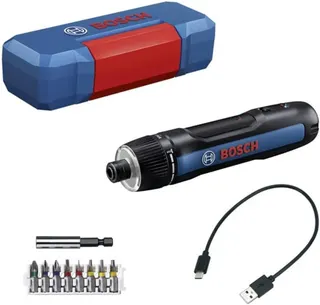
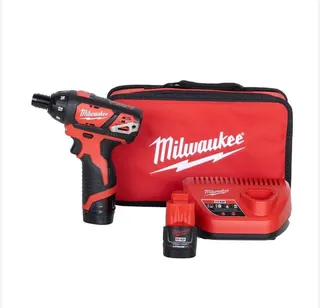
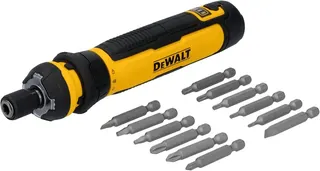
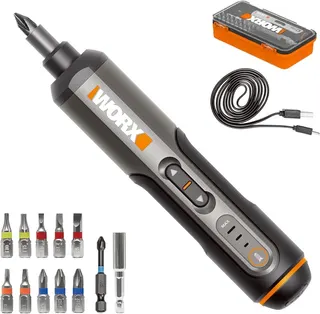
The lineup: four 12-volt pistol drivers that are basically small drills (the Milwaukee M12 2401-22, Bosch PS21-2A, Makita DF033D and DeWalt DCF601). Makita's 7.2-volt DF012DSE, which folds between straight and pistol. Then the household class: Bosch's GO 3, DeWalt's FlexDrive DWHT66719, Milwaukee's long-running M4 2101-22, two Fanttik sticks (NEX S1 Pro and S2 Pro), the WORX WX240L and the bit-swapping WX255L, the SKIL Twist 2.0 and the circuit-sensing SKIL SD561201, three BLACK+DECKER 4V MAX models (BDCS20C, the pivoting BDCSFL20C, the bit-carousel BDCS50C), the CRAFTSMAN CMHT66718, and Makita's little DF001DW.
Torque: the headline number is measured into steel
Max torque in our table runs from 22 inch-pounds (the SKIL Twist 2.0) to 266 (the Makita DF033D), which is a twelvefold spread across tools that all get filed under "screwdriver." The split is clean. The four 12-volt pistol drivers land between 71 and 266 inch-pounds. Everything else sits between 22 and 71, and most of the household sticks cluster around 35 to 53.
The catch is how the number gets made. Makers quote "hard joint" torque, measured driving into a rigid steel fixture where the screw stops dead. Driving into wood (a "soft joint") the motor delivers much less before it bogs. Bosch is one of the few brands that prints both, and its GO 3 datasheet makes the gap plain.
Testers keep finding that gap. Bob Vila's reviewers picked the WORX 4V as their best light-duty screwdriver but said it felt weaker than its 5 Nm claim. Reviewed's tester couldn't get the SKIL SD561201 to sink a screw into a 2x4 without a pilot hole. At the other end, Reviewed found the Milwaukee 2401 drove 1.5-inch screws into a stud where the others in its test topped out at 1 inch.
Two cells in the column are blank on purpose. SKIL publishes no torque figure for the SD561201 and CRAFTSMAN publishes none for the CMHT66718, so we left them empty rather than borrow a distributor's number we couldn't trace to the maker.
Slopsheets says: For furniture, outlet covers, cabinet hinges and electronics, 35 to 50 inch-pounds is plenty, and more just strips screws faster. Buy a 12-volt pistol driver only if you're sinking screws into studs or doing it all day.
Clutch settings: the spec that saves the screw head
A clutch lets you set a torque ceiling. When the screw reaches it, the motor slips or stops instead of spinning the head into a smooth crater or pulling the screw through soft board. Flat-pack furniture is where this matters most. Particleboard and cam-lock screws are soft, and an unclutched driver at full tilt strips them easily.
Seven drivers here have no clutch at all: all three BLACK+DECKERs, the CRAFTSMAN, the SKIL SD561201, the WORX WX255L and the Makita DF001DW. Each one drives until you let go of the button or the motor stalls. The rest offer 3 to 21 positions. The M4 and Makita's DF012DSE have the finest steps at 21, and the PS21-2A and DF033D have 20 plus a drill mode. Among the household sticks, the Bosch GO 3 has 7, the Fanttik S2 Pro 7 (as low as 0.5 Nm per Fanttik), the DeWalt FlexDrive 6, and the WORX WX240L, SKIL Twist 2.0 and Fanttik S1 Pro 3 apiece.
How a clutch behaves matters as much as how many steps it has. Makita's DF012DSE uses an auto-stop clutch that cuts the motor once the setting is reached instead of ratcheting while you hold the trigger. Bosch's GO 3 pairs its 7 steps with an electronic brake.
Don't overpay for: twenty clutch positions on a tool you'll use for bookshelves. Three well-spaced settings cover furniture and electronics. What you can't live without, if you assemble anything from a flat box, is having a clutch at all.
Speed: 180 rpm is slow, 1,700 is a drill
Top no-load speed runs from 180 rpm (all three BLACK+DECKERs) to 1,700 rpm (the Makita DF033D). Speed matters less on a screwdriver than on a drill, because you rarely want a screw going in fast. Apart from Milwaukee's two-speed M4, the 3.6V and 4V drivers sit between 180 and 396 rpm, and that's deliberate: slow enough to start a screw straight and stop before it's overdriven.
The 12-volt drivers are two-speed. The Bosch PS21-2A runs 350 or 1,300 rpm and the DF033D 450 or 1,700, so the low gear does screws and the high gear drills pilot holes. The M4 (200/600) and DF012DSE (200/650) bring the same two-gear idea to smaller bodies. Home Fixated's long-term M4 review found it bogged on 3-inch wood screws until shifted into low gear, which is how two-speed drivers are meant to be used.
One quirk: the DF012DSE has two fixed speeds and no variable-speed trigger, which is the most common complaint about it. The DeWalt FlexDrive runs at one fixed 360 rpm, a touch quick for delicate electronics.
Body style: inline, pistol, or both
Inline sticks (Bosch GO 3, DeWalt FlexDrive, both Fanttiks, WORX WX240L, CRAFTSMAN, SKIL SD561201) hold like a manual screwdriver and reach into cabinets and between studs. Their weakness is grip under load. Owners report the Fanttik S1 Pro body wanting to spin in the hand when a screw tightens, because a straight body gives your wrist little leverage.
Pistol grips (the four 12V drivers, the BDCS20C, BDCS50C and WX255L) let you push straight behind the screw and handle more torque comfortably. They're also taller. Bob Vila and Reviewed both flagged the Milwaukee 2401's height with the battery fitted, which hurts in tight spots.
Five drivers pivot between the two: the Milwaukee M4, Makita DF012DSE and DF001DW, BLACK+DECKER's BDCSFL20C, and the SKIL Twist 2.0. The SKIL only angles to 45 degrees, not a full right angle, so it's a partial fit for the category. If you can own only one cordless screwdriver, a pivoting body is the safest bet.
DeWalt's FlexDrive changes how the controls work too. A 360-degree collar sets direction with a twist and runs with a push, so there's no button to find by feel. Pro Tool Reviews named it the best inline screwdriver of its roundup, though some owners find the push-to-run collar awkward one-handed.
Weight: from 0.49 to 2.1 pounds
The lightest driver here is the SKIL SD561201 at 0.49 pounds, and the heaviest is the Makita DF033D at 2.1 with its battery fitted. Most of the household sticks sit between half a pound and 0.85. The four 12-volt drivers weigh 1.4 to 2.1 pounds, roughly three times a typical stick, and you feel it overhead.
Read this column with its notes open. Weight is the spec makers report least consistently. Bosch lists the GO 3 "excluding battery" even though its battery is built in. Milwaukee's site gives the 2401 as both 2.0 and 2.26 pounds. Fanttik publishes no tool weight at all, only the boxed kit's, so those two cells stay blank.
Voltage: what "MAX" means
Voltage tells you which class a tool is in, not how strong it is. The Bosch GO 3's 3.6 volts and the DeWalt FlexDrive's "4V MAX" are the same cell chemistry described two ways.
4V MAX, so it must out-muscle the 3.6V driver beside it on the shelf.
MAX is the voltage of a fresh charge with no load. WORX's own WX255L manual footnotes its "4V Max" as 3.6V nominal. Same cell, bigger number.
The same logic applies up the range: "12V MAX" packs are 10.8 volts nominal. Look at torque and clutch instead. The 4V WORX WX240L and the 3.6V Bosch GO 3 both claim 44 inch-pounds.
What voltage does tell you is the battery system. The 12-volt drivers and Milwaukee's M4 use removable packs, so you can swap a dead battery for a fresh one and share packs with other tools. Milwaukee's M12 line has an enormous tool family, while the M4 platform is a dead end with few tools. The household sticks mostly have built-in batteries: no swapping, and when the cell wears out, the tool is done. Owners of the WORX WX240L and SKIL Twist 2.0 report a minority of batteries fading over time.
USB-C charging: six of nineteen
On a tool that lives in a kitchen drawer, this matters more than it sounds. A screwdriver you charge with your phone cable is one you'll find charged. One with a proprietary wall wart is one whose charger walked off two moves ago. The WORX WX255L takes about five hours on its barrel-plug charger, while the WX240L refills in about 1.5 hours over USB-C. The CRAFTSMAN and SKIL SD561201 use micro-USB, and so does Makita's DF001DW (via an adapter), which feels dated next to USB-C rivals.
The 12-volt drivers don't charge over USB-C, and that's fine: their packs go on a dedicated charger, and that's part of the trade for swappable batteries.
Pay up only if: you'd use the extra torque every week. For a drawer screwdriver, USB-C and a clutch beat any number of volts, and the GO 3, FlexDrive and WX240L give you both.
Which electric screwdriver should you buy?
- For furniture, hanging things and general household jobs: the Bosch GO 3. It has a real 7-step clutch, an electronic brake, push-to-drive activation and USB-C. Its predecessor, the GO 2, was Bob Vila's best overall pick. It's light on torque by design.
- For a cleaner inline stick with clutch control: the DeWalt FlexDrive DWHT66719, Pro Tool Reviews' best inline pick, with a 6-step clutch and a collet bit lock.
- On a budget: the WORX WX240L. It has three speed and torque steps and USB-C, and Bob Vila picked it for light duty, even if it felt short of its claimed torque.
- For real driving (studs, decking hardware, all-day installs): the Milwaukee M12 2401-22, which out-drove everything in Reviewed's test. Or the Bosch PS21-2A, Bob Vila's most powerful pick, if you want two speeds and a smaller tool.
- Skip unless the feature is the point: the no-clutch BLACK+DECKERs and the SKIL SD561201. They're cheap and widely loved, but the first stubborn screw can strip.
Frequently asked questions
Can an electric screwdriver replace a cordless drill? A 4V screwdriver can't. With 22 to 53 inch-pounds and speeds mostly under 400 rpm, the household sticks drive screws but won't bore holes in wood or masonry. The 12-volt pistol drivers here (Milwaukee 2401, Bosch PS21-2A, Makita DF033D, DeWalt DCF601) come close: a hex shank takes hex-shank drill bits, and their high gears manage pilot holes and light drilling. They still aren't a hammer drill.
What's the best electric screwdriver for IKEA furniture? Any one with a clutch, set low. Particleboard and cam-lock fittings strip easily, so control matters more than power. The Bosch GO 3, DeWalt FlexDrive, WORX WX240L and Fanttik S2 Pro all have clutches and USB-C. Drive the screw most of the way with the tool and do the final quarter-turn by hand.
Is an electric screwdriver good for PC building and electronics? The low-torque household sticks are. You want the lowest clutch setting you can get: the Fanttik S2 Pro goes down to 0.5 Nm, and owners report using the WORX WX240L's three steps for PC builds. Leave the 12V pistol drivers out of it: Bob Vila's testers felt even the Milwaukee 2401 had too much torque for electrical plates and electronics.
Is it worth paying more for a screwdriver with removable batteries? Only if you already own, or plan to buy, other tools on the same battery. A Milwaukee M12 or Makita CXT driver makes sense as part of a system. For a standalone drawer tool, a built-in USB-C battery is simpler, although it means the tool is done when the cell wears out.
Sources / further reading
- Bob Vila, the best electric screwdrivers, tested
- Reviewed, the best electric screwdrivers
- Pro Tool Reviews, best electric screwdriver reviews
- Pro Tool Reviews, DeWalt FlexDrive cordless screwdriver review
- Home Fixated, Milwaukee M4 2-speed screwdriver kit review
- Bosch Professional, GO (Gen 3) product page
- Milwaukee, M12 1/4" hex screwdriver kit (2401-22)
- Milwaukee, M4 1/4" hex 2-speed screwdriver kit (2101-22)
- Makita, DF012DSE 7.2V cordless 1/4" hex driver-drill kit
- Makita, FD10R1 12V max CXT 1/4" hex driver-drill kit
- DEWALT, FlexDrive cordless screwdriver set (DWHT66719)
- DEWALT, 12V MAX brushless 1/4" screwdriver (DCF601)
- SKIL, Twist 2.0 rechargeable 4V screwdriver (SD5619)
- Fanttik, NEX S2 Pro cordless screwdriver
- WORX, SD slide driver (WX255) specifications