

Seventeen of the twenty-four dash cams in this table print 4K on the box. Twelve are built on a sensor that can actually deliver it. Three are not. Two will not tell you either way.
That is not a rounding error or a firmware quirk. A 4K frame is 3840 by 2160 pixels, which is about 8.3 million of them, and a camera cannot record 8.3 million pixels through a sensor that only has five million. What happens instead is interpolation: the camera captures a smaller image, stretches it to 4K dimensions, and invents the difference. The file says 3840x2160. The detail does not.
So we built the sheet around the two numbers that settle the argument. One is what the camera records. The other is what its image sensor can physically see. When those match, the 4K badge is a fact. When they do not, it is a file size.
The number that decides whether you can read a plate
Every dash cam listing leads with resolution because resolution is the one spec a shopper already understands. Almost none of them lead with the sensor, which is the part that decides what lands in the frame.
The sensor names that matter here are short. Sony's IMX678 is an 8 MP part that natively covers 3840x2160, so a camera built on one can record true 4K. The IMX675 and the older IMX335 are 5 MP parts topping out at 2592x1944, which is a little over 2.5K. The Dash Cam Guys' side by side of the IMX335 and the IMX678 walks through the pixel-pitch difference, and DashCamTalk has maintained a running "list of shame" of cameras advertising resolutions their sensors cannot reach for years now.
The best-selling example is the awkward one.
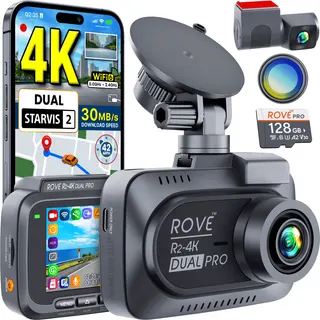
Vortex Radar, who installs and drives these things rather than repackaging spec sheets, put it plainly in the review: the R2-4K Dual "uses a 5MP Sony Starvis 2 IMX675 image sensor which is a 2.5K sensor and thus it's physically incapable of capturing in 4K." It records lower and upscales.
What the box won't tell you: Sort the table by "Sensor's native res" rather than by what the camera records. Any row where the second number is smaller than the first is a camera doing arithmetic on your evidence.
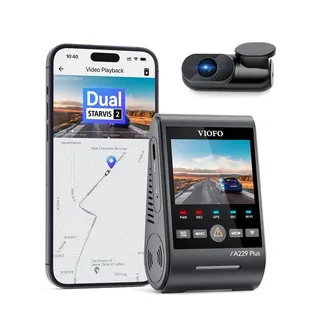
The fix is not to spend more. VIOFO's A229 Plus uses the same 5 MP IMX675 as the ROVE and simply calls itself a 2K camera, and it sits in the same part of the market. Nobody loses anything by being told the truth except the marketing department.
What STARVIS 2 buys you after dark
Resolution is the daytime spec. The night spec is sensitivity, and that is where the generation of the sensor matters more than its pixel count.
Sony's STARVIS 2 line was designed around dynamic range, which in a car means the difference between a plate that reads and a white rectangle sitting inside a pair of headlights. It is the reason a 5 MP STARVIS 2 camera will often beat an 8 MP camera from an older family on the footage that actually ends up in a claim, and the reason Thinkware built its Super Night Vision 4.0 around the same sensor family in the U3000.
Which gives you a simple ranking, and it is not the one the box implies. An 8 MP STARVIS 2 camera is the best of both. A 5 MP STARVIS 2 camera honestly labelled is next. An 8 MP sensor from an older generation, like the IMX415 in the 70mai A800S and the DDPAI Mini5, still gives you real 4K detail in daylight. A 5 MP sensor wearing a 4K badge is last, because you are paying the 4K price for neither.
The catch: Nobody in this category tests their own night footage against a rival's and publishes the result. Read the sensor line, then go watch someone drive a dark road on YouTube before you spend anything.
Nine of these cameras will not tell you what is behind the lens
Sensor disclosure is not universal. Nine of the twenty-four cameras here do not name their image sensor, and five of those give you no resolution figure for it either.
Garmin is the most interesting case, because Garmin is not cutting corners. The X310, X210 and X110 all keep the sensor to themselves, and all three are well-regarded cameras whose real advantage is optical: a built-in polarizer that kills windshield reflection, which is a problem no sensor upgrade solves. TechRadar's X310 review rates the footage highly. You are simply asked to take it on trust.
There is a polite way to withhold and a less polite one. BlackVue does not print a model number for the DR970X-2CH Plus either, but its spec sheet says "STARVIS 2 CMOS Sensor (Approx. 8.4M Pixel)," which is all you need to know the 4K is real. REDTIGER's F7NP advertises a "STARVIS 2 sensor" with no model and no pixel count, while REDTIGER's own F17 listing names its part: the 5 MP IMX675. A brand that names the sensor when it flatters them and drops the number when it does not has told you something.
The second channel is where the money quietly goes
Six of these cameras record the road and nothing else. The rest add a rear camera, a cabin camera, or both, and the second channel is usually where a spec sheet gets quiet.
Rear channels here run from 1080p to a full second 4K. The pattern is that flagship money often buys a budget rear: BlackVue's DR970X-2CH Plus is one of the most expensive rigs in this table and its rear camera stops at 1080p, while VIOFO's A229 Pro and the ROVE R2-4K Dual PRO both put a 2K STARVIS 2 sensor back there for less. Miofive's S1 Ultra is the outlier that runs 4K at both ends.
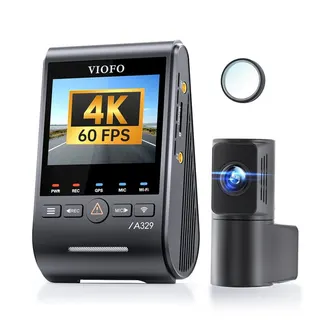
Three-channel cameras have their own trap: adding the third stream often steals bitrate from the front. VIOFO make a point of the A329S holding its front channel at full quality in 3CH mode where the older A229 Pro drops it, which is the kind of detail that only shows up once you are trying to read something.
Pay up only if: you actually need the cabin. If you drive for a living, a three-channel camera is not optional. If you do not, that budget is better spent on a better front sensor.
Supercapacitor or lithium, and why a windshield is a bad place for a battery
Eighteen of the twenty-four use a supercapacitor. Four use a lithium battery. Two will not say.
This is the least glamorous column in the table and one of the most consequential, because a parked car in summer is an oven and lithium cells do not enjoy ovens. Supercapacitors hold enough charge to close the current file cleanly on power loss, tolerate the heat, and last through hundreds of thousands of cycles. VIOFO, Thinkware, BlackVue, Vantrue, REDTIGER, ROVE and DDPAI have all standardised on them.
The four holdouts are notable: all three Garmin X-series cameras and the 70mai A800S ship a lithium-ion cell. In Garmin's case it buys you a camera that keeps running for a few minutes unplugged, which is genuinely useful and also a component that ages in a way a capacitor does not.
Parking mode is a wiring project, not a feature
Every camera in this table lists parking mode. Almost none of them can do it out of the box, because parking mode needs power after the ignition is off, and the cigarette socket in most cars dies with the key.
24-hour parking surveillance, so the camera keeps watching the car overnight in the garage and in the work lot.
It watches nothing until you buy a hardwire or OBD kit and run a cable to the fuse panel. Garmin sells its parking cable separately. REDTIGER puts one in the carton.
Once it is wired, what parking mode does varies more than the shared phrase suggests. The weakest version wakes on impact, records twenty seconds, and goes back to sleep, so the approach that caused the impact is never on the card. Buffered parking mode holds a rolling pre-roll and keeps the seconds before the event, which is the version worth having. VIOFO's A229 line and Vantrue's N5 buffer by default.
The best of it goes further. Thinkware's U3000 and U3000 PRO carry radar that watches for motion at a few milliamps instead of keeping the camera awake, which is how you get weeks of surveillance instead of a flat battery and a jump start. The A329S does something similar with a low-power impact detection mode. If your car sits on a street rather than in a garage, this column matters more than the resolution one.
Slopsheets says: Budget for the hardwire kit and a high-endurance card the day you buy the camera. A dash cam without parking power is a camera that only works while you are sitting in front of it.
What we would actually buy
The VIOFO A329S is the one to get if the budget stretches, because it is the only camera here with no asterisk in any column. The A229 Plus is the value pick and the honest one, a 2K camera that says 2K. If you want real 4K without shopping the enthusiast brands, the ROVE R2-4K Dual PRO now carries the same sensor pair as the flagships, which is a strange thing to say about the brand that also sells the R2-4K Dual. And if your car lives outdoors, the Thinkware U3000 PRO's radar parking is worth the premium on its own.
Whatever you pick, sort the table by sensor first. The 4K on the box is a claim. The sensor is a part number, and part numbers do not negotiate.
Sources / further reading
- Vortex Radar, ROVE R2-4K Dual review, hands-on testing that identified the upscaling
- Vortex Radar, best dash cams, every camera personally installed and driven
- DashCamTalk, the list of shame: fake 4K dash cameras, the long-running community register
- Dashboard Camera Reviews, the best true 4K dash cams and how to spot fakes
- BlackboxMyCar, real 4K vs fake 4K dash cams
- The Dash Cam Guys, Sony IMX335 vs STARVIS 2 IMX678 explained
- BlackboxMyCar, Thinkware U3000 in-depth review
- BlackVue, DR970X Plus series product specification, a manufacturer sheet that states the sensor and its pixel count
- PCWorld, Nextbase iQ 4K review
- TechRadar, Garmin Dash Cam X310 review