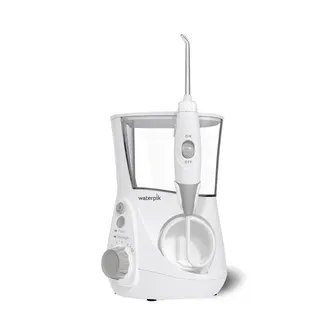
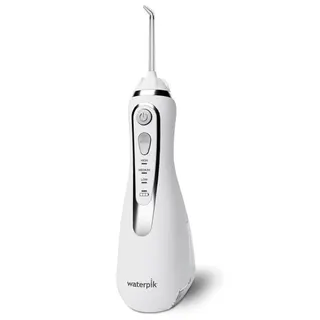
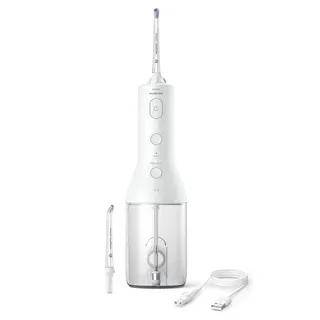
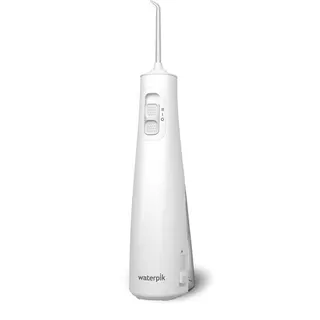


Fifteen water flossers, three brands that actually clear the bar, and one question that decides most of this before any spec comes into it: does the thing live on your sink, or in your hand? Countertop units carry three times the water and ten pressure steps. Cordless ones fit in a drawer and run out mid-mouth. The shortlist and check-price buttons sit above this article, and the full sortable sheet lines all fifteen up side by side. Down here we sort out which numbers matter, and which ones are the box talking.
The lineup: six corded countertops (Waterpik's Aquarius WP-660, Aquarius Professional WP-670, Ultra WP-100 and Nano Plus WP-320, plus Philips' Sonicare Power Flosser 3000 and 5000). One battery-powered countertop, the Waterpik ION Professional WF-12. And eight handhelds: Waterpik's Cordless Advanced 2.0 WP-580, Cordless Plus 5000 WF-26, Cordless Pulse 3100 WF-20, Cordless Pearl WF-13, Cordless 1100 WF-30 and AA-powered Cordless Express WF-02, the Sonicare Cordless Power Flosser 3000, and the Oral-B Water Flosser Advanced.
Why so much Waterpik? We looked hard at Panasonic, Burst, quip, Hydro Floss and the rest, and none had the ratings and review volume our quality bar asks for in the US right now. The marketplace's high-volume no-name flossers didn't get a look at all.
Countertop or cordless: pick this first
Every other column follows from this one. A countertop flosser is a pump in a base with a water tank on top and a hose to the handle. A cordless flosser is the pump, the battery and the tank all in your fist. Physics does the rest: there's only so much water you can hold up to your face.
Countertops win on capacity, pressure range and tip count. They also need about a 6 by 6 inch patch of counter and an outlet, per Electric Teeth's buying guide, and they're loud. Cordless units win on space, travel and the shower (several are rated for it), and they lose on everything that needs water or a bigger motor.
The ION Professional splits the difference: a countertop-sized base and tank with a rechargeable battery inside, so there's no cord to the wall while you floss. Electric Teeth measured about 30 minutes of runtime at full power, which is roughly a month of one-minute sessions, but called it too big to really travel with and loud at 79 to 80 dB.
Slopsheets says: If you have the counter space and an outlet, buy a countertop. It cleans for longer per fill, gives you room to start gentle and work up, and the best one here is also one of the cheaper ones. Go cordless for a small bathroom, a shared sink, braces on the road, or a shower habit.
Reservoir size: the spec that decides if you finish
Tanks run from 150 mL (the Cordless Express and Oral-B Advanced) to 650 mL (the Aquarius pair and the Ultra). That's more than a fourfold spread, and it's the biggest practical difference in the table.
The countertops cluster high: 650 mL on the Aquarius WP-660, WP-670 and Ultra, 590 mL on the ION, 550 mL on both Sonicare countertops, and 445 mL on the compact Nano Plus. Waterpik rates its big tanks for 90-plus seconds of flossing, and Philips says the same of its 550 mL units.
Cordless tanks sit between 150 and 250 mL. Sonicare's Cordless 3000 is the roomiest at 250 mL, which Philips rates for a full 60-second session. The Cordless Advanced, Plus 5000 and Pearl hold about 205 mL, and the Pulse 3100 and 1100 about 175 mL.
Electric Teeth's guide sets 45 seconds of flossing per fill as the minimum worth buying. The full-size cordless units just make it at top pressure. The 150 mL tanks are the ones that make you stop, refill, and lose your place.
Pressure settings: more steps, gentler start
Six flossers have 10 settings: the Aquarius pair, the Ultra, the ION and both Sonicare countertops. The Nano Plus has 5. The cordless field is thin. The Cordless Advanced, Sonicare Cordless 3000 and Oral-B have 3, and the rest have just 2.
More steps matters mostly at the bottom. Per Electric Teeth, Waterpik's countertop range runs from 10 psi at level 1 to 100 psi at level 10, while the Cordless Advanced spans 45 psi on low to 75 psi on high. New users with sensitive or bleeding gums are better off starting near the bottom and working up, and a cordless low setting starts well above where a countertop does. Electric Teeth's own line is that power isn't everything: lower pressure with good technique beats high pressure aimed badly.
Philips doesn't publish psi at all. Its countertops pair 10 intensities with two modes, and the cordless model pairs 3 intensities with two modes. Oral-B's handheld has 3 intensities and three stream styles, but Electric Teeth found little difference between the intensities and gave it 3 out of 5.
1,700 pulses per minute, the highest count in the range, so the Pulse 3100 must clean harder than a 1,400-pulse Aquarius.
Every Waterpik here pulses between 1,200 and 1,700 times a minute. The Aquarius has eight more pressure steps and nearly four times the water, and those decide the session.
Pay up only if: you want fine control at the gentle end. Ten steps don't buy a cleaner mouth than three, but they make the first week much less of an ambush for tender gums.
Tips included: count them, then price the refills
Box counts run from 1 (the Cordless 1100) to 7 (the Aquarius WP-660, WP-670 and the ION). The Ultra has 6, the Nano Plus, Cordless Advanced and Pearl have 4, the Plus 5000 has 3, and everything else has 2.
Extra tips mean more than one person can share the base (each gets their own color-coded tip), and specialty heads for braces, implants and gum pockets. Waterpik's orthodontic, Plaque Seeker and Pik Pocket tips come in the bigger boxes. Two-tip boxes usually give you two of the standard nozzle.
Tips wear out, and Waterpik's own guidance is to replace them every three to six months. That's where brands differ. Electric Teeth flagged Sonicare's Quad Stream nozzles as notably more expensive than Waterpik's on both the countertop and cordless reviews. The entry-level Cordless 1100's single tip also doesn't rotate, which makes reaching the back molars awkward.
Don't overpay for: a seven-tip kit if you live alone without braces or implants. You'll use one tip. Its replacement cost matters more than how many ship in the box.
Power and charging: the cordless fine print
The six corded countertops plug into the wall and that's that. The cordless field splits four ways:
- USB-C: the Pulse 3100, Cordless 1100 and Cordless Plus 5000. One cable for your phone and your flosser, which matters most on a trip.
- Proprietary chargers: the Cordless Advanced and ION use Waterpik's magnetic USB-A charger, the Pearl a two-prong cable, and the Sonicare Cordless 3000 and Oral-B Advanced their own leads. Lose the cable and you're ordering a replacement.
- AA batteries: the Cordless Express runs on three AAs, with no charge indicator and an ongoing battery bill. Electric Teeth gave it 3 stars.
Battery claims vary a lot. Waterpik rates the Pulse 3100 and Plus 5000 for up to 9 weeks per charge, the Cordless Advanced, Pearl and ION for up to 4 weeks, and the Cordless 1100 for 3. Philips claims 40 days for the Sonicare Cordless 3000, and Electric Teeth measured 54 days on its strongest mode. Electric Teeth also got about six weeks out of the Cordless Advanced, against a 4-week claim. The Oral-B is the outlier: Electric Teeth timed a full charge at up to 14 hours.
What the box won't tell you: the cable. A flosser on USB-C charges from whatever's in your bag. A flosser on a proprietary magnetic puck is dead the day you leave that puck behind.
ADA Seal: 13 of 15, and why two miss
The American Dental Association's Seal of Acceptance means the ADA has reviewed evidence that a product is safe and effective at removing plaque and reducing gingivitis when used as directed. Every Waterpik here carries it, and so do the two Sonicare countertops, which the ADA lists under the Sonicare Power Flosser family.
The two without it are the Sonicare Cordless Power Flosser 3000 and the Oral-B Water Flosser Advanced. Neither appears in the ADA's listings we could check, and neither maker claims the Seal on its product page. That doesn't make them unsafe. It means nobody has shown the ADA the evidence for those specific units.
Water flosser FAQ
Does a water flosser replace string floss? The ADA counts water flossers among the accepted ways to clean between teeth, and every Waterpik here plus the Sonicare countertops carry its Seal for plaque removal and gingivitis reduction. Ask your dentist if you have tight contacts or a specific gum problem.
Is a cordless water flosser as good as a countertop? It can clean as well per second, but it holds less water and offers fewer pressure steps. In this table, cordless tanks top out at 250 mL and three settings, while countertops reach 650 mL and ten.
Which water flosser is quietest? Electric Teeth measured the Sonicare Power Flosser 3000 at about 52 to 54 dB on its lowest setting, well under the ION's 79 to 80 dB. Every flosser gets louder as pressure rises.
Which is best for braces? One with an orthodontic tip in the box and enough water to work around every bracket: the Aquarius WP-660 ships with one, as do the ION and the Cordless Plus 5000.
Sources / further reading
- Electric Teeth: Best water flosser 2026
- Electric Teeth: Waterpik ION / ION Professional Cordless review
- Electric Teeth: Waterpik Cordless Advanced review
- Electric Teeth: Philips Sonicare Power Flosser 3000, 5000 and 7000 review
- Electric Teeth: Philips Sonicare Cordless Power Flosser 3000 review
- Electric Teeth: Oral-B Water Flosser Advanced review
- Which?: Best water flossers, tried and tested
- ADA Seal of Acceptance: Philips Sonicare Power Flosser
- ADA MouthHealthy: Water flossers and water flossing
- Waterpik: Aquarius WP-660 product page
- Waterpik: Cordless Plus 5000 product page
- Philips: Sonicare Cordless Power Flosser 3000 product page