

A sunrise alarm clock doesn't really compete on how bright it gets. What matters is whether the light has time to do anything before the beeping starts, whether you can set it without downloading an app, and whether it'll still be on your nightstand in February. Those are the questions behind the 17 sunrise alarm clocks and wake-up lights in this comparison, from Hatch, Philips, Lumie, Beurer, Lexon, Groov-e, Blueair and Loftie. The shortlist sits above this article, and the full sortable sheet puts every model side by side. Down here we go through it column by column and point out which claims are mostly marketing.
The lineup: the Hatch Restore 3; three Philips lights (the SmartSleep Wake-up Light HF3520, the plain Wake-up Light HF3505 and the bigger SmartSleep Sleep and Wake-Up Light HF3650); seven Lumies (the Bodyclock Luxe 700FM, Luxe 750DAB, Shine 300, Glow 150, Spark 100, Rise 100 and the entry Sunrise Alarm); the Beurer WL 50 and WL 65 Wake + Charge; the Groov-e Light Curve; the Blueair Mini Restful, which is also an air purifier; the battery-powered Lexon Mina Sunrise; and the Loftie Lamp.
Quick answers, if you only read this far:
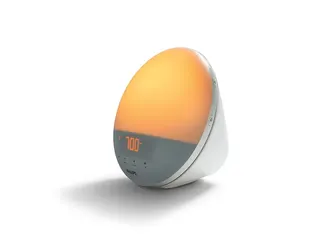
- Best overall: the Philips HF3520. It has a 20 to 40 minute red-to-yellow dawn, a sunset, and FM radio, and no app is involved.
- Longest sunrise: the Lumie Shine 300 or Luxe 700FM, adjustable up to 90 minutes.
- Best if you want an app: the Hatch Restore 3, as long as the app and Wi-Fi setup don't bother you.
- Best for travel: the Beurer WL 50, which does the full sunrise on its own battery.
Longest sunrise: how far ahead the light starts
This is the first column on the sheet, and it says the most. It's the longest ramp the maker lets you set before the alarm goes off. A longer ramp gives a slower, smoother climb from dark to bright.
By that yardstick, 30 minutes is the common floor and most of the field stops there. The Philips HF3505, Beurer WL 50 and WL 65, Groov-e, Lexon, Blueair and the three small Lumies (Spark 100, Rise 100 and Sunrise Alarm) all top out at half an hour. The Philips HF3520 reaches 40. The Lumie Glow 150 lets you pick 20, 30 or 45. Hatch says the Restore 3 runs anywhere from 5 to 60 minutes, and the Philips HF3650 goes from 5 to 60 as well.
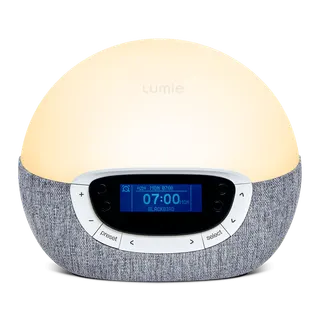
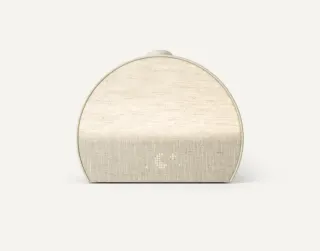
The Lumie Bodyclock Shine 300, Luxe 700FM and Luxe 750DAB stand out here, with sunrises adjustable from 15 to 90 minutes. That matches the whole range Foster describes. At the other end is the Loftie Lamp. Its sunrise is fixed at 9 minutes, which Loftie picked because it's the standard snooze length. That's more of a gentle nudge than a dawn.
How smoothly the light climbs matters as much as how long it takes. The Independent saw the cheapest Lumie Sunrise Alarm brighten in visible steps, and said the Beurer WL 65's light "just flicks on" instead of building. It praised the Hatch Restore 3's fabric-diffused glow. Good Housekeeping's testers found the Lexon Mina's transition sudden at times.
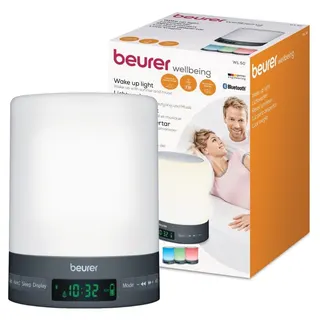
The Beurer WL 50 claims about 800 lux and the Philips HF3520 300, so the Beurer must be the brighter lamp.
Beurer measures at 10 cm from the lamp. Light falls off fast with distance, so lux figures taken at different distances can't be compared, which is why the sheet leaves brightness in the notes.
Slopsheets says: sort by longest sunrise first. A 30-minute ramp is the floor worth paying for, and anything adjustable past 40 gives you room to find the length that actually wakes you.
Sunset fade: the half people forget
Most of these lights also run in reverse, dimming slowly at bedtime so you can fall asleep to a fading glow. On the sheet, 15 of 17 have it. The two that don't are the Philips HF3505, which Philips lists with no fall-asleep function, and the Blueair Mini Restful, which both The Independent and Good Housekeeping say has no sunset. On the Philips HF3520, the sunset can run from 5 to 60 minutes. Good Housekeeping's one complaint about the Hatch Restore 3 was that its sunset dimming could be more gradual.
The catch: a sunset is only useful if you go to bed when it starts. If you read in bed with the lamp on, you'll mostly be using it as a dimmer switch.
Built-in radio: FM, DAB or nothing
Eight of the 17 have a radio. Philips puts FM on all three models here, and the HF3650 adds an AUX input. The Lumie Shine 300 and Luxe 700FM have FM, and WIRED liked that the 700FM saves five stations. The Luxe 750DAB swaps FM for DAB and DAB+, which suits the UK and Europe, where it's sold. The Beurer WL 50 has FM with 30 presets plus a Bluetooth speaker. The Groov-e Light Curve has FM too, though The Independent noted that its display doesn't show which station is playing.
The rest rely on built-in sounds, and how many varies a lot. The Lumie Luxe 750DAB has more than 30, the Philips HF3520 has five, and the HF3505 has just two bird sounds. The Lumie Spark 100 and Rise 100 only offer an optional beep. The Loftie Lamp has no alarm sound at all, and WIRED points out that you need a separate Loftie Clock to get one. The Hatch Restore 3 has free sounds and a bigger library behind its Hatch+ subscription.
Pay up only if: you'll actually listen. The Independent named the Lumie Luxe 750DAB its pick for audio, but it weighs 1.39 kg and took their tester more than 20 minutes to set up.
Works without a phone: apps and subscriptions
This column splits the field. Fourteen of these lights do everything from their own buttons, and three don't.
- Hatch Restore 3: setup and alarm settings run through the Hatch Sleep app on 2.4 GHz Wi-Fi. Extra sounds and content sit behind Hatch+.
- Blueair Mini Restful: alarm settings live in the Blueair app. The Independent says the buttons on top only switch the alarm, purifier and light on and off.
- Loftie Lamp: the light presets work from the buttons, but Loftie says you need its app and 2.4 GHz Wi-Fi to set alarms.
None of the Philips or Lumie models here use an app. That keeps the phone out of the bedroom, but it has a cost. WIRED noted that the Luxe 700FM only shows a 24-hour clock and has to be changed by hand for daylight saving.
What the box won't tell you: an app-first alarm clock depends on the company keeping the app running. A button-first one keeps working as long as it has power.
Runs on battery: for travel, not power cuts
Only two of these can do a full sunrise unplugged. The Beurer WL 50 has a 2000 mAh rechargeable battery, which Beurer rates at up to three hours at low light and volume. The Independent named it the best pick for travel, and Good Housekeeping called it the best value but found the battery didn't last long. The Lexon Mina Sunrise is much smaller and charges over USB-C. Lexon rates it at up to four months as a sound-only alarm, up to a month using the sunrise, and only about 24 hours used as a lamp.
The rest run on mains power, and some keep a little backup for outages. Philips says the HF3520 keeps the time for four to eight hours when unplugged. The Independent says the Groov-e and the Lumie Sunrise Alarm can keep minimal functions running on batteries. The sheet doesn't count that as running on battery.
Don't overpay for: phone charging. The Beurer WL 65 has a 10 W Qi pad and the Philips HF3650 charges a phone too, but The Independent rated the WL 65's sunrise the weakest in its test.
Which sunrise alarm clock to buy
If you want a good light and never want to open an app, get the Philips HF3520, Good Housekeeping's top pick. For the longest and most adjustable dawn, get the Lumie Shine 300, which Good Housekeeping ranked a close second, or the Luxe 700FM, WIRED's favorite, if you also want a proper bedside lamp. If you like apps and routines, the Hatch Restore 3 was The Independent's best overall, though WIRED found it too dim to be useful as a bedside lamp. For a bag, the Beurer WL 50 is the one that works unplugged. On a tight budget, the Groov-e Light Curve was The Independent's budget pick, as long as you can live with a flimsy feel and sticky buttons. If cleaner bedroom air is part of the appeal of the Blueair, check it against our air purifier sheet before you accept its app.
Sunrise alarm clock FAQ
Do sunrise alarm clocks actually work? For many people, yes. Dawn simulation brightens the room slowly before your alarm, so you're closer to waking by the time it goes off. Researcher Russell Foster told The Independent that studies use 15 to 90 minute ramps. Results vary from person to person, and a light alone may not rouse a deep sleeper.
Is a sunrise alarm clock the same as a light therapy lamp? No. A sunrise alarm brightens slowly toward a few hundred lux to wake you, while light therapy lamps for winter blues are used at full brightness for set sessions, often rated at 10,000 lux. Several models here double as bedside lamps, but none of them replace one of the light therapy lamps on our sheet.
Will a sunrise alarm wake a heavy sleeper? Light by itself might not, which is why almost every model here adds a sound alarm at the end of the sunrise. The exceptions are the Loftie Lamp, which has no sound of its own, and the Spark 100 and Rise 100, which only beep. If you sleep through alarms, pick a model with radio or several wake sounds.
Do you need a subscription for the Hatch Restore 3? No. The sunrise, alarms and a set of free sounds work without paying. Hatch+ unlocks a much larger audio library, which WIRED counts at more than 2,500 options. You do need the Hatch Sleep app and 2.4 GHz Wi-Fi to set it up and change alarms, so it isn't a phone-free option.
Sources / further reading
- WIRED: Should You Get a Sunrise Alarm Clock?
- The Independent: best sunrise alarm clocks to help you wake up more naturally this winter
- Good Housekeeping UK: best sunrise alarm clocks, tested by experts
- Hatch: how a sunrise alarm clock helps you wake up refreshed
- Lumie Bodyclock range
- Lexon Mina Sunrise
- Loftie: sunrise alarms