

A jump starter is a battery whose only real job is to hand your dead battery enough current, for a few seconds, to turn the engine over. Everything else on the box (the flashlight, the USB ports, the tire pump, the four-digit amp number) is either a bonus or a sales pitch. The trick is telling which is which before the first cold morning, because that's when the calls start.
This comparison lines up 19 brand-name portable jump starters from NOCO, WOLFBOX, Hulkman, GOOLOO, TOPDON, AstroAI, Clore Automotive, STANLEY and Schumacher. Each one has a long, well-rated sales record behind it. Fifteen are pocket-to-glovebox lithium packs; four are the heavy sealed lead-acid boxes that tow drivers and shops keep around. The full jump starter sheet sorts all of them on the seven things that actually differ: battery type, peak amps, the biggest gas and diesel engines the maker rates it for, battery capacity in watt-hours, whether there's a built-in air compressor, and weight.
Lithium pack or lead-acid box: pick the chemistry first
This choice splits the table in two before any other spec matters.
Lithium packs weigh between 0.9 lb (the AstroAI S8) and about 6 lb (the NOCO Boost Pro GB150, unit only). They live under a seat or in the glovebox, double as a phone power bank, and hold a charge for months. That's the point: a jump starter only helps if it's in the car and charged when the battery dies.
Lead-acid boxes (the Clore Jump-N-Carry JNC660, the Clore Booster PAC ES5000, the STANLEY J5C09 and the Schumacher SJ1332) weigh 17 to 18 lb. In exchange, they carry far more energy and long, heavy cables. The JNC660 has 46-inch #2 AWG leads, which is why Outdoor Life named it the pick for pros and AutoGuide called it the one for large vehicles. AutoGuide also notes it loses charge faster than the lithium units, and STANLEY's own manual asks you to recharge the J5C09 every 30 days.
Slopsheets says: For a daily driver, buy lithium. A lead-acid box makes sense in a shop, a farm truck or a garage where it sits on a charger, not rolling around in a trunk for six months.
Peak amps: the number every box shouts
Peak amps run from 1,000 on the NOCO Boost Plus GB40 and the STANLEY J5C09 up to 4,250 on the NOCO Boost X GBX155. It's the biggest number on almost every listing, and it's the least useful.
4,000 peak amps, so it's four times the jump starter a 1,000-amp unit is.
Peak amps is a split-second burst with no industry test behind it, per GearLab. What starts a car is current held for several seconds without the voltage sagging.
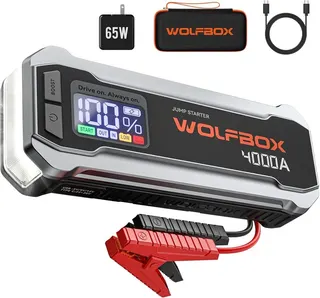
The sustained number is the one makers bury. WOLFBOX lists 1,000 starting amps for the 4,000-peak MegaVolt24. Clore lists 425 cranking amps for the 1,700-peak JNC660, and STANLEY lists 500 instant amps for the 1,000-peak J5C09. When Mighty Gadget put the TOPDON JumpSurge 3000 on a load tester, it held about 400 A for four to five seconds and stayed above 200 A for nearly ten. That's the shape of a real start, and it's a long way from 3,000.
AutoGuide's rule of thumb is a useful sanity check: most cars need 400 to 500 cold cranking amps, compact cars need less, and cold weather, big engines and old batteries all push the number up.
Don't overpay for: a peak-amp figure. Two packs with the same engine rating and very different peak amps will usually start the same car.
Engine ratings: the maker's best case, not a promise
The gas and diesel columns are the closest thing to a straight answer on the box: the largest engine the maker says the unit can start. They range from 6.0 L gas and 3.0 L diesel on the NOCO GB40 and AstroAI S8 up to 12.0 L gas and 10.0 L diesel on the GOOLOO GT4000S. GOOLOO rates the GP4000 for "all gasoline engines" without giving a number, so that cell stays blank. Clore and STANLEY don't rate their lead-acid boxes by engine size at all.
Read these as a ceiling on a warm day with a battery that isn't completely flat. AutoGuide calls the GB40's 6-liter claim optimistic and suggests a 1,500 or 2,000 A unit for anything bigger than a 3.5-liter V6. Outdoor Life's hands-on test is a good illustration: on a 6.0-liter gas V8 Yukon with a battery that was completely drained, a small unit rated for 6.0 liters needed backup from a stronger one.
Pay up only if: you drive a V8, a diesel pickup, or live where it drops below freezing. Then buy a pack rated at least one size above your engine. The WOLFBOX MegaVolt24, NOCO GBX155, GOOLOO GT4000S and GP4000 all reach 8 to 10 liters of diesel.
Battery capacity: watt-hours decide how many tries you get
Capacity is the column that tells you whether the second and third attempts will work, and how many phones you can charge while you wait for a tow. Among the lithium packs it runs from 24 Wh on the GB40 to 99.2 Wh on the GOOLOO GP4000. The lead-acid boxes sit far above that: 264 Wh for the JNC660 (22 Ah at 12 V) and 228 Wh for the J5C09.
It doesn't track peak amps as closely as you'd think.
Claimed capacity is also mostly honest at the top of the market. GearLab measured 82.3 Wh out of the WOLFBOX MegaVolt24's claimed 88.8 Wh and got three back-to-back starts on a V6 with a dead battery, using about 3% each time.
NOCO's own jump counts show how the two NOCO lines differ. The original Boost series is rated for up to 20 starts per charge on the GB40 and up to 80 on the GB150. The newer Boost X units are rated for 6 (GBX45), 12 (GBX75) and 18 (GBX155). The Boost X trades stored starts for very fast USB-C recharging.
Built-in air compressor: one box or two
Four units here can also pump a tire: the GOOLOO A3, the WOLFBOX MegaVolt24 Air, the STANLEY J5C09 and the Schumacher SJ1332. It's handy, since a cold snap drops tire pressure the same morning it kills batteries, but the pump and the jump pack share one battery.
The test results vary a lot. Bob Vila's testers found the STANLEY filled a tire in about four minutes, the fastest in its group, and that the Schumacher's gauge read roughly 8 PSI off. Popular Science's reviewer took an SUV tire from 25 to 35 PSI in about a minute with the MegaVolt24 Air, and it started a crossover at 0°F. Nikktech found the A3's pump slower than a corded 12 V inflator, which is fine for a top-up and tedious for a flat.
The catch: a combo unit is great if it replaces a separate inflator you'd otherwise forget to pack. If you already keep a tire pump in the car, a dedicated jump pack with a bigger battery is the better buy.
Weight and standby: the one that's charged when you need it
The lightest units here are the AstroAI S8 (0.9 lb), the NOCO GBX45 (1.3 lb) and the GOOLOO GP4000 (1.8 lb). All three fit in a glovebox. The 3- to 6-lb packs ride better under a seat, and the 17- to 18-lb boxes belong in a trunk or on a shelf.
What weight can't tell you is how long the thing holds its charge in a cold car. GOOLOO quotes up to 24 months of standby for the GT4000S, and Hulkman says the Alpha 85 holds charge for up to 18 months. Consumer Reports' jump starter tests run cold starts with both the car battery and the jump pack chilled to 0°F, which is a reminder that a pack left in a freezing car all winter won't deliver its rated output. Check it every few months, and bring it inside before a deep freeze if you can.
What the box won't tell you: the most common complaint across almost every unit here, from NOCO to GOOLOO to STANLEY, is a pack that stopped holding a charge after a few months. Top it up on a schedule and you'll avoid most of them.
Which jump starter should you buy?
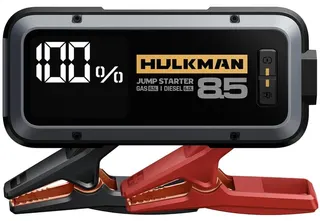
- Best overall: Hulkman Alpha 85. 2,000 A, 74 Wh, rated for 8.5 L gas and 6.0 L diesel, and a 65 W charger that refills it in about 90 minutes. Outdoor Life's best overall, and it has the strongest owner reputation in the table.
- Best for trucks and diesels: WOLFBOX MegaVolt24. Rated for 10 L gas and 10 L diesel, and it was GearLab's Editors' Choice after its own capacity measurements confirmed 93% of the claimed watt-hours.
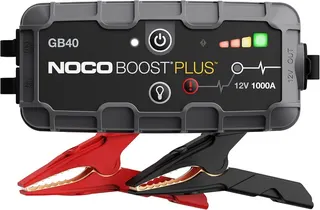
- Best compact: NOCO Boost Plus GB40. The best-selling jump starter on Amazon, IP65, up to 20 starts per charge, and GearLab's best compact pick. Stick to engines under about 3.5 L.
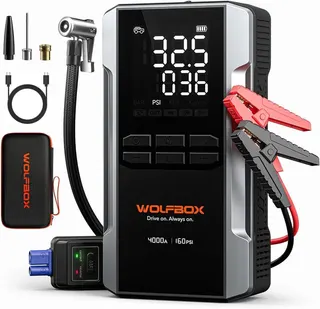
- Best with an air compressor: WOLFBOX MegaVolt24 Air. The same 88.8 Wh battery and engine ratings as the MegaVolt24, plus a 160 PSI pump that Popular Science tested in a real 0°F emergency.
If you want the most raw starting power in a lithium pack, the NOCO Boost X GBX155 scored highest in GearLab's tests and was its pick for big engines. And if you need a box for a shop or a tow truck, the Clore JNC660 is still the standard.
Car jump starter FAQ
How many amps do I need to jump-start my car?
Go by the engine rating, not the peak amps. Most four- and six-cylinder cars are covered by a unit rated for 6 L gas, while V8s and diesel pickups need an 8 to 10 L rating. Size up one step if you live somewhere cold.
Is a lithium jump starter better than a lead-acid one?
For keeping in a car, yes. The lithium packs here weigh 0.9 to 6 lb and hold a charge for months. The lead-acid boxes weigh 17 to 18 lb and need recharging more often, but they store more energy and come with heavier cables, which is why shops use them.
Can a jump starter start a completely dead battery?
Often, but not always. A lithium pack's safety circuit may refuse to send power to a battery that reads very low voltage, so most of them include a boost or manual override mode. NOCO, Hulkman, GOOLOO, TOPDON, WOLFBOX and AstroAI all have one. A fully flat battery in a big engine is where small packs fail.
Is a jump starter with an air compressor worth it?
Only if it replaces a tire inflator you'd otherwise not carry. The pump and the jump pack share one battery, and in hands-on tests the pumps ranged from quick to tediously slow.
Sources / further reading
- GearLab: The Best Jump Starters of 2026
- Outdoor Life: I Tested the Best Portable Jump Starters for Cars, Trucks, ATVs, and Boats
- AutoGuide: The Best Portable Car Jump Starters
- Bob Vila: We Tested 11 Jump Starters with Air Compressors
- Popular Science: Wolfbox 4-in-1 Jump Starter with Air Compressor, tested
- Mighty Gadget: Topdon JS3000 Jump Starter Review
- Nikktech: GOOLOO A3 & GT4000S Jump Starters Review
- Automoblog: Best Portable Jump Starters
- NOCO GB40 data sheet (PDF)
- NOCO GBX155 data sheet (PDF)
- Clore Automotive: Jump-N-Carry JNC660
- Hulkman: Alpha 85